
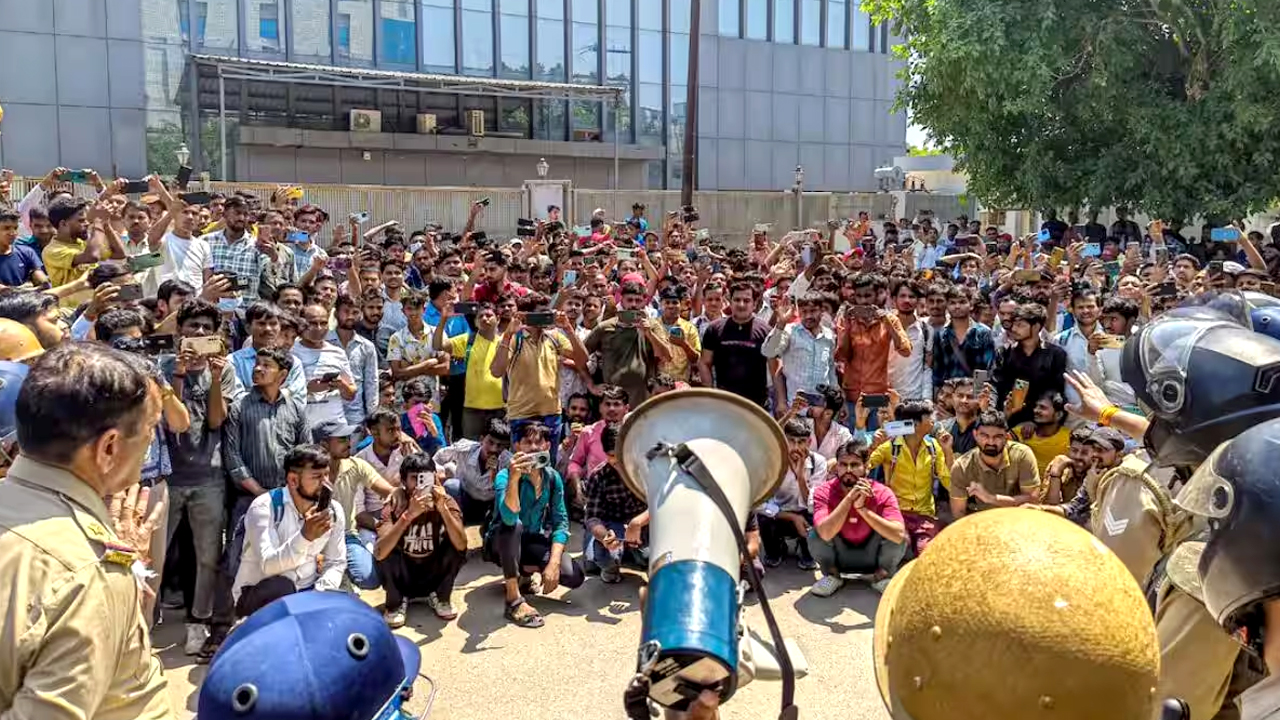
After decades of silence, fragmentation, and deepening exploitation, a new wave of workers’ struggles is beginning to reshape India’s industrial landscape. While Part I of the article by Manas Kumar documented the spontaneous eruption of contract workers’ resistance across the country, Part II turns to a deeper question: what do these struggles signify politically, and can they mark the beginning of an independent, nationwide reorganisation of the working class?
In Part I of the article, some documentation of the spontaneous eruption of contract workers’ agitation in different industrial corners of the country was presented; and it was stated that, in the second part, an attempt would be made to discuss what this signifies for activists who are committed to the revolutionary transformation of society. Let us now try to enter into that discussion.
Part I ended with a point about how the current phase of workers’ struggle differs from those that surfaced in the 21st century. The only difference mentioned was this: even though the earlier struggles were heroic, they could not spread from one site to another, remaining limited primarily to individual factories or industrial areas. This time, one struggle is leading to another.
But there were other significant differences too. First, in most of the plants — particularly in Haryana, Rajasthan, Uttarakhand, Tamil Nadu, and elsewhere — the earlier struggles were initiated and led primarily by permanent workers (with the exception of the Munnar Tea Plantation workers and Bangalore garment workers). Contract workers joined in only as the struggles advanced. This time, at every plant across the country, struggles have emerged exclusively from among the contract workers. Permanent workers still remain silent spectators.
Second, in the earlier phase, workers initiated struggles by attempting to form plant-level trade unions (again, those two were exceptions). Almost everywhere, the management — in collusion with the government and administration — unleashed all-out attacks to break those formations. They succeeded in limiting the struggles to the single demand of trade union recognition.
Subsequently, once the struggles started to subside, management in most plants first significantly reduced the number of permanent workers and then raised the wages of the remaining ones. At the same time, in many plants, management simply dismissed all the contract workers. In this way, they successfully alienated the permanent workers from the contract workers. This tells us that, at that time, the struggle for organisation could not lead to a struggle for economic demands; and equally, unity between the permanent and contract workers could not be preserved.
This time, struggles are surfacing everywhere around some basic common economic demands, but the question of organisation has not yet surfaced. And since state terror against these struggles is already so severe, it is too early to say whether the workers will be able to advance from the struggle for economic demands to the struggle for organisation. The brighter side this time is that, since the demands are more or less common across almost all the struggles, the possibility of some form of workers’ organisation emerging that cuts across all factories, sectors, and regions is stronger.
However, one feature is common to both the earlier struggles and the current ones. In both phases, the struggles were, and are, the product of the workers’ own initiative — not only independent of any established political party or central trade union (with some exceptions, as in Tamil Nadu), but also independent of any organisation led by communist revolutionary groups. These groups got some scope to intervene only in the later phase of the struggles. This time, since the struggles are vast in scope and are happening simultaneously, it is unclear how much scope these organisations, leaders, and activists will get to intervene, given their limited resources.
Origin of Rebellion – Exploitation Further Intensified, Patterns of Exploitation Diversified
We all know by now that, in order to rebuild the economy after the devastation of the Second World War, global capitalism proceeded with the policies of the ‘Welfare State’. As part of that, the working class was provided with better wages and greater job security.
However, a deep fissure in this economic policy started to surface in the late sixties and early seventies of the last century. Imperialism once again started to plunge into a deep economic crisis. And to overcome that crisis, it chose the path of globalisation-liberalisation from the mid-eighties onward.
Two aspects of those policies are particularly relevant to our present discussion: 1) the transfer of capital from imperialist countries to low- and middle-income countries; and 2) the severe curtailment of the established rights and privileges of industrial workers.
As part of this, the Indian ruling elite started implementing similar policies from 1991 onward, and it took time for them to become fully entrenched, until the beginning of this century. Under the façade of ‘development’, foreign as well as indigenous big capital started to flow more freely into our country in search of cheap labour. All the political parties aspiring to lead the government — be it ‘Left’, ‘Centre-Left’, ‘Centre-Right’, or ‘Right’ — came together on the question of ‘industrialisation’ and the unhindered functioning of capital. The only difference among them was how aggressively the policy would be implemented. Hence, during the last 25 years, all the political parties leading governments, at the Centre or in the states, have left no stone unturned in following a similar path — some with hesitation, some without qualms.
Undoubtedly, the present BJP governments are the most trusted and capable among them.
As part of this, severe and multi-pronged attacks were unleashed on the working class as a whole. In the case of older-generation industries, many were closed, rendering large numbers of workers jobless. For the rest, the number of permanent workers was drastically reduced through various means, and those jobs were gradually replaced by contract workers. From the first decade of the 21st century, the wage gap between the residual permanent workers and the ever-increasing number of contract workers was intentionally widened day by day. The intention was to keep the permanent workers’ eyes shut to the inhuman exploitation of the contract workers. Yet, at the same time, workload pressure started to increase for both categories.
At the other end, in industries like jute and textiles, some workers were officially recorded as ‘permanent’ but were stripped of their legal rights in practice. They could easily be kept ‘idle’ without pay, and retirement benefits like gratuity, etc., could easily be withheld. In the case of new-generation industries, core production activities were shifted primarily to contract workers. Their wage rates were fixed below the subsistence level. Their working day was extended to 10–12 hours. They bore the burden of an enormous workload, with no rest, no leave, and no terminal benefits.
All these changes began gradually toward the end of the last century and took a massive stride, particularly during the Modi era. Though labour laws contrary to these practices still existed, capitalists were blatantly allowed to flout them. In each and every case, workers were denied legal protection — whichever political party was in power, either at the Centre or in the states. This is because labour is a subject in the Concurrent List of the Seventh Schedule of the Indian Constitution. Subsequently, all these policies were formally legalised through the four New Labour Codes passed by the central BJP government in Parliament in 2020 and made effective from 21 November 2025.
So, it can easily be concluded that the attacks workers are facing today are part of centralised policies initiated long ago, in response to the current requirements of both international and national capital. All the political parties ruling or aspiring to rule are more or less in the same boat. In that sense, attacks are centralised, but resistance is still at the individual plant level.
Since demands like the 8-hour workday, a minimum living wage, and overtime at double the rate have spontaneously emerged in the current phase of struggle, and on such a large scale, the possibility of a centralised resistance against these centralised policies has started to develop — even if it is still embryonic in nature. Whether this possibility starts to transform into reality depends on something more, and we will enter into that discussion hereafter.
But before that, we need to answer why it has taken such a long time for this resistance to develop.
The Delayed Rebellions – Cause and Concern
Why have workers tolerated this unbearable level of exploitation with almost no major resistance for so long, beyond the few struggles discussed earlier? All of us have observed with awe not only the heroism, but also the tenacity and endurance, of the peasants’ struggle of 2020. But what we do not account for enough is the role of the organisations leading that struggle — organisations that took 30 long years to develop.
Due to the impact of the Green Revolution, the upper economic strata of peasants in Punjab and Haryana started organising different layers of the peasantry, and it bore fruit in 2020. A well-oiled organisation was the determining force behind winning that struggle. On the other hand, the working class has become more and more organisation-less over the last 50 years. We need to keep in mind a basic premise: an all-out struggle against centralised policies presupposes some sort of central organisation capable of leading that struggle.
How can we say this when there are a good number of central trade unions led by all the existing national political parties? You need to know how workers evaluate these trade unions in relation to their day-to-day struggles. Go to the workers at any factory gate, and you will get the answer in a single sentence — workers do not trust any of them. Why is this so?
All of us would agree, I hope, that all the right-wing and centrist parties that exist today are basically representatives of different sections of the capitalist class — so the trade unions led by them will not stand for the rights of workers. But what about parties like the CPI and CPI (M), which claim to be ‘Marxist’, and their trade unions? What about the communist revolutionary groups that started to emerge from the ashes of CPI (ML) and the Naxalite movement in the mid-seventies? To get a proper answer, we need to delve into the history of a particular phenomenon in the international communist movement for a few moments.
In the history of the international working-class movement, two different ideological and political lines have always persisted side by side — ‘Revisionist’ and ‘Revolutionary’. In the name of the possibility of completely overhauling existing society in the distant future, revisionists try to keep the working class limited within the arena of capitalism. Revolutionaries, through their policies and activities, try to push the working class continuously toward the revolutionary transformation of existing capitalist society. The Russian Revolution is one of the most glaring examples of the victory of the Revolutionary Line over Revisionism. The struggle continues still, and has become the determining factor for working-class revolution in the era of imperialism.
At the end of the Second World War, revisionism gained solid ground, though it had started growing since the last decade of the nineteenth century. After Joseph Stalin’s death and Nikita Khrushchev’s rise to power, the final death knell rang for working-class power in the Soviet Union — revisionists won over revolutionaries. However, the newly born ‘Socialist’ China appeared as a hindrance. A further battle emerged between the two lines under the leadership of Mao Zedong, which manifested as an ideological struggle between the Soviet Union and China.
The saddest part is that even though Mao took this struggle to its peak in his own country, he could not win there either. In China, in opposition to revisionism, the Revolutionary Line rapidly transformed into ‘Ultra-Leftism’ after a point, and consequently, after Mao’s death, revisionism prevailed. (The tragedy is that the inevitable fate of ultra-leftism is its transformation into revisionism; one transforms into the other.) The struggle led by Mao divided communist forces across the world into two opposing camps — Soviet Union vs China — and in almost all countries, communist parties became divided between the two. As sections of revolutionaries in China turned toward ultra-leftism, it further impacted the global communist movement, and most of the communist wings in different countries that favoured the Chinese path tilted toward ultra-leftism in some way or another.
Since the mid-seventies of the last century, the international communist movement has started to fragment further, once the futility of the Ultra-Left Line came to be realised among most of these sections. Two things happened.
First, the ideological struggle against revisionism could not reach its desired destination. It remained unfinished and incomplete. As a result, even those who subsequently dissociated themselves from ultra-leftism and decided to adhere to the Revolutionary Line could not take a firm and definitive stand against revisionism on different political-ideological questions, and soon started wavering — a tendency that continues to this day.
Second, international communist forces became increasingly fragmented. Since the fall of the Soviet Union and the East European ‘socialist’ regimes in the late eighties and early nineties, and China’s adoption of the capitalist model of development, the final defeat of this phase of the international communist movement became increasingly apparent. A further crisis developed among communist revolutionaries on a global scale, leading to further divergence — a process that continues to this day.
The sheer complexity of the subject demands an elaborate discussion, but the present article is not the place for that. Only some relevant preliminary comments are being offered here, in order to reach the answer to our original questions.
As an integral part of this point, we now need to look back at our own country. Here, we have a long history of heroic working-class struggles, and as a consequence, different organisations embracing communist ideology have emerged — the CPI being the most significant among them. The CPI(M) was born in opposition to the revisionist line of the CPI — but, while carrying with it the major revisionist tenets of the CPI, the most significant being the policy of forming governments within the existing system.
Subsequently, as part of the ideological struggle between the Soviet Union and China, the CPI(ML) was born in India, defying the revisionist and opportunist line of the CPI(M). They tried to unfurl the flag of revolution in opposition to revisionism, but soon drifted toward ultra-leftism. Within three years of its inception, fragmentation surfaced — initially under two broad categories: pro-CPI(ML) and anti-CPI(ML). Some forces that broke away from the CPI(M), etc., but did not join the CPI(ML), remained outside these two broad categories.
Here again, we find the repetition of the same international phenomenon. Many communist-revolutionary factions started to emerge from among those categories. Everyone stressed their distance from the ultra-left line of the CPI(ML) in some way or another, but did not dig deeper to identify the fundamental expressions of the revisionist lines of the past.
On the contrary, most of them started to behave like communist parties — each formulating its own independent political line on the urgent questions of proletarian revolution in India, divergent in nature. Since those lines were formulated subjectively, in isolation from the objective necessity of class struggle, the core tenets of the old revisionist lines, in different variations, continued to persist among them.
Since everyone remained alienated from the working class, the objective necessities of class struggle failed to hold them together. Minor differences led to further fractures, and more and more tiny groups started emerging with each passing day.
Had all this not happened — had most of the communist revolutionary groups been able to distance themselves both from ultra-left deviations and from the core tenets of the revisionist lines of the past, had they remained committed to the cause of the proletariat — it could only have led them toward convergence in a truly revolutionary communist party. Had that happened, such a party could have emerged as a genuine and formidable force before the working class of India, in opposition to revisionist forces like the CPI and CPI(M), and workers could have advanced toward united resistance against the attacks of the capitalist classes under its leadership. But none of this happened. The impact of the defeat of the international communist movement has made the condition of these communist revolutionaries far more vulnerable, and most of them are gravitating increasingly toward revisionism. This continues to this day.
So, the primary responsibility for the organisation-less condition of the Indian working class lies not merely with the betrayal of revisionist parties like the CPI and CPI(M), but even more with the failure of the forces claiming themselves to be communist revolutionaries to combat revisionism in a truly revolutionary direction.
So, the deepest crisis of the working class in India right now, in its effort to combat the centralised attacks of the capitalist class, is the absence of a central organisation of its own to lead the struggle of resistance. This is due to two facts: (1) the working class no longer has confidence in established Left parties like the CPI and CPI(M) because of their betrayal; and (2) the self-proclaimed communist revolutionary groups are so fragmented, and thus so alienated from the vast masses of the working class, that they do not matter much to them. This is the core concern in the face of the current phase of rebellion.
So, Where Lies the Solution?
It is evident that the present phase of heroic struggles can advance toward its natural destination only if the workers can be organised into a central organisation. That destination — at least at the immediate level — means forcing the government to change the new Labour Codes, and compelling industrialists across the country to implement the 8-hour workday, a standard living wage, overtime at double the rate, job security, and, most importantly, the abolition of the contractual mode of employment, which is the core aspect of the existing nature of exploitation. Without such an organisation, the vast potential of this struggle will go to waste. But that organisation does not exist now, as discussed. So, is there any future for these struggles? And if so, where?
We must be assured of one thing. The attacks of the policies of liberalisation-globalisation on the working class have become so severe that they have already become unbearable. After a prolonged phase of lull, the volcano has started to awaken. The ‘Invisibles’ have started to become ‘Visible’.
So, even if the current phase of struggle subsides today, it will only be temporary. These workers will rise again, and more intensely — the present phase is already fiercer than the previous one.
In the given circumstances, right now workers have no other option but to proceed toward building their own nationwide organisation to lead the struggle on the above issues. Is it at all possible? Right now, no. But unless at least the leading workers emerging from the present phase of struggle start organising themselves in this direction today, these struggles will have no future.
But if, today, they can move in this direction, they will be able to present a new reality to the rest of the workers of the country — that an organisation of their own is finally beginning to evolve from among themselves. That itself would provide an impetus to those workers who are still hesitant to choose the path of struggle, due to the long-sustained frustration and inaction that history has imposed upon them.
And as soon as the struggle spreads, it will again help consolidate the evolving organisation, which would subsequently start transforming into a mass organisation of workers at the national level.
As most of these leading workers are intrinsically connected to the vast mass of workers in their own individual plants, they also have the responsibility of keeping these workers organised. To do so, they must immediately build plant-level independent trade union organisations, because that alone would ensure the survival and advancement of the worker masses at the plant level against the brutal retaliation of the capitalist classes and their allies, once this wave of rebellion subsides.
Already, this retaliation has begun in BJP-led state governments — the most faithful representatives of the capitalist classes — where the flags of this rebellion have been unfurled, and it will continue. The workers’ only remedy against this retaliation is their own unity. That can only be manifested through building their own trade union — but of a new kind. This union has to be truly democratic and combative: led by the workers themselves, functioning solely on the basis of the collective will of the worker masses.
This experience will also help the leading workers advance toward building and running their own organisation at the national level.
Is It Not a Daydream? Can Workers Do That by Themselves, Without Any External Help?
First, one thing needs to be clarified. The following discussion is not intended to say that external help is not needed at all. But what that role should be can only be formulated when most of the communist organisations and activists committed to the revolutionary transformation of society are able to free themselves from certain notions and theorisations deeply ingrained by the long-persisting influence of the previous revisionist line, as discussed earlier. This is not the fault of any organisation or individual, but rather the effect of the weakness of the ideological struggle against revisionism — which emerged particularly after the Second World War.
The most extreme among these ingrained notions is the idea that the acceptance of communist ideology by itself implies the acceptance of working-class ideology — and that any party or organisation, simply by accepting ‘communism’ as its ideology, automatically becomes a working-class party. For them, the actual, physical role of the working class carries no particular significance in the process of developing into a working-class party. The working class is merely one among the exploited and oppressed classes for them.
Even those organisations that recognise the necessity of the working class’s role, and place greater importance on working among them, also tend to perceive that workers are unable to do anything without the guidance of communists. Their task, as they see it, is to groom workers from immaturity into adulthood. As part of this thinking, these organisations and activists also perceive that ‘communists build up struggles’ — that workers need to struggle and organise only on the basis of the communists’ own organisational and theoretical framework, driven by the subjective efforts of communist activists, rather than by the inherent contradiction between labour and capital that exists in capitalist society.
As a result of such thinking, workers are seen merely as followers. In spite of talking about working-class leadership, there is nothing for the communists to learn from the workers or from their struggles. No conscious role is adopted to bring workers into positions of leadership, to make the workers themselves the true determining force of their own organisations — and, most importantly, of the communist party.
Contrary to this, Marxism teaches us that the practical and inevitable struggles and actions spontaneously undertaken by workers — arising from their real necessities — reveal to communists the historically objective direction of class struggle, that is, its advancement toward socialism. The conscious role of communists is to help develop this struggle in that direction by freeing it from the clutches of revisionism, reformism, and opportunism. That consciousness grows from the dialectical-materialist assimilation of knowledge of philosophy and science (Marxist theory), as well as of the objective reality of class struggle. This point too requires elaboration, but it is not attempted here. This is one of the core political and ideological tenets of revisionism — so deeply ingrained for so long, even in the minds of those communists who genuinely dream of working-class power and the end of all forms of exploitation and oppression.
At the other end, due to the impact of this politics in daily life, workers themselves have long believed that without the leadership of the ‘literate babu’ leaders, they can do nothing. But this has started to change. Since the beginning of this century, workers have again started to stand independently — free from the influence of any external forces, though definitely still with much hesitation — and independent of the socio-political influences of all other classes. This is still at an embryonic stage and limited to the trade union sphere. In this way, they have started freeing themselves from the influence of revisionist politics, right now, in their own economic struggles. This is the true significance of these struggles.
So, revolutionaries, if they genuinely claim themselves to be Marxists, must first grasp the inherent direction of these struggles and decide their course of action accordingly. That inherent direction is this: workers are attempting to break the shackles of the long-standing perception that they cannot stand independently.
Since this process is still at a very elementary level, there is still much hesitation among workers — breaking away from the baggage of the past invariably begins with many hiccups. In this situation, the true role of revolutionaries is to have faith in the independent ability of the working class and in its own class struggle — to help workers free themselves from all hiccups and hesitations, and to assist them in such a way that tomorrow they can become fully independent. Not only in the arena of economic struggles, but in the arena of political struggles as well.
Only the development of a truly independent working-class organisation, destined to lead the class struggle, can help communist revolutionaries overcome their long-standing fragmentation. So, for their own sake, they need to play this role.
The author is a political activists associated with workers’ movement. Opinions expressed in the article are those of the author alone.
Read the Part 1 of the article: Finally, the ‘Invisibles’ have started to become Visible (1)