
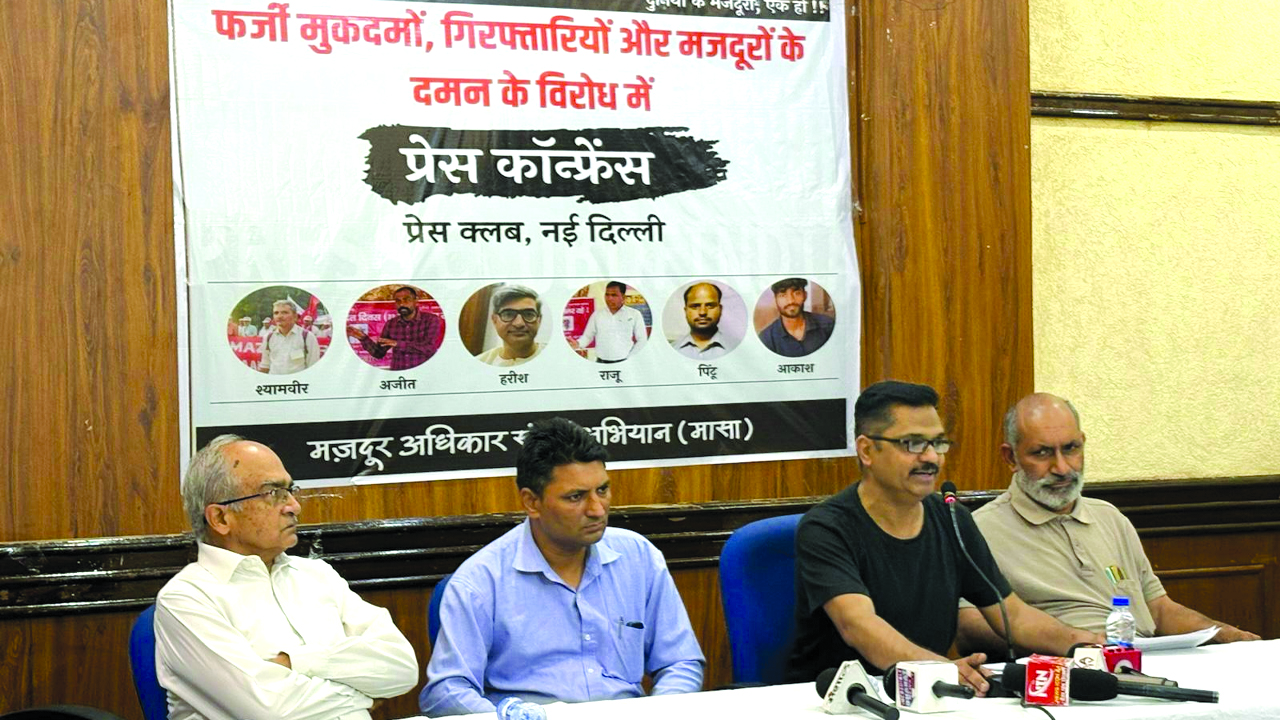
Mazdoor Adhikar Sangharsh Abhiyan (MASA), a joint platform of workers’ organisations and trade unions, organised a press conference on Tuesday, 21 April, at Press Club of India. The gathering was addressed by Supreme Court senior counsel Adv. Prashant Bhushan and various worker organisation leaders. At this time, thousands of workers across Delhi-NCR and various other states are in open revolt. The driving force behind this movement is skyrocketing inflation in the face of stagnating wages, pushing workers to the brink of starvation. This crisis is further exacerbated by the LPG shortage triggered by the Israel-US attack on Iran, forcing workers into even deeper cycles of hunger. Consequently, in industrial hubs like Gurgaon-Manesar, Noida, Faridabad, Bhiwadi, Panipat, and Rudrapur, millions of workers have taken to the streets demanding a hike in the minimum wage. (MASA Press Release, 21st April 2026, Press Club of India, New Delhi)
April 22, 2026 | New Delhi
by Mouli Sharma
At a press conference at the Press Club of India in New Delhi on the 21st of April, labour leaders from Haryana and New Delhi slammed the government’s recent criminalisation and wave of mass arrests across Haryana and Uttar Pradesh in response to a large scale labour agitation that has erupted across the North Indian industrial belt.
The recent implementation of the much delayed wage increase (the first since October 2015) in the region has led to outrage among blue collar workers across the industrial hotspots of Gurgaon-Manesar, Noida, Faridabad, Bhiwadi, Panipat, and Rudrapur, with the building pressure on the workers with recent geopolitical crises—alongside their alleged gross mismanagament—and the repeated controversial amendments to India’s labour laws by the incumbent administration having come to a boiling point in the form of back to back strikes and militant protests across the UP-Haryana-Uttarakhand factory belt.
Mazdoor Adhikar Sangharsh Abhiyan (MASA), or the Movement for the Struggle of Workers’ Rights is a joint platform of trade unions and labour rights organisations based in Haryana, that organised the conference. But MASA, of course, is not the only organisation whose decades long struggles seem to have come to a head, a mere week away from Labour Day 2026, fourteen decades after the Haymarket affair marked the climax of a long series of strikes in the United States of America when a till date unknown bomber threw a dynamite explosive at armed police officers forcibly dispersing protesters (just a day prior, two demonstrators had been killed by the Chicago police in a similar ‘dispersion’) and killing 7 policemen.
“The Supreme Court has said that a minimum wage should be given, and our constitution has gone beyond that, and said that not only a minimum wage, but a living wage should be given,” said Somnath, a MASA leader. “But what we are seeing is that the minimum wage, which experts have calculated from the beginning of the month, should be more than 30,000 rupees [in small cities]. And in the big cities, it should be even more,” he said.
This Rs. 30,000 is a far cry from the ground reality of India’s blue collar worker, positioning the question of minimum wage at the heart of the ongoing movement. “What the government is giving now, at present—we are hearing from all the labourers, who work 12 hours, 13 hours—is 9,000, 10,000, 11,000, 12,000. And after the struggle,” said Somnath, referring to the recent protests, “what the government has decided—like in Haryana— was 15,220 rupees.”
Nearly a century and a half after the bloody struggle that led to legal and social protections like the weekend, the 40-hour work week, and the 8-hour workday, all these protections have endured a slow and painful erasure, with comforts such as labour rights, minimum wages, and designated working hours having long since become mere illusions of the bureaucratic machinery.
“This is an old fight,” Somnath said. “It’s an old fight of the labourers, how many hours of work should be there. In 1886, we fought and took the right of 8 hours of work, but it is being violated completely.”
140 years later, the world has gone back instead of moving forward. “Now new labour codes has come, in which this legal stamp of approval has been put that [corporates] can take more than 8 hours of work. So this anger of the labourers, it has come from within, it is a fight to stay alive. Their children are going hungry, mothers are saying, “we are going to work, our children are sleeping hungry.”
In 2026, the looming threat of nuclear war overshadows food-insecurities over a global climate catastrophe, a genocide in the middle east approaches its three year anniversary as its aggressor has joined hands with a settler colonial superpower in the West to attack a nation that the majority of Asia depends on for crude oil, and Indian labourers, are getting paid less than half of what they need to stay alive.
140 years later, tens of thousands of workers are back on the streets, having to be beaten down by police and charged with terror conspiracies in courts. 140 years later, the cracks in the capitalist facade of the global economy are beginning to reappear, and it all began, like most things do today, with oil; 12,000 km across the Pacific Ocean from Chicago’s Haymarket.
The Ripple—Panipat
On February 21, three workers of the Indian Oil Corporation Limited’s Panipat Refinery and Petrochemical complex were grievously injured in an on-site accident, the details of which are still unclear. The news only broke out after 30,000 workers went on strike two days later, on the 23rd of February, prompting inquiry and curiosity from labour rights organisations and the media.
A fact finding team from an independent news outlet named Counterview found that the trigger for the protest was this accident, as a result of which two workers had died, and the third survived as an amputee. The protesting workers revealed that the management refused to even provide an ambulance to the fatally injured workers, and that the delay and apathy in addition to the already negligent working conditions likely cost two men their lives.
“An FIR has been registered against 2,500 unidentified workers, while no proceedings have been initiated against management or contractors despite the negligence that caused the accident,” noted Counterpoint’s fact finding team, but the real horror lays in the allegations regarding the workers’ normalised abuse, which has gone on since the refinery’s inauguration in 1998, employing over 50,000 workers—most of whom are contractual labour.
“They work 12 hours a day but are paid only for the standard eight hours. They are permitted only two days of leave a month, which means they work two Sundays every month. Wages are frequently delayed, fraud is perpetrated in the name of Provident Fund contributions, and workers are denied even basic facilities such as toilets at the workplace,” wrote Counterpoint’s Rosamma Thomas.
Neither the deaths of industrial workers nor their strikes are anomalous occurrences in India’s normally labour intensive, exploitative, and often brutal economy. In the past two years alone, from Samsung workers in Tamil Nadu to tea plantation workers in Darjeeling, strikes have been an ordinary and neglected part of India’s economic reality, rarely making headlines, and almost always dying down in the canals of red tape and judicial bureaucracy.
Coming to workers’ deaths, in a previous report, GroundXero covered the incessant institutional murders of Dalits employed as manual scavengers through legal loopholes and contractualisation in the sanitation sector, largely by the government itself; 41 of them have died in 2026 alone, and despite a strike at New Delhi’s Jantar Mantar on the 26th of March last month, the prime time news saw no headlines.
But Panipat was different.
According to Thomas, the building pressure at IOCL’s Panipat refinery, steadily growing as the decades have gone on, was exacerbated by the introduction of the new Labour Codes in November last year.
“In one stroke, the government has effectively dismantled the foundational rights of workers: the eight-hour workday, provident fund protections, and overtime rules. The right to organize and unionize has been curtailed and treated as tantamount to a crime.”
Writing on the 26th of February 2026, Thomas ironically predicted the cascade effect that the Indian Oil workers’ protests was soon going to have on the industrial landscape: “Panipat may be an early sign of wider worker unrest — one that could spread and intensify as conditions of work come to resemble those of an earlier, darker era.”
Two Waves—Manesar to Noida
On 28th February 2026, the USA and Israel launched a war against Iran, assassinating their Supreme Leader, Ali Khamenei. A series of airstrikes and consequent counterstrikes between the feuding nations led to a devastating global consequence; the Strait of Hormuz, a maritime choke point within the Gulf from where 20% of the world’s liquified petroleum trade occurs—liquefied petroleum that is backbone of the Indian kitchen, both residential and commercial—was blockaded by Iran, leading to a global energy crisis.
“You used to get gas for 70 rupees [per kg],” Somnath said. “Today, in black [market], gas is being sold for 400 rupees, 600 rupees, at least 250 rupees. Near the refinery in Panipat, the contractor himself is getting gas for 250 rupees!”
Come April, the implementation of the long resented and controversial ‘New Labour Codes’ in effect since November last year on the 1st of the month, together with a mass emigration of labourers from big cities across the countries due to this acute LPG shortage, led to Thomas’ predictions coming true: what the workers of the Panipat IOCL refinery started snowballed into a wave of strikes across northern India.
On the 7th of April 2026, contract workers at Honda Motorcycle and Scooter India’s IMT Manesar plant in Haryana went on strike. Around 7,000 workers gathered outside the factory gates demanding better wages, eight hour workdays with double overtime and dignified working conditions. They were soon joined by over a dozen other factories in the industrial hub, leading to an intense police crackdown and the imposition of section 163 of the Bharatiya Nagarik Suraksha Sanhita (BNSS), formerly the infamous section 144 of the erstwhile Code of Criminal Procedure (CrPC), on the IMT Manesar region.
As conditions on ground heated both literally and figuratively, the next domino to fall was textile, with the Richa Global and Modelma Garments plants in Manesar being among the first from non-automobile related industries to join the protesting fold.
In February 2026, a research study titled, Breaking Point: Heat and the Garment Floor, by HeatWatch and the Tata Institute of Social Sciences (TISS) closely examined the direct correlation between the healths of workers in the textile industry with negligent heat management.
“[These] factory floors are death traps,” wrote Jumana Shah for India Today, suggesting that this context of climate change was an underrated contributor for the recent outburst of workers’ justified and long suppressed rage.
“Eleven of the 15 surveyed factories had metal or asbestos roofs. Jet-dyeing machines operate at 125-130°C. Seven factories had no equipment to measure temperature or humidity. In the four that did, sensors were activated only during buyer visits. Critically, 78 per cent workers skipped toilet breaks to meet production targets, nearly doubling their heat-stress levels than those who did not. Around 45 per cent workers showed amber-to-brown urine, a clinical marker of dehydration and kidney strain,” Shah wrote, revealing a horrifying and talked over reality of the lives of garment factory workers that one would be remiss to not take into account in the conversation of labour justice.
The strike wave then gathered speed parallel to the annual North Indian heat wave, at this point taking the legitimate form of a bonafide workers’ revolt, and soon spread to thousands of workers including garment makers Motherson Group and auto-parts makers Bellsonica, Satyam Auto, and Munjal Shows among others. This movement, organic, spontaneous, and entirely unique in its decentralised form, despite facing brutal repression from the state, would soon make its way to UP’s Noida, where in mid-April, it would witness its largest agitation yet, and also face its most brutal attack from the state.
Manesar, Noida and the Art of Criminalisation
Following the emergency-like situation that overtook Gurgaon-Manesar with the implementation of section 163 on the 7th of April, the following day, the Haryana government announced an increase in minimum wages from Rs. 11,274 to Rs. 15,220 for so-called “unskilled” workers.
However, this 35% upward wage revision in the state was too little, too late. As mentioned earlier, wage revisions under the annulled Minimum Wages Act, (year), as well as the new Code of Wages, 2020, are required to be implemented as frequently as necessary, with the maximum wait period of 5 years. In nearly eleven years since the last wage revision in October 2015, this 35% was not only long overdue, but also far below the true increase in the cost of living in Gurgaon-Manesar in the same period, which is just over Rs. 30,000.
As a result, the strikes continued.
On 9th April, the management allegedly sent hired bouncers dressed in civil clothes to incite violence. Labour leaders at the conference said that this was used as the pretext for arrests of labour leaders, including six members of MASA arrested on the midnight of 12th April—this includes Shyambir, Harish Chandra and Raju Singh from Inquilabi Mazdoor Kendra (IMK), Ajit Singh and Pintu Kumar Yadav from the Bellsonica Employees Union (BEU) and Munjal Shows worker Akash Kumar.
Haryana police has accused the six of an arson conspiracy, stating to the press that ‘digital evidence’ has been secured against them of planning to make ‘petrol bombs’ and inciting violence. Deputy Commissioner of police (West) Karan Goyal said, “The role of external miscreants in instigating violence has come to light…Digital evidence, including WhatsApp chats, indicates a premeditated conspiracy to incite arson, vandalism and serious harm.”
Additionally, 56 workers were also arrested from Manesar, including 20 women, who were sent to Bhondsi Jail. Workers and union leaders have been given 14 days judicial custody by the court.
The Manesar incident, though, was little preparation for the strikes in Noida, UP. The announcement of wage revision in neighbouring Haryana inspired workers of over 300 factories in Noida to go on strike, leading to a 21% wage hike being announced on paper. But here too, the pattern was the same: the wage increase was too little, too late, and most importantly—only the groundwork for what would follow in the form of criminalisation.
Peaceful strikes were disrupted with violence and brutal clampdown on workers and union activists from Mazdoor Bigul, six of whom—Rupesh, Akriti, Srishti, Manisha, Satyam Verma, and Aditya Anand—were among the over a thousand arrests made between April 13-16th in Noida, Lucknow and Varanasi.
Fighting Dirty—The Infamy of UP and Haryana Police
Against the BJP government’s claim of promoting “Nari Shakti,” videos recovered from Noida violence show male police officers lathi charging unarmed women who had no alleged role in any “violence”.
Speakers at the conference, including Supreme Court senior advocate Prashant Bhushan and leaders of several trade unions and labour rights organisations, specifically condemned the response of the Haryana and UP governments, highlighting how these, in particular, have unleashed a wave of brutal repression, and upon criticism, have fallen back to lowly and weak defences of absurd conspiracies and propagandistic diversions.
“While the corporate owned media acts as a mouthpiece for the state, baselessly alleging ‘Pakistani links’ and ‘external instigation’ to brand workers demanding their rights as “rioters,” the police are shamelessly raining lathis upon them and filling hails with the innocent,” said the press release of MASA, referring to a recent press statement by Uttar Pradesh Labour Minister Anil Rajbhar.
“The incident appears to have been carried out with the intention of disrupting the development and law and order of the state. In recent days, four suspected terrorists have been arrested from Meerut and Noida, whose links were connected to handlers based in Pakistan. In such a situation, the possibility of a conspiracy to create instability in the state gains strength. Agencies are seriously investigating the entire matter,” Rajbhar said in a statement on the 12th of April 2026, the same day Haryana Police also alleged the previously mentioned ‘conspiracy’ in Manesar on the basis of which six labour leaders were arrested.
These accusations, though, seem to be only part of a larger pattern of underhanded tactics and shady strategies being employed by corporate management and the police responding to the recent wave of protests—such as beating up women protesters, and lying about negotiations to lure workers into detention.
“Several workers from Noida’s factories were called to report to duty, with the promise of better pay, and handed over to the police,” a MASA leader alleged.
‘Justified Demands’: Prashant Bhushan
In a release following the conference, MASA put forth a list of five demands on behalf of the several thousand workers who are currently in, as they put, “open revolt” across the states of UP, Haryana, and Uttarakhand:
- Immediate and unconditional release of all arrested workers and labour activists. Immediate withdrawal of all fabricated and grave criminal cases.
- Repeal of the four anti-worker Labour Codes. Ensure permanent employment for permanent work and the total abolition of the contract system.
- Minimum wage of Rs. 30,000 per month for an 8-hour working day.
- Abolition of laws compelling women workers to work night shifts.
- Legal action against the officials and police personnel responsible for the lathi-charge on workers and women labourers.
Adv. Prashant Bhushan, seconding the demands, also added that a judicial inquiry needed to be initiated to look into the violence that has taken place at the hands of the state in an attempt to suppress these protests.
“All the demands that have been placed in this are absolutely right, justified and valid. I fully support these unions,” Bhushan said, adding that, “there should also be a demand for a judicial inquiry. An impartial judicial inquiry on the recommendation of the Chief Justice, Chief Justice of the High Court, Chief Justice of the Supreme Court. The government should not reveal the name of the judge who will conduct the judicial inquiry.”
All five demands, as expressed by Bhushan, appear justified at a first glance, but may require further explanation to those uninitiated. This article has so far contextualised—to some degree—the troubles with the new Labour Codes, the underhanded tactics of the police in on ground violence, the criminalisation of protesters and also the necessity of a scientific minimum wage. One demand that may seem unintuitive here is the fourth: abolition of laws compelling women to work night shifts.
Richa Pandey of MASA explained her organisation’s rationale behind placing forth such a demand, and also contextualised the legal loopholes through which laws may be ‘compelling’ women to work night shifts.
“In [the older] labour laws, women’s protection—like maternity leave benefits—it was there that women would not be allowed to work in the night shift, except in the service sector,” Pandey said. “Now, in the new labour codes, women are allowed to work in the night shift, on consent.”
Upon asking her what the issue was if the laws required consent, she said, “you put a goat in front of a lion and then say consensually, I mean, there is so much unemployment and so much lack of work.”
“The worker, whether it is a woman or a man, whatever work he is getting, he is holding on to it. Whatever is possible for them, new, heavy, light, whatever it is, they are holding on to it. The condition of women is that they are working for 6,000-7,000 rupees for 8-10 hours. 10,000 is a very unimaginable thing,” Pandey argued. “So in this case, if the boss tells them to come to the night shift, will they refuse? If they refuse, they will lose their job. So this is ‘consent’. You are taking advantage of the compulsion and taking consent.”
The matters of the arrests in Manesar will be heard on the upcoming Friday. At time of writing, section 163 orders are still in place in both the Haryana and UP protest zones, and likely will be till the situation of unrest is resolved.
Mouli Sharma is an independent journalist from New Delhi.