
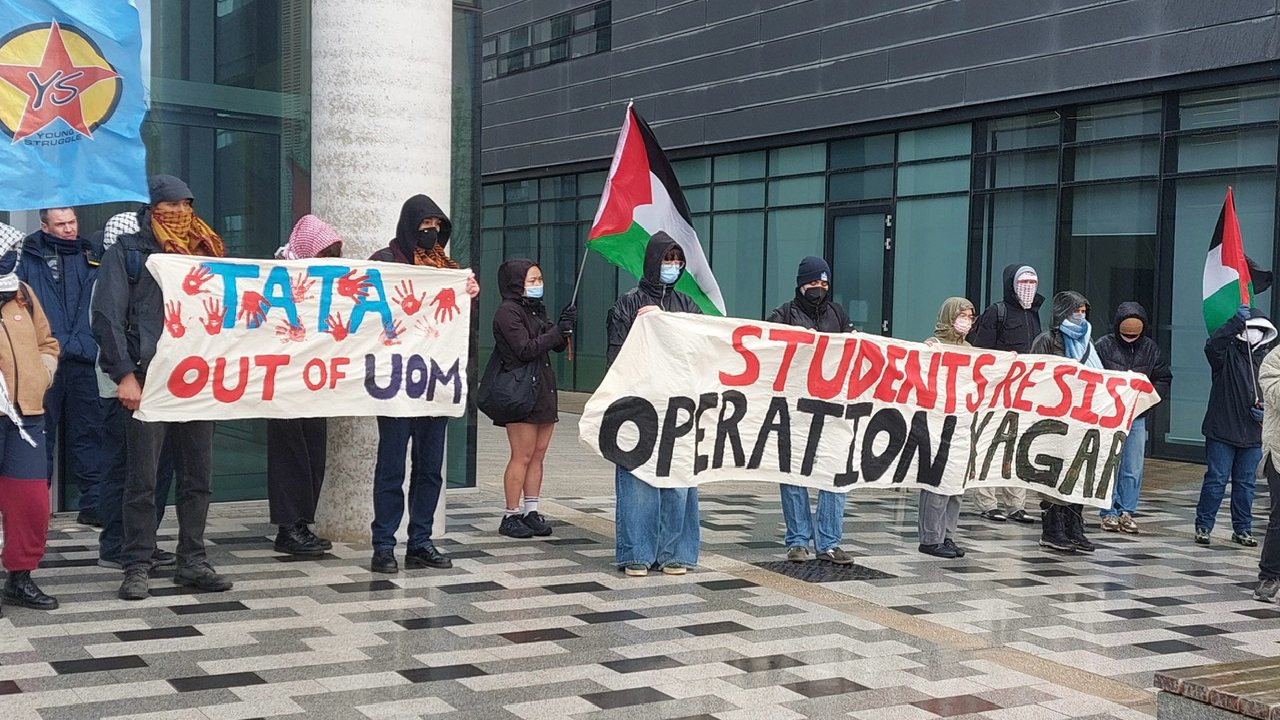
Demonstrations held in cities across UK against escalating state violence under “Operation Kagar” in central-eastern India.
Groundxero | April 4, 2026
Protests were held across Britain on March 28, as internationalist and progressive groups mobilised against what they described as escalating state violence under “Operation Kagar” in central-eastern India. Demonstrations were held in London, Manchester, Nottingham and Glasgow, responding to a global call for action.
Protesters alleged that the Indian state has intensified military operations in Adivasi regions to meet the March 31 “Naxal-free” deadline set by the Bharatiya Janata Party government. The mineral-rich Bastar region, they said, has been transformed into one of the most heavily militarised zones in the world.
The protestors also denounced the abduction, torture and sexual violence inflicted on 10 activists and students in Delhi on the 12th March.
In Manchester, protestors targeted the collaboration between Tata Steel and the Henry Royce Institute at the University of Manchester. Groups including the Progressive Indian Coalition, South Asian Liberation Movement and Young Struggle Manchester and various student organisations accused the Tata conglomerate of playing a central role in land acquisition in Adivasi areas and contributing to the Zionist genocide machine, for which it faces globally campaigns including by pro-Palestine activists within India.
In London, the Science Museum was targeted for collaborating with Adani Green – the greenwashing arm of the world’s largest private coal developer. This demonstration consisted of Anti-Imperialist Front, Young Struggle, India Labour Solidarity, Parents for Palestine amongst others. The Adani Group was accused for being particularly complicit in violence against Adivasi communities as well as Palestinians. Hundreds of leaflets were distributed explaining Operation Kagar and Adani’s various violences across the world including their ownership of Haifa Port and collaboration with Elbit Systems.
In Glasgow, activists targeted offices of American International Group, citing its role in insuring Adani Group projects. Demonstrators framed the protest as part of a broader anti-imperialist mobilisation.
Meanwhile, in Nottingham, activists with the Camp for the Liberation of Palestine protested at the University of Nottingham, pointing to its ties with defence and technology firms including BAE Systems, Boeing, Caterpillar Inc., Palantir Technologies and Rolls-Royce Holdings. Protesters alleged these companies are linked to surveillance and military technologies used to surveil and kill Palestinians, Kashmiris, Adivasis and others in multiple conflict zones.
Demonstrators raised slogans including “Inquilab Zindabad”, “Lal Salaam”, and “Jal, Jungle, Jameen”, while calling for an end to corporate involvement in extractive projects in Adivasi territories.
Speeches also drew connections between Operation Kagar and broader ideological repression, with references to Marxist movements and solidarity extended to those facing crackdowns in countries such as Turkey. Protesters argued that militarised deadlines cannot extinguish insurgencies rooted in structural inequalities.
Through this day of action, activists raised not only awareness of the corporatist brutality of state repression in India, but also stressed on the role of capitalist-imperialism perpetuated by imperialist countries like Britain. Calling Operation Kagar as being an assault also on progressive ideas and Marxism, the protestors highlighted that clearing the forested lands of its rightful owners, the Indian state aims to carve up the land for big corporates to facilitate mineral extraction to benefit global capitalism.
Demonstrators raised slogans including “Inquilab Zindabad”, “Lal Salaam”, and “Jal, Jungle, Jameen”, while calling for an end to corporate involvement in extractive projects in Adivasi territories. They held up pictures of various key figures in the Indian revolutionary tradition, including Dr Ambedkar, Shaheed Udham Singh, Birsa Munda and others. Solidarity was also extended to Marxists facing repression elsewhere such as by the Turkish state.
Organisers said the coordinated protests aimed to expose the financial, political, economy, and military links that sustain capitalist loot of India and the ruthless repression conducted in the “world’s largest democracy”. They called for continued international mobilisation against corporate-driven dispossession and militarisation in Adivasi regions.