
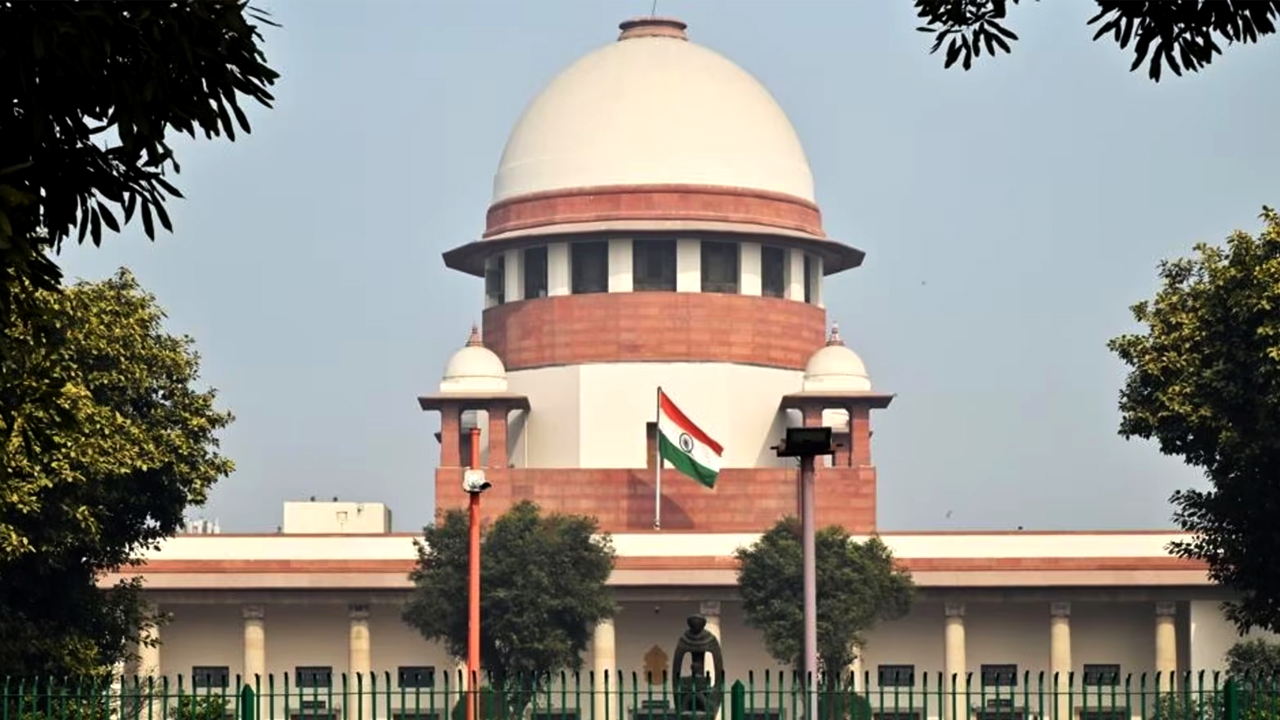
As India heads towards a nationwide general strike on February 12 against the four labour codes, Chief Justice of India (CJI) Surya Kant’s remarks holding trade unions responsible for stopping industrial growth during a PIL hearing in the Supreme Court have sparked a sharp backlash from trade unions and Left political organisations.
Groundxero | Jan 29, 2026
Observations made by Chief Justice of India (CJI) Surya Kant on 29 January 2026 during the hearing of a Public Interest Litigation seeking welfare measures for domestic workers have drawn strong criticism from labour unions, Left parties, and workers’ rights activists across the country.
During the hearing of Penn Thozhilalargal Sangam vs Union of India (W.P.(C) No. 42/2026) on January 29, the CJI reportedly remarked that trade unions had been “largely responsible for stopping industrial growth in the country” and suggested that several traditional industries had shut down due to union activity. He also expressed concern that extending legal protections such as minimum wages to domestic workers could result in trade unions dragging households into prolonged litigation. The CJI also said such a move could turn every Indian home into a legal battlefield.
“How many industrial units in the country have been closed thanks to trade unions? Let us know the realities. All traditional industries in the country, all because of these ‘jhanda’ unions, have been closed, all throughout the country. They don’t want to work. These trade union leaders are largely responsible for stopping industrial growth in the country,” Chief Justice Surya Kant remarked during the hearing.
The Centre of Indian Trade Unions (CITU) described the CJI’s remarks as “most unfortunate and unconstitutional”, particularly coming from the head of the judiciary. In a detailed statement, CITU argued that the observations lacked both theoretical and empirical basis and closely resembled the language of “failed neoliberal policies” that blame organised labour for economic crisis.
CITU underlined that the right to association for Indian workers is a fundamental right guaranteed under Article 19(1)(c) of the Indian Constitution and is regulated by the Trade Unions Act, 1926, (together with subsequent amendments), which provides for registration and legal immunity for union activities.
Any suggestion that unionisation is inherently harmful to economic growth, the union said, undermines this constitutional guarantee that enables collective bargaining and representation of workers’ interests.
Challenging CJI’s claim that trade unions are responsible for industrial closures, CITU cited data from the reports on “Industrial Disputes, Closures, Retrenchments, and Lay-offs in India” showing a significant decline in industrial disputes over the past decade. Industrial disputes fell to a 17-year low in 2023, with fewer than 100 disputes reported annually since 2018, compared to an average of over 350 disputes per year between 2006 and 2014. The union also noted that industrial closures are often higher in states where trade union presence is weak.
CITU pointed to official data presented in Parliament, where the Ministry of Corporate Affairs stated that over 2 lakh private companies had closed in the past five years due to amalgamations, insolvency proceedings, or being struck off under the Companies Act, 2013. According to trade unions, data from the Insolvency and Bankruptcy Board of India (IBBI) reinforces the argument that closures of industries stem from financial distress, corporate mismanagement, and policy failures rather than labour unrest.
CITU firmly stated: Contrary to the illogical claims of neoliberal apologists, it is not industrial disputes by trade unions that are forcing industrial units to close down. On the contrary, it is the crisis within the capitalist neoliberal order and the unbridled concentration and financialisation of the economy, at the cost of the MSME and the productive sector as a whole, that have led to increasing industrial closures. Trade unions can in no way be made a scapegoat to cover up the failure of the policy regime and economic governance.
The controversy over CJI’s remarks has gained added significance as it come days before the workers’ mobilisation for the February 12 all-India general strike called by the joint platform of central trade unions against the four labour codes. Unions argue that these codes are premised on weakening collective bargaining and union rights in the name of “Ease of Doing Business”.
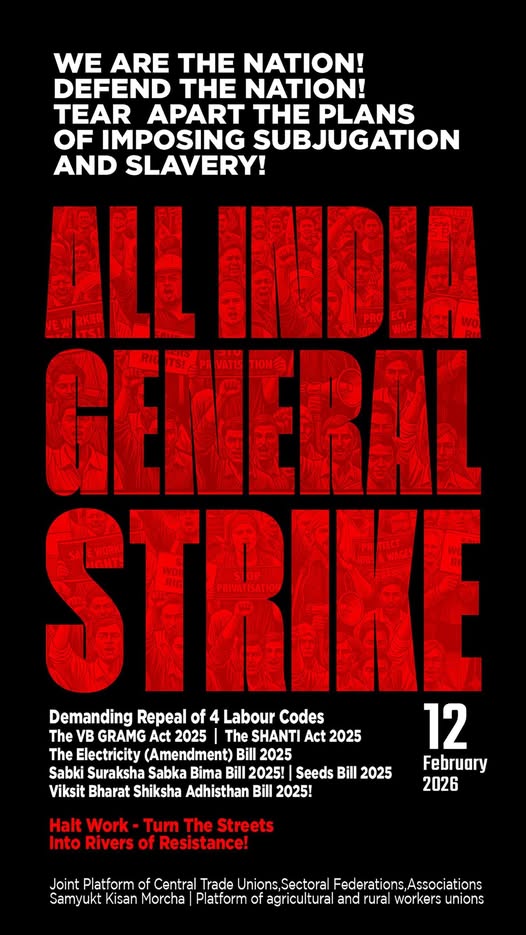
CITU pointed out that the statement of the CJI resembled the political-economic illogic of the Modi Government. Be it the four labour codes, the Shram Shakti Niti, the dismantling of MGNREGA, various incentive programmes, or legislations accelerating the expropriation of the country’s resources for private gains — all form part of the aggressive restructuring of the Indian state in favour of capital and the fast-withering away of the welfare state as envisaged in the Indian Constitution. The CJI’s remarks, CITU said, exposes the changing nature of the Indian state in a very dangerous manner.
CITU reaffirmed that the upcoming General Strike, called by the CTUs and supported by the Samyukt Kisan Morcha and the platform of unions of agricultural and rural workers, is not only to defend the hard-earned rights of the Indian people but also to defend and save the national economy from a perverse economic order and governance. “The working class has never received anything through the benevolence of institutions or governments; it is only through struggles and sacrifices that rights have been earned and defended, not only for workers but for the people and society as a whole,” CITU added.
The Communist Party of India (Marxist-Leninist) Liberation also condemned the remarks, calling them reflective of a “myopic and privileged outlook” that views collective worker action as inherently anti-development. The party said the observations undermine the fundamental right to collective bargaining and erase the historic struggles through which workers secured rights such as the eight-hour workday, minimum wages, and social security.
“To dismiss trade unions as impediments to economic growth is to overlook the fundamental reality that labour protections are not obstacles but the very foundation upon which a just and equitable society is built,” CPI(M-L) said.
Both CITU and CPI (ML) also criticised the reported ridicule of demands for minimum wages for domestic workers, noting that several states already notify scheduled minimum wages for domestic work.
The remarks by the CJI, echoing neoliberal economic arguments, have reopened debates over the constitutional right to collective bargaining, the causes of industrial decline, and the judiciary’s role in matters of labour policy.
Trade unions have urged the Chief Justice to reconsider the remarks, warning that such statements risk legitimising anti-worker prejudices and weakening constitutional commitments to social justice at a time when labour protections are already under sustained legislative and economic pressure.