
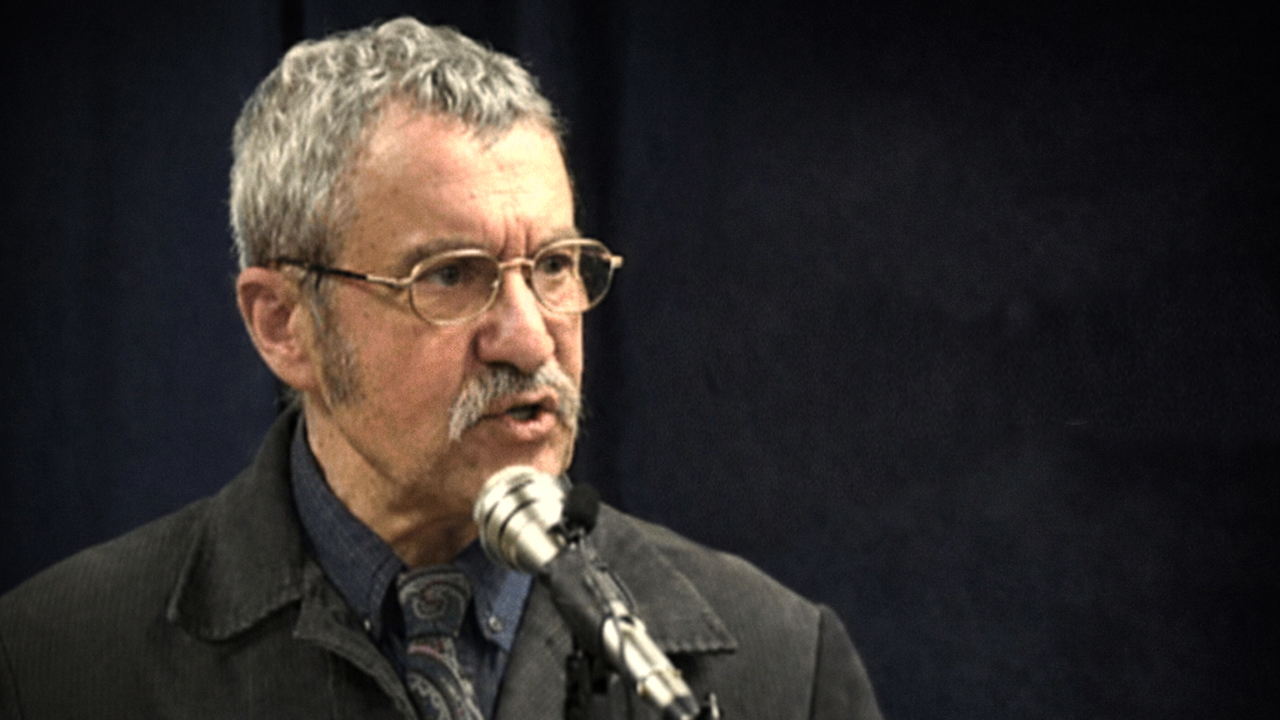
Michael Parenti’s greatest contribution was not a single book or argument, but a stance: the refusal to flatter power, the refusal to forget history, the refusal to trade truth for respectability.
By Arkadeep Goswami
Jan 25, 2026
Michael Parenti’s death marks the passing of one of the last great unapologetic Marxist public intellectuals of the twentieth century – a thinker who did not merely interpret the world, but spent a lifetime trying to expose the lies through which power naturalizes itself. In an age when radical critique is often domesticated into academic jargon or liberal moralism, Parenti stood out for his clarity, anger, historical memory, and class loyalty. He spoke plainly when others equivocated, named capitalism when others blamed abstractions, and insisted – against fashion, funding, and fear – that imperialism was not a mistake of policy but a structural necessity of empire.
Yet Parenti’s legacy is not immune to criticism. His fierce polemical style, his tendency to prioritize structural analysis over internal contradictions, and his sometimes defensive posture toward socialist states have sparked debate even among comrades. To write an honest obituary of Parenti is therefore to do what he himself would have demanded: to situate him historically, critically, and politically – not sentimentally.
This is not a eulogy for a liberal hero. It is an obituary for a class warrior of ideas.
The Making of a Class-Conscious Intellectual
Born in 1933 to Italian-American working-class parents, Michael Parenti’s political orientation was shaped less by abstract theory than by lived experience. He came of age in a United States marked by McCarthyism, Cold War hysteria, racial segregation, and aggressive imperial expansion. Unlike many academics who discovered Marxism through books, Parenti encountered capitalism first as discipline, exploitation, and exclusion.
He earned a PhD in political science from Yale, but Yale never claimed him. Nor did he seek refuge in elite institutions. Instead, Parenti became one of the most systematically marginalized intellectuals of his generation – not because he lacked rigor, but because he refused to depoliticize it. His teaching career was repeatedly disrupted; his academic prospects curtailed. Yet this marginalization did not lead him to soften his critique. On the contrary, it sharpened it.
Parenti’s intellectual formation occurred at the intersection of Marxist political economy, historical materialism, and Gramscian cultural analysis. But what distinguished him was his insistence that theory must be accessible to ordinary people. He wrote not to impress peer reviewers, but to arm readers with analytical weapons.
Demystifying Power: Parenti’s Central Contribution
If one had to summarize Parenti’s life work in a single phrase, it would be this: the demystification of power. Across books such as Democracy for the Few, Against Empire, Inventing Reality, Blackshirts and Reds, and The Assassination of Julius Caesar, Parenti relentlessly exposed how ruling classes manufacture consent through ideology, media, law, and selective memory. He insisted that democracy under capitalism is not rule by the people, but rule by elites with periodic electoral legitimation.
His critique of the corporate media remains among the most devastating ever written. Long before the term “manufactured consent” became academic shorthand, Parenti documented how news framing, omission, language choice, and repetition function as tools of ideological control. He showed that media bias does not primarily operate through lies, but through patterns of silence and normalization – what is made unthinkable, not merely what is said.
Equally important was Parenti’s insistence on class analysis at a time when much of the US Left was drifting toward culturalism, identity reductionism, or NGO liberalism. He never denied the reality of race, gender, or national oppression, but he refused to detach them from political economy. For Parenti, oppression was never merely representational – it was material, institutional, and enforced by state power.
Empire as Structure, Not Policy Error
One of Parenti’s most enduring contributions lies in his analysis of imperialism as a structural feature of capitalism, not a deviation from it. Against liberal narratives that portray US foreign interventions as misguided attempts at spreading democracy, Parenti demonstrated – with historical precision – that empire exists to secure markets, resources, strategic dominance, and class interests.
From Latin America to the Middle East, from Vietnam to Yugoslavia, Parenti showed how “human rights” discourse is routinely weaponized to justify destruction, while far greater crimes committed by allied regimes are ignored or excused. He did not romanticize resistance movements, but he insisted on a baseline honesty: that the greatest violence in the modern world is organized, normalized, and sanitized by imperial power.
His writings on Yugoslavia, particularly controversial, exemplify both his courage and his limitations. Parenti challenged the dominant Western narrative of “ancient ethnic hatreds” and humanitarian intervention, exposing the role of NATO, IMF restructuring, and geopolitical interests in the disintegration of the socialist federation. Yet critics argue that his focus on external forces sometimes underplayed internal authoritarianism and nationalist contradictions.
This tension, between structural clarity and political defensiveness, runs through much of Parenti’s work.
Blackshirts and Reds: A Necessary Provocation
No discussion of Parenti can avoid Blackshirts and Reds, his most debated and influential book. Written at a time when socialism was being declared dead and fascism treated as an aberration of the past, Parenti offered two deeply unfashionable arguments.
First, that fascism was not merely irrational evil, but a mass movement rooted in capitalist crisis and elite fear of socialist transformation. Second, that actually existing socialism, for all its failures and crimes, had delivered real material gains for working people – and that its collapse represented not liberation, but catastrophic regression for millions.
Parenti did not deny repression, purges, or authoritarianism in socialist states. But he rejected the moral asymmetry that treats socialist violence as proof of inherent evil while capitalist violence is rendered invisible or regrettable. He asked an uncomfortable question: Compared to what?
This insistence on historical comparison infuriated liberals and embarrassed parts of the Left. It also provided generations of readers with a framework to resist Cold War moral blackmail.
Yet the book also exposes Parenti’s blind spots. His tone sometimes borders on apologetic, his engagement with dissident socialist traditions is limited, and his treatment of internal class struggle within socialist states remains underdeveloped. A more dialectical approach would have strengthened, not weakened, his argument.
The Style of an Academic Street Fighter
Parenti was not a cautious thinker. He was a polemicist, and he embraced that role unapologetically. His lectures – now widely circulated online – are remembered not only for their content, but for their delivery: sharp, sarcastic, indignant, often humorous. He did not hide his contempt for hypocrisy, nor his anger at injustice.
This style was both his strength and his vulnerability. It made his work accessible and emotionally compelling, but it also allowed critics to dismiss him as simplistic or biased. Parenti understood this risk and accepted it. For him, neutrality was not objectivity – it was complicity.
In an academic culture that rewards ambiguity and punishes conviction, Parenti chose sides.
Relevance in an Age of Collapse
Michael Parenti did not live to see the end of imperialism, but he lived long enough to see its moral bankruptcy laid bare: endless wars, rising inequality, ecological devastation, and the hollowing out of democratic institutions. In this sense, his work has aged not poorly, but prophetically.
For younger generations confronting surveillance capitalism, permanent war, and neoliberal austerity, Parenti offers not ready-made answers, but analytical discipline. He teaches us to ask: Who benefits? Who decides? Who pays the price? And whose suffering is rendered invisible?
At the same time, the Left today must go beyond Parenti. We must integrate ecological crisis, feminist political economy, postcolonial theory, and democratic socialist practice in ways Parenti only partially addressed. To honor him is not to repeat him mechanically, but to extend his method without inheriting his limitations.
Conclusion: A Legacy of Refusal
Michael Parenti’s greatest contribution was not a single book or argument, but a stance: the refusal to flatter power, the refusal to forget history, the refusal to trade truth for respectability.
He reminded us that ideas matter because they shape action, that ideology kills as surely as bombs, and that neutrality in conditions of oppression is itself a political choice.
Parenti did not win the institutional battles of his time. But he won something more enduring: the loyalty of readers who learned, through him, to see the world as it is, and to imagine how it might be otherwise.