
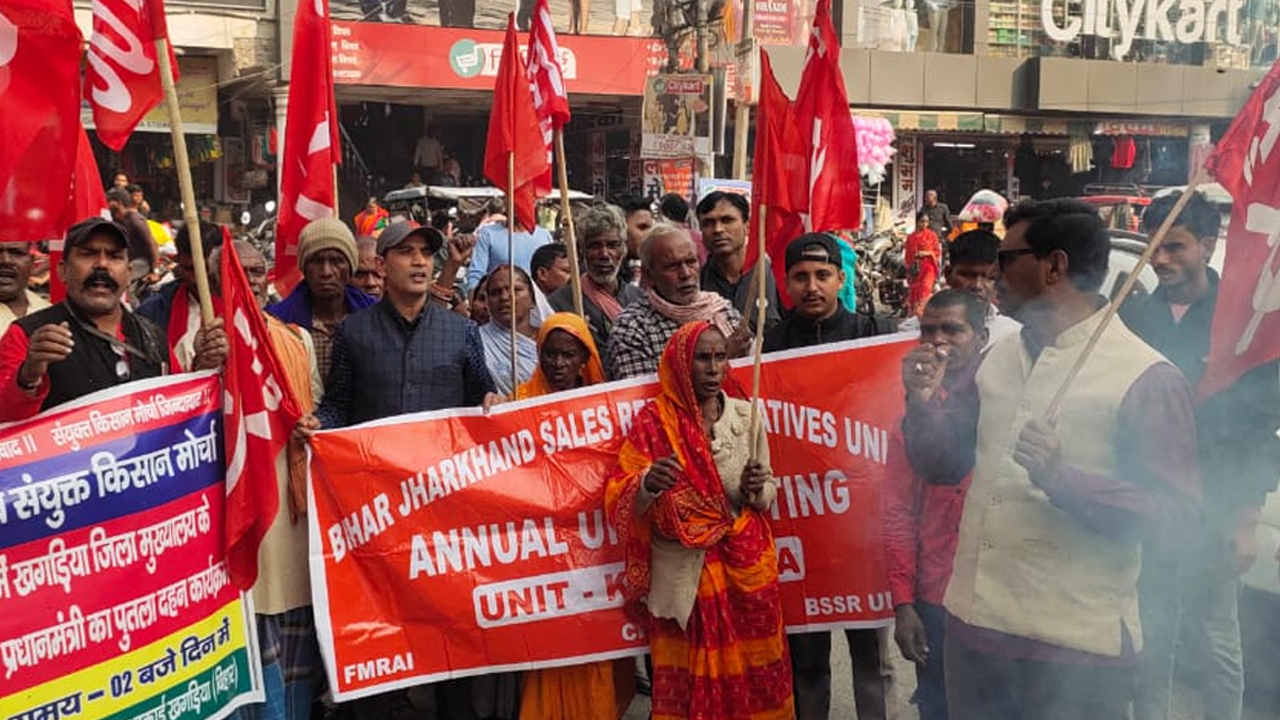
Across all governments – the Union govt. in particular, many state governments and multiple political parties; there is a consensus that workers’ rights can be compromised and violated, in the pursuit of ‘ease of doing business’, and in the service of ever greater private profits.
Groundxero | December 29, 2025
As several Indian states quietly rewrite factory laws to allow 10–12 hour workdays, All India Workers Forum and the National Alliance of People’s Movements (NAPM) warn that hard-won labour rights and protections are being dismantled to appease corporate interests. The labour rights groups have issued a sharp condemnation of recent amendments to state factory laws, calling them a direct assault on workers’ rights—especially those of migrant and informal labourers who form the backbone of India’s manufacturing economy.
In a detailed press statement released on Monday, NAPM accused state governments of pushing through regressive labour reforms under the rhetoric of “ease of doing business”, while ignoring mounting evidence of overwork, occupational hazards, and public health risks faced by India’s working class.
From eight hours to twelve: a quiet rollback
At the heart of the controversy is the steady erosion of the long-established norm of an eight-hour workday, with the Factories Act, 1948 setting a legal ceiling of maximum nine hours per day and 48 hours per week. Recently, however, several states across India have amended their labour/factory legislation to allow working hours beyond 9 hours a day for adult workers in factories (and in some cases, in commercial establishments & shops).
The governments have been justifying the 9+ hours work per day as a measure to enable “ease-of-doing-business”, “attracting investments”, “boosting manufacturing” and “flexibility for industry”. However, from the working class, human rights and trade-union perspective, especially for millions of informal and migrant factory workers, these changes marks a grossly unjust, worrying erosion of established labour protection norms.
NAPM argues that these are unjust and anti-worker amendments, and are an assault on the rights of the working class. “What is being presented as reform is, in reality, a rollback of basic safeguards,” the forum said, warning that the burden of industrial competitiveness is being shifted squarely onto the workers.
Corporate pressure
NAPM situates these amendments within a broader political and economic climate. Corporate leaders have publicly advocated for 70–90 hour work weeks framing such demands as necessary for ‘global competitiveness’ and ‘rapid economic growth’. International agencies though paint a starkly different picture. The International Labour Organisation (ILO) has consistently documented that Indian workers are among the most overworked in the world, a finding highlighted in various ILO working-time reports. A joint research by the WHO and ILO has established a clear and alarming link between excessive working hours and heightened risks of heart disease, stroke, and premature death.
Despite this, several state governments — facing both lobbying from industry associations and the imperative to attract investment — have chosen to ‘relax’ long-standing labour protections, allowing increased daily and weekly working hours with fewer mandatory overtime safeguards, framing the changes as necessary for boosting manufacturing output and integrating into global supply chains.
State-by-state expansion of work hours
The pattern over the past four years shows multiple states (Karnataka, Gujarat, Andhra Pradesh, Maharashtra, Goa, Rajasthan) amending factory-labour laws ‘legally’ increasing work hours to10-12 hours a day, often with longer stretches without break, higher permissible overtime, and night-shifts (especially for women) – all in the name of ‘industrial growth and flexibility’.
NAPM highlighted amendments in states such as Karnataka, Gujarat and Andhra Pradesh as emblematic of this trend.
In Karnataka, the Factories (Karnataka Amendment) Bill, 2023 empowers the state to allow daily work hours to be extended up to 12 hours (inclusive of rest), permits six hours of continuous work without a break, and nearly doubles the quarterly overtime cap. Trade unions have warned that the change violates conventions, opens the door to over-exploitation of manufacturing and migrant labour
Gujarat, through the Factories (Gujarat Amendment) Ordinance promulgated on 1st July, 2025, raised permissible daily work hours to 12 while retaining the 48-hour weekly cap. It allows continuous work without rest up to 6 hours, spread-over up to 12 hours, and increases quarterly overtime hours limit to 125 hours. Women are permitted to work night shifts (7 pm to 6 am) under conditions Unions criticised the move as “extended exploitation”, especially of migrant and informal factory workers lacking protections. Unions have criticised the move as “extended exploitation”, especially of migrant and informal factory workers lacking protections.
In Andhra Pradesh, amendments passed in September 2025 increased daily working hours to 10 per shift, allowed a weekly cap of up to 60 hours, and raised quarterly overtime up to 144 hours. Trade unions there have described the changes as openly pro-employer and dangerous for workers with little negotiating power.
Similar amendments in Maharashtra, Goa and Rajasthan point to what NAPM describes as a coordinated national drift towards normalising extended workdays.
Trade Unions & migrant workers’ concerns
While the reforms in the laws emphasises flexibility and choice, NAPM argues that the reality on the ground is very different—particularly for migrant and informal workers. Often employed through contractors, working in precarious conditions, and lacking union representation, these workers have little ability to refuse longer shifts.
Provisions requiring “written consent” for extended hours are often formalities. Even if double wage overtime or rest intervals are mandated, in practice enforcement is weak, especially for migrant/contract workers. Extended shift norms risk becoming the de-facto standard with less recourse.
The “Four-day work week” narratives, NAPM cautions, obscure the reality of 12-hour shifts that leave migrant workers without strong collective bargaining, with longer continuous work periods, reduced rest, and raise serious concerns about workplace accidents, chronic fatigue, and personal safety. Unions warn of “modern-day slavery” in the name of manufacturing ‘boom’.
Paving the way for labour codes
NAPM said, “These state-level moves demonstrate a shift in labour-regulation norms toward greater flexibility for employers, loosening of rigid daily-work restrictions while retaining only broad ceilings, which mirrors the flexibility embedded in the four central labour codes. The Four Labour Codes, recently implemented by the central government, aim to replace 29 older central laws with a unified, modern structure covering wages, industrial relations, social security and occupational safety. By normalizing extended work-hour norms at the state level, these state amendments arguably build operational and regulatory acceptance for the broader national framework envisaged by the Codes. In effect, they pave the way, in both de facto practices and legal-institutional culture, for the Codes’ emphasis on employer flexibility, simplified compliance, and enabling conditions for ‘ease of doing business.’”
NAPM links the shift in labour-regulation norms toward greater flexibility for employers, loosening of rigid daily-work restrictions while retaining only broad ceilings as mirroring the flexibility embedded in the four central labour codes, which consolidate 29 existing laws with a unified, modern structure covering wages, industrial relations, social security and occupational safety. By normalising extended work hours at the state level, the forum argues, governments are creating legal and cultural acceptance for the codes’ pro-industry orientation.
In effect, these changes pave the way, in both de facto practices and legal-institutional culture, for the Codes’ emphasis on employer flexibility, simplified compliance, and enabling conditions for ‘ease of doing business.’
A call for resistance
In India, workers’ power in the form of unions, etc has been systematically eroded overtime. The fact is that these changes represent a significant shift in regulatory balance in favour of owners of capital and against workers. Unless guarded and resisted, these amendments may well lead to longer working hours, weaker rest, more fatigue, and higher risk for those least able to defend themselves. For informal and migrant workers, who lack bargaining power, strong representation, stable accommodation and union coverage, this shift is very deeply concerning. The amendments risk extending and entrenching exploitation, rather than protecting rights of the already vulnerable and less-unionized workforce.
Across all governments – the Union govt. in particular, many state governments and multiple political parties; there is a consensus that workers’ rights can be compromised and violated, in the pursuit of ‘ease of enabling business’ and in the service of ever greater private profits! Warning of a slide towards “modern-day slavery” under the guise of manufacturing growth, NAPM said that it is time to raise a clarion call: what is being marketed as “flexibility” is in effect a rollback of protection; what is being called “four-day work week” for 12-hour shifts may mean longer daily toil; what is being framed as “women’s participation in night shift” may translate into extra burden on vulnerable migrant women.
Given the major shifts in legislation and policy, in favour of big capital, NAPM strongly urges all democratic organizations, trade unions and workers collectives to unite and resist these changes and to demand an immediate roll back of these regressive amendments that are an assault on the rights of the working class.
As India pitches itself as a global manufacturing hub, the battle over work hours and workers rights is shaping up as a critical fault line—one that raises a fundamental question: growth at whose cost?
The news report is based on the press statement issued by All-India Workers Forum and National Alliance of People’s Movements (NAPM)