
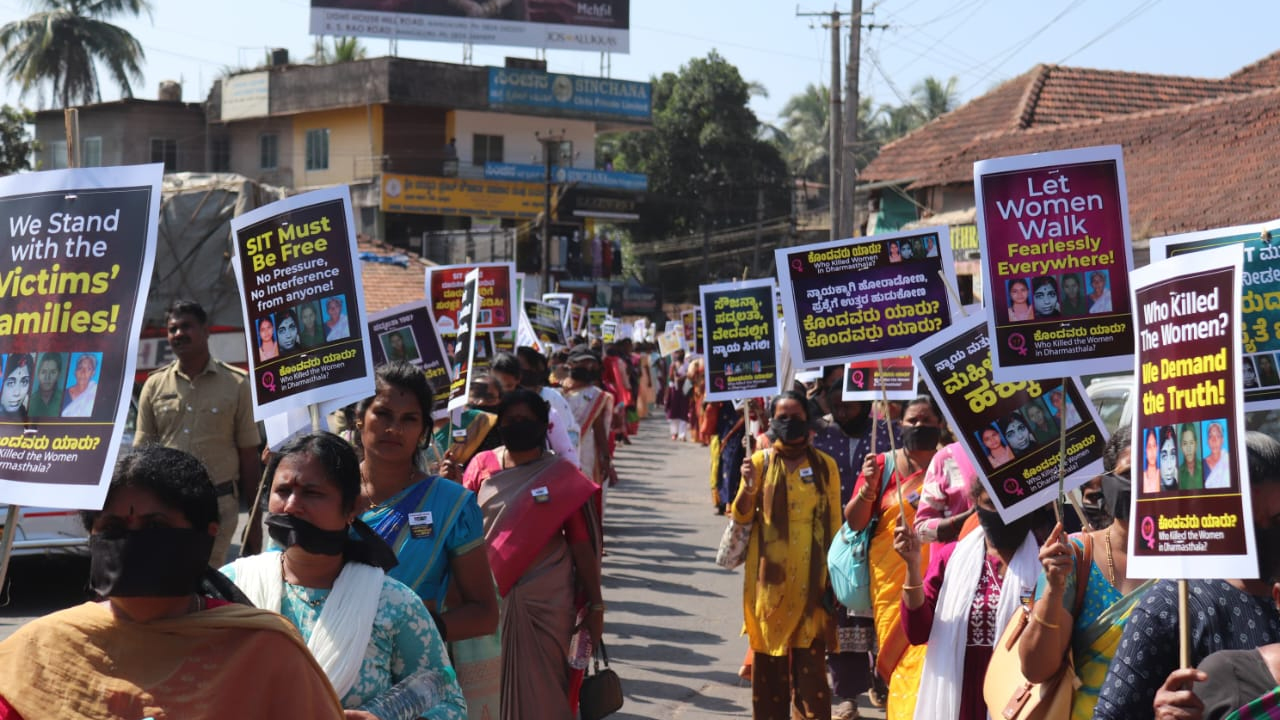
Thousands of women from across Karnataka marched through the streets of Belthangady in a silent rally, demanding truth, justice, and accountability for rape, disappearances, and unnatural deaths of women and girls reported over several decades in and around Dharmasthala.
Groundxero | December 24, 2025
Thousands of women from across Karnataka marched through the streets of Belthangady on December 16 in a silent rally in black masks and clenched resolve, demanding truth, justice, and accountability for rape, disappearances, and unnatural deaths of women and girls reported over several decades in and around Dharmasthala. The march culminated in a Women’s Justice Convention that echoed with a single, unresolved question: Who killed the women of Dharmasthala?
The mobilisation drew women, men, members of the trans community, and citizens from diverse social backgrounds, united under the banner of “Kondavaru Yaaru – Who Killed the Women of Dharmasthala”, a statewide movement launched in August following the constitution of a Special Investigation Team (SIT) to probe the crimes.
Standing with families of victims seeking justice for the loss of their loved ones, the movement has sought to challenge what it describes as a deeply entrenched culture of silence, fear, complicity, and impunity that has shielded perpetrators and denied justice in hundreds of cases. While multiple deaths have been officially recorded, the failure to identify those responsible has only sharpened public anger and suspicion.
In a powerful display of women’s collective strength, solidarity and wisdom, speakers at the rally and convention, including families of those who lost loved ones, articulated what justice means to those who have lived through decades of denial and systemic violence that is often justified and condoned using religion, caste, community and political power.
Addressing the gathering, movement member Mallige Sirimane said the decision to hold the rally on December 16—observed as Nirbhaya Day—was deliberate. “This struggle is part of a nationwide continuum of women’s resistance, from Hathras to Hassan, Bijapur to Belthangady,” she said. She emphasized that the struggle is for not only known victims such as Vedavalli, Padmalatha, and Soujanya, but also for countless unnamed women whose deaths were never even came into public discourse.
Jyothi A, another key member of Kondavaru Yaaru, recalled how nationwide protests following the 2012 Nirbhaya rape led to swift identification and arrests of perpetrators and landmark legal reforms recommended by the Justice Verma Committee. “Why has Dharmasthala not seen similar accountability?” she asked, pointing to the protection allegedly enjoyed by perpetrators due to religious, political, and institutional power. Drawing from her experience on the Ugrappa Committee in 2016, she noted that senior police officials acknowledged over 100 unnatural deaths annually in the region but failed to explain why.
Soundarya, sister of Soujanya—raped and murdered in 2012—said, “Justice is that after my sister’s murder, the deaths of women have reduced and more girls are able to walk these streets without fear.”
Sashikala Shetty of the Justice for Soujanya movement said the sheer scale of the mobilisation itself was a form of justice. “Justice is that thousands have come together today to ask who killed these women and why justice has been delayed for so long.”
In a powerful performance, Dalit poet, writer, and activist Du Saraswathi said, “We are asking not only for the buried bodies to be recovered, but also for the truth buried with them. We will keep asking because we are alive, and the breath of those who died lives within us. We will keep asking and asking and asking and asking till we get answers and the truth.”
Other speakers included Kusumavathy, Soujanya’s mother; Indiravathi, sister of Padmalatha; writers BM Rohini and Dr Sunandamma; senior Raitha Sangha activist Anasuyamma; Justice for Soujanya campaigner Prasanna Ravi; and Belthangady-based women’s rights activist Vidya Naik.
The programme opened with a collective reading of the Preamble of the Constitution by Bharathi Prashanth and reading out of the demands of Kondavaru Yaaru by Gowramma, concluded with the submission of memorandums to the Tahsildar and to the Special Investigation Team (SIT) by a delegation comprising victims’ family members and activists. The memorandums raised serious concerns about unresolved cases, alleged misconduct by investigating officials, and systemic failures that have denied justice to families for years.
Key demands include an independent and transparent SIT, a comprehensive probe into all past and unresolved cases, protection for complainants and witnesses under the Witness Protection Scheme, action against officials guilty of negligence, stronger safety measures for women in public and religious spaces, mandatory Internal Complaints Committees in all religious institutions, activation of local committees at the taluk level, and strict action against online abuse and harassment of women seeking justice.
The movement has urged the Karnataka government, the SIT, and statutory authorities to act with urgency, warning that justice delayed any further would only deepen public distrust—and the wounds of families who refuse to forget.
Also Read: Dharmasthala Mass-Burial Case: A Report