
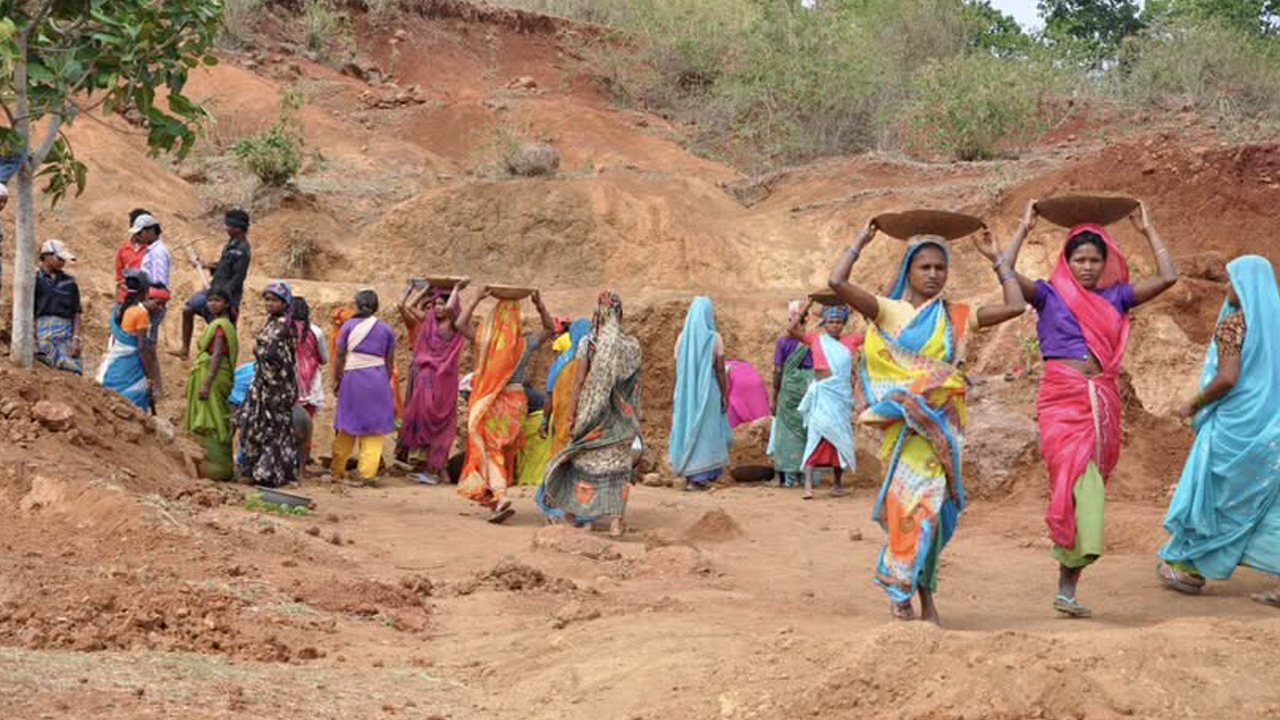
Rural workers and peasants registered under MGNREGS across the country will submit a resolution to the President of India to demand restore and enrich MGNREGA in the Special Gram Sabhas.
Groundxero | December 24, 2025
The Samyukt Kisan Morcha (SKM) has called upon rural workers and peasants registered under MGNREGS across the country to use the “Special Gram Sabhas” scheduled on December 26 to pass and submit resolutions demanding the restoration and strengthening of the Mahatma Gandhi National Rural Employment Guarantee Act (MGNREGA) and the repeal of the Viksit Bharat Guarantee for Rozgar and Aajivika Mission (Gramin) Act (VB-GRAMG).
The appeal follows a December 21 letter issued jointly by Shailesh Kumar Singh, Secretary, Department of Rural Development, and Vivek Bharadwaj, Secretary, Ministry of Panchayati Raj, directing Chief Secretaries of the states to ensure the conduct of special Gram Sabhas in every Gram Panchayat by December 26. The two ministries have instructed states and Union Territories to hold these Gram Sabhas to build public opinion in favour of the new law.
SKM has termed the move a violation of federal norms, accusing the Union government of bypassing state governments and centralising power. The appeal by SKM coincided with a broader call issued by the All India Agricultural Workers Union (AIAWU) and NREGA Sangharsh Morcha urging rural workers across the country to openly reject the VB–G–RAM–G Act in “Special Gram Sabhas” proposed by the Union government.
SKM has circulated a draft resolution to be submitted to President Droupadi Murmu through Gram Sabhas across India. The resolution, issued in the name of the country’s 26.57 crore registered MGNREGA workers, urges the President “to restore and enrich the historical Mahatma Gandhi National Rural Employment Guarantee Act by repealing the VB-GRAMG Act.”
Rejecting the new law, the draft resolution states that the VB-GRAMG Act “negates the statutory right to employment to all rural households demanding work” and reverses the core principle of MGNREGA by dismantling its demand-driven character. Under the new framework, the resolution warns, “funds no longer follow demand; instead, demand is forced to fit within a predetermined budget,” allowing the Union government to arbitrarily decide state-wise allocations and, consequently, the number of days of employment generated.
The resolution also opposes provisions that allow work to be generated only through pre-approved “Viksit Gram Panchayat Plans” and “normative allocations” decided by the Union government, rather than when workers seek employment. This, it says, amounts to a direct denial of the legal guarantee of work under MGNREGA, as “once budgeted funds run out, workers will be denied their statutory right to employment.”
A key concern raised in the draft is the financial restructuring under the VB-GRAMG Act. While MGNREGA mandates 100 percent central funding of wages, the new law requires states to bear 40 percent of total costs. This shift, the resolution warns, will “severely impact states with high poverty and low revenue capacity, leading to fewer work opportunities in regions that need them the most.”
The draft resolution strongly condemns the provision mandating a 60-day suspension of works during peak sowing and harvesting seasons. This, it argues, will push landless workers into private employment at depressed wages, stripping them of MGNREGA’s wage protection. “The forced suspension removes the wage floor that MGNREGA provided year-round and attacks rural workers’ and peasants’ right to bargain for better wages,” the resolution states.
SKM has also criticised the law for centralising authority over local development works. By mandating alignment with a national infrastructure database, the Act, according to the resolution, “limits the flexibility of local body institutions to address unique and immediate local needs,” undermining federalism, a basic feature of the Constitution.
The resolution describes the removal of Mahatma Gandhi’s name from the employment guarantee law as a symbolic and political assault. The resolution calls it “an insult to the great tradition of the people’s struggle for independence” and alleges that it is an attempt to erase the legacy of the historic 2005 law.
Alongside repeal of the new law, the resolution places a charter of demands to “enrich MGNREGA,” including 200 days of guaranteed work, a minimum wage of not less than Rs 700 per day, individual entitlements, timely daily or weekly payments without delays, stronger Gram Sabha oversight, and integration of MGNREGS with agriculture and allied sectors to address agrarian distress, rural indebtedness, distress migration and farmer suicides.
SKM has denounced the Union government’s direct call for Gram Sabhas without consulting state governments as exposing “the degree of centralisation that violates the federal rights of the states and the principles of cooperative federalism.” It accused the NDA government of pushing through sweeping changes to rural employment policy through authoritarian means.
With December 26 shaping up as a nationwide day of resistance at the village level, SKM is betting on the Gram Sabha to push back against what it calls the dismantling of a hard-won right to work. Whether the resolutions passed in thousands of villages will force the Union government to retreat from the VB-G RAM G framework or be brushed aside as symbolic dissent may well determine the future of guaranteed rural employment and federalism in the Modi government’s vision of “Viksit Bharat”.
PDF copy of the Draft Resolution is attached below.
Draft Resolution to demand restore and enrich MGNREGA