
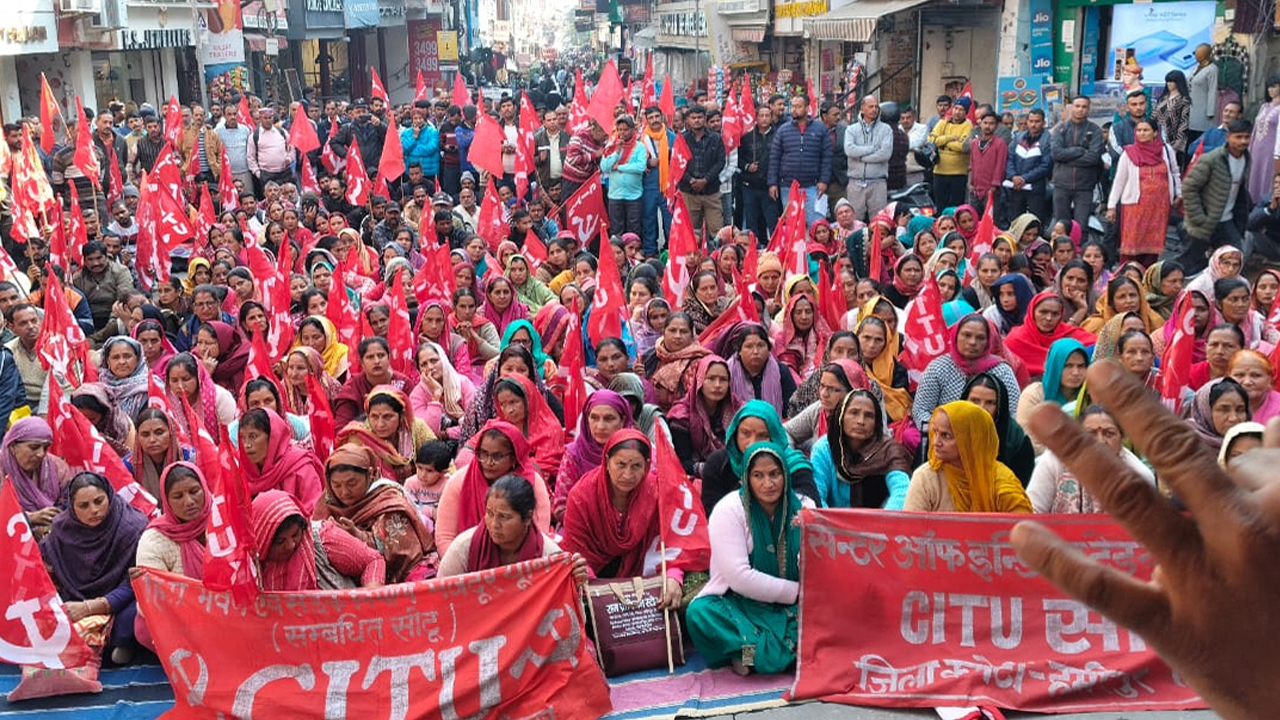
The CTUs warned that if the Modi government proceeds with notifying rules under the codes without repealing them, the February strike could be followed by multi-day general strikes and expanded sectoral actions.
Groundxero | 23 December 2025
India’s central trade unions (CTUs) have called for a nationwide general strike on February 12, 2026, intensifying resistance against the Modi government’s notification labour codes and a series of policy moves they describe as an unprecedented assault on working people’s rights, public resources and national sovereignty.
The decision was taken at a meeting of the Joint Platform of Central Trade Unions (CTUs) and sectoral federations held on December 22. The strike date will be formally ratified at a National Workers’ Convention scheduled for January 9 at HKS Surjeet Bhawan in New Delhi.
In a strongly worded statement issued on Tuesday, the CTUs accused the Narendra Modi-led Union government of carrying out “blatant attacks inside and outside Parliament” through legislative and policy measures that favour corporate and foreign capital while deepening unemployment, precarity and ecological crisis.
Beside the 4 labour codes, at the centre of the worker unions’ opposition is the recently enacted Sustainable Harnessing and Advancement of Nuclear Energy for Transforming India (SHANTI) Act, which opens nuclear power generation to private and foreign players. The trade unions warned that the dilution of supplier liability in the event of nuclear accidents poses grave risks to public safety and undermines India’s nuclear security and sovereignty.
The CTUs also sharply criticised the repeal of the Mahatma Gandhi National Rural Employment Guarantee Act (MG-NREGA) and its replacement with the Viksit Bharat – Guarantee for Rozgar and Ajeevika Mission (Gramin) Act, 2025 (VB-GRAMG Act). The new law, they said, dismantles a rights-based employment guarantee for rural workers at a time of severe joblessness, shifts the financial burden onto states, and bans work during harvesting seasons, effectively ensuring supply of cheap labour for landlords.
Among other recent measures of the government condemned by the unions are the decision to allow 100 per cent foreign direct investment (FDI) in the insurance sector, the introduction of the Viksit Bharat Shiksha Adhishthan Bill, and the circulation of the Draft Seed Bill 2025 and the Draft Electricity (Amendment) Bill, 2025. The government has placed the Viksit Bharat Shiksha Adhishthan Bill, 2025, in both Houses of Parliament, though it could not be passed in this session.
According to the CTUs, these proposed laws threaten farmers’ autonomy, and will seriously undermining food security and seed sovereignty with disastrous impact on agriculture; raise electricity costs for households and MSMEs, and weaken the public power sector.
The trade unions also linked their protest to the unfolding environmental crisis in north India, pointing to hazardous pollution levels in Delhi-NCR and a recent Supreme Court order permitting large-scale destruction of the Aravalli hills. The unions warned that the decimation of the Aravallis would accelerate desertification and deepen ecological instability in the region. The CTUs extended strong solidarity to the people and movements who are fighting against all of these draconian attacks.
The call for the February 12 strike has received unconditional support from the Samyukta Kisan Morcha (SKM). The National Coordination Committee of Electricity Employees and Engineers (NCCOEEE) have announced a parallel sectoral strike on the same day.
Earlier, a joint meeting of the CTUs, NCCOEEE and SKM had resolved to hold nationwide protests against the SHANTI Act on December 23, along with a series of joint conventions of electricity workers and consumers in January and February. The SKM has also announced a “Resistance Day” on January 16 at village and block levels against the Seed Bill, Electricity Amendment Bill, and the VB-GRAMG Act. The CTUs will take part in this action with full strength, said the press statement.
Accusing the Modi government of using state machinery, the media and public sector managements to manufacture consent for the labour codes, the CTUs said workers across sectors were preparing for intensified resistance. They warned that if the government proceeds with notifying rules under the codes without repealing them, the February strike could be followed by multi-day general strikes and expanded sectoral actions.
Calling on opposition parties, students, youth and democratic movements to stand in solidarity, the CTUs framed the impending strike as a broader fight to defend basic rights and the democratic fabric of the country, rather than a sectoral labour dispute.