
The present-day alignment between Hindutva and Zionism is not accidental; it is ideological, strategic, and deeply rooted. It is an alliance built not on philosemitism (love or admiration for Jews), which stands in stark contrast to antisemitism, but on a shared logic of supremacy, securitization, and the demonization of a common enemy: Muslims.
Does antisemitism grow in India? Are protests against genocide in Gaza actually an imported conspiracy of Muslims and the Left? And is the Hindu nationalist, supremacist government now positioning itself as fighting “antisemitism” after discovering Israel as a supposed “civilisational ally”?
These are the charges and claims made in a recently published article in The Times of Israel, “Antisemitism in India: An Unwelcome Import“, which presents itself as an analysis of India’s response to Jews, Zionism, and Israel, and portrays a section of Indians as becoming hostile to Jews. To support the claim, the article argues that social media in India has fertile ground for imported conspiracy and that the infiltration of anti-Jewish rhetoric from abroad is fuelling antisemitism. The piece places the blame for the alleged “antisemitism” in India on Muslims and the Left.
While such a flattened or manufactured narrative appearing in The Times of Israel may not come as a shock, what is far more disturbing is the byline. The article is not written by an Israeli academic or commentator but by Khinvraj Jangid, an Indian scholar who currently serves as Professor and Director of the Centre for Israel Studies at O.P. Jindal Global University, a prominent liberal arts institution in India’s National Capital Region.
Jangid’s piece lacks any empirical basis. His argument exemplifies a dangerous conflation of anti-Zionism with antisemitism and serves a narrative that is politically convenient for both the Israeli state and India’s Hindu nationalist government. This provenance reveals the article not as analysis, but as advocacy for a deliberate political project: to criminalise solidarity with Palestine and sanctify the Indian government’s deepening alliance with the Israeli state.
Jangid asks if India is “beginning to absorb forms of antisemitism”, yet he cannot cite a single incident of anti-Jewish violence or harassment in India related to the Gaza protests. In a country where hate crimes are documented, this absence is deafening. His evidence rests instead on a conflation: that criticism of Israel’s state ideology and military conduct is inherently anti-Jewish. This false equivalence is the article’s foundational flaw.
To manufacture a historical basis, he draws a laughable connection between India’s traditional Jewish communities and the modern political project of Zionism. He argues that because Jewish communities have lived in India for centuries, across multiple cities, this establishes a historical relationship between India and the Israeli state. This framing deliberately ignores historical facts and rests on fundamental falsehoods.
In reality, India’s diplomatic history reflects a principled, anti-colonial stance distinguishing between Judaism and political Zionism. The country even in the British colonial period did not endorse Zionism, despite the British mandate for the creation of a Jewish homeland in Palestine. Before Independence, in February 1947, India was part of the 11-member UN Special Committee on Palestine to discuss the question of Palestine and insisted that there should not be a partition, whereas others, especially the Soviet Union and the United States, supported the idea of a partition that resulted in the expulsion of Palestinians, followed by ethnic cleansing in Palestine by Israel.
But still, India recognised Israel—not on a full scale, but yes, recognised it—and some reasons were there. Domestic pressure was also at the surface when the newly independent country’s most important opposition party of that time, the Communist Party of India, followed the Soviet Union line in support of Israel, and that was why it had no problem with the Nehru-led Indian government’s recognition either.
In fact, it was only much later, after India recognised the Palestine Liberation Organisation (PLO) as the sole legitimate representative of the Palestinian people in 1974 and formally recognised the State of Palestine in 1988—that India extended diplomatic relations with Israel in 1992.
This historical trajectory shows India’s engagement with Israel was neither ideological nor unconditional. Rather, India’s position was shaped by its own anti-colonial experience, with both India and Palestine emerging from British rule—a shared history that forged a more organic solidarity rooted in opposition to colonial occupation. And across these decades, India’s position fell in neither antisemitism nor the support of Zionism.
No one has ever described Mahatma Gandhi as an anti-Semite when he stated in 1938 that “Palestine belongs to the Arabs, just as France belongs to the French and England to the English.” In 1947, India voted against the creation of the Israeli state—a position that in no way made India antisemitic. When Israel sought admission to the United Nations in May 1949, India voted against it. Even decades later, despite formally recognising Israel in 1950, India supported the United Nations General Assembly resolution in 1975 that equated Zionism, Israel’s state ideology, with racism. That position, too, did not make India antisemitic by any standard.
Even Albert Einstein wrote to Nehru for the support of the creation of a Zionist state, but the request failed. At that time, Indian political leaders, especially Gandhi and Nehru, were empathetic to the persecution of Jews in Germany and simultaneously recognised the rights of Arabs to inhabit their lands. 1948 when the Foreign Minister of Israel wrote to Nehru requesting to acknowledge Israel. Nehru proposed to take no action addressing chief ministers. Nehru had a belief that the conflict between Arabs and Jews was not a religious one but an “Arab national struggle for independence against British treachery”.
It is worth asking who actually drew inspiration from the Nazis’ persecution of Jews. The very Hindu nationalist project and the carriers of Hindutva, whom Jangid now portrays as “fighting antisemitism”, once had ideologues and organisations that regarded Nazi Germany’s treatment of Jews as a model and source of inspiration.
Ironically, a dramatic shift has occurred in recent decades, a shift has taken place with the rise of the Sangh Parivar and the BJP. Particularly under the Hindu supremacist government led by Narendra Modi, India has moved closer to Benjamin Netanyahu–led Israel, defying its longstanding stand on the Palestinian cause. This shift is largely framed as India’s strategic relationship with Israel.
The article’s most profound irony is its portrayal of Hindu nationalists as warriors against antisemitism. Jangid argues they see Israel as a “civilisational ally”. History, however, complicates this narrative. Early Hindu nationalist ideologues were explicitly antisemitic and openly admired Nazi Germany. The Rashtriya Swayamsevak Sangh (RSS), founded in 1925, was influenced by European fascist movements. The Hindu Mahasabha, established in 1915, went further—publicly endorsing Nazism and praising what it described as “Germany’s crusade against the enemies of Aryan culture”. They saw the persecution of Jews as a model for marginalising India’s Muslim population.
Seen in this historical light, the present-day alignment between Hindutva and Zionism is not accidental; it is ideological, strategic, and deeply rooted. It was only later—when Israeli settler violence against Palestinians became visible—that these groups found in Israel a model worth emulating, reframing occupation and apartheid as civilisational allyship. It is an alliance built not on philosemitism (love or admiration for Jews), which stands in stark contrast to antisemitism, but on a shared logic of supremacy, securitization, and the demonization of a common enemy: Muslims.
Academic spaces and scholars are expected to remain unbiased, but this does not seem to be the case when it comes to Israel. Globally, Israeli educational institutions have faced repeated criticism for their deep entanglement with Zionism, the ideology of the Israeli state, and military interests. Some universities have even broken collaborations over these concerns. Ben-Gurion University is one such example, where Jangid has been associated as a researcher and fellow.
No wonder Jangid, who has published with many progressive or largely unbiased platforms, found space for this particular article in The Times of Israel, a publication with a pronounced Zionist orientation that has itself faced criticism for publishing genocide rhetoric. Interestingly, he has never published on this platform before. Unlike The Times of Israel, he has appeared in Haaretz, which is relatively more influential in shaping public discourse. Yet, he did not choose Haaretz, or Haaretz did not give space to raise concerns about what he manufactured as “rising antisemitism in India”.
Against this backdrop, it is surprising that his arguments in the article align closely with Zionist and Israeli state perspectives, portraying apartheid violence as the actions of a historically persecuted community now engaged in a struggle against “Islamist extremism” and framing the occupation of Palestinian land as a justified, moral stance.
The piece came from an Indian scholar at a time when even the International Criminal Court (ICC) issued arrest warrants for Israeli Prime Minister Benjamin Netanyahu and a former defence minister for war crimes. UN Special Rapporteur Francesca Albanese has repeatedly described the situation in Gaza as a crime against humanity by Israel, inflicting unquantifiable human, material, and environmental costs. In her report “Gaza Genocide: A Collective Crime”, Albanese warns that the risks are causing irreparable prejudice to the very existence of the Palestinian people in their homeland.
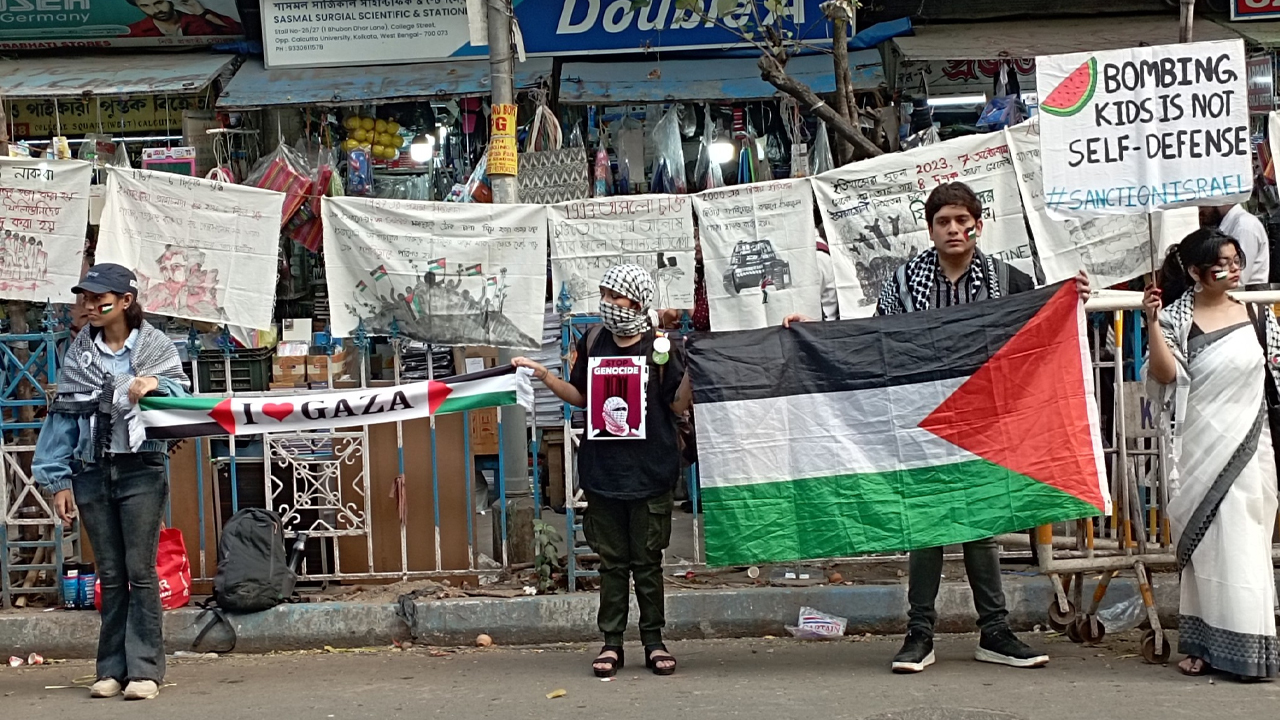
Over the last two years of Israel’s genocide and destruction in Gaza, Jangid’s claim of rising antisemitism in India collapses against actual events. Not a single attack on Jewish or Israeli individuals has been reported in this period. What has been documented is the systematic suppression of pro-Palestine protests—largely organised by Muslims and left-leaning groups—by Indian authorities. In the first year alone of protests against Israel’s war on Gaza, at least 17 cases were filed against 51 protesters across seven states, including Left-ruled Kerala. Many were booked under serious charges, including the draconian anti-terror law UAPA. In September 2025 alone, Kerala Police registered a case against 30 activists of the Girls Islamic Organisation for organising a pro-Palestine demonstration and public meeting.
Far from evidence of antisemitism, the record shows something else entirely. Over the same period, there have been multiple incidents in which Hindutva groups attacked pro-Palestinian demonstrators and raised openly anti-Muslim slogans. Support for Israel and Zionism among Hindu nationalists is rooted less in solidarity with Jewish communities and more in a shared hostility towards Muslims and the systematic delegitimisation of their citizenship. In this sense, Hindutva and Zionism operate as ideological cousins in the project of demonising Muslims.
Ultimately, in the time we are witnessing, the real threat in India is the active suppression of dissent and the consolidation of an exclusionary politics that finds a mirror in the Israeli state. The myth of growing antisemitism is not an analysis of reality, but a political tool to legitimise this very convergence.
Rizwan Rahman is a Delhi-based independent journalist, researcher, and documentary filmmaker. His work focuses on Indigenous communities, human rights, and climate change.
Feature Image: On the occasion of International Day of Solidarity with the Palestinian People, activists in College Street, Kolkata, formed a human chain demanding an end to Israeli genocide of Palestinians in Gaza.
This report has been republished from Middle East Monitor. Read the original article here.