
The memorandum concludes with an explicit warning: “If the Government continues to ignore and neglect the burning demands, the masses belonging to farmers and workers have no option other to launch “massive, peaceful, protracted struggles” similar to the 2020–21 agitation.
Groundxero | NOV 25, 2025
On the eve of the fifth anniversary of the historic farmers’ siege of Delhi’s borders in 2020, the Samyukt Kisan Morcha (SKM), today, released a memorandum to be submitted to President Droupadi Murmu, sharply accusing the Narendra Modi government of “betraying” it’s written commitment to farmers, and deepening policies that “ruin agricultural self-reliance and food security”.
The memorandum, released to the media on November 25, says, for the last five years, “the farmers of India have waited patiently… unfortunately, instead of fulfilling the assurance given to SKM on 9 December 2021; the Government has instituted measures that further ruined the economical sustenance of farmers.”
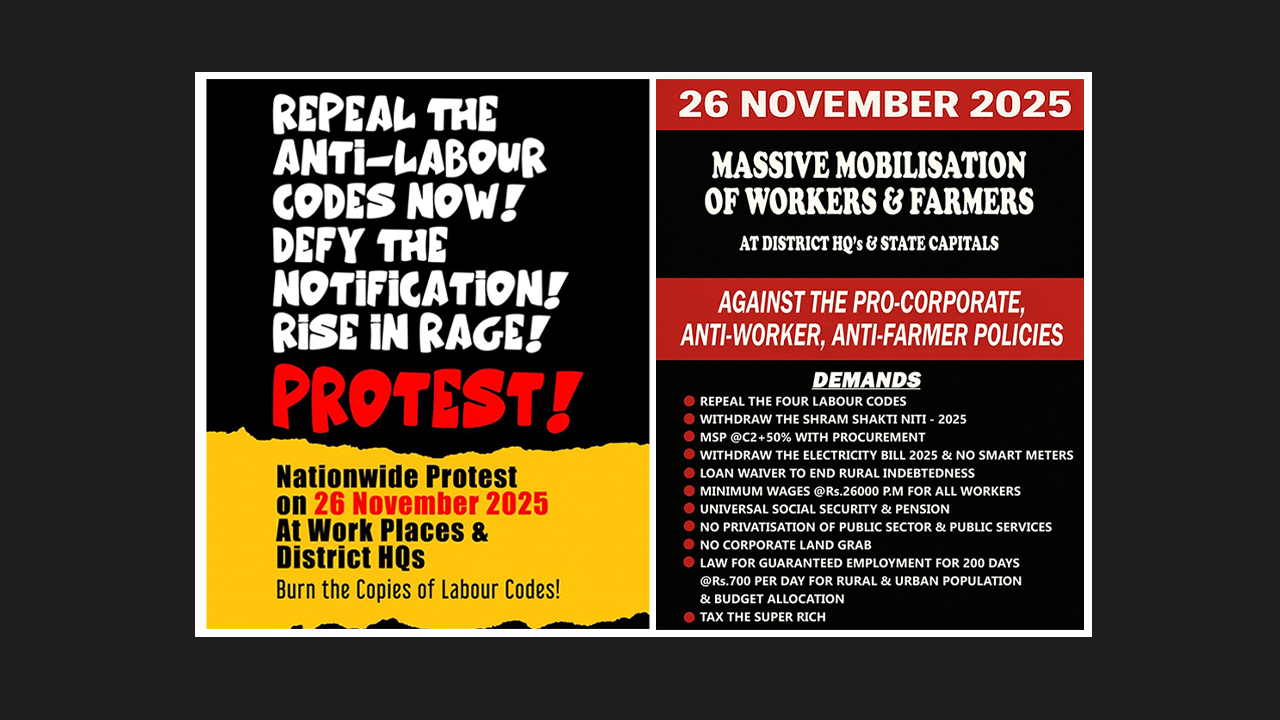
The memorandum marks a sharp escalation in tensions between the farmers’ unions and the Modi government, which has, in recent months, notified the four labour codes, pushed ahead with the Electricity Bill 2025 and the Seeds Bill 2025, and removed import duties on cotton—all measures the SKM says “undermine farmers, workers, and state governments.”
With state and district-level protests scheduled for November 26, the SKM’s tone signals a renewed phase of confrontation between farmers’ unions and the Union government.
“Five lakh distress suicides… cost of living tripled”
In the memorandum addressed to the President, SKM warns the agrarian crisis has entered a phase of “pauperisation and dispossession” causing acute distress in rural India. “The last eleven years have witnessed… more than five lakh distress suicides by peasants, agricultural workers, daily wage workers and unemployed youth,” the memorandum notes.
It adds: “The Prime Minister’s promise in 2017 to double farmers’ incomes by 2022 has proved a damp squib; rather the cost of production has doubled while the cost of living has tripled.”
Instead of providing relief to the distressed farmers, the memorandum alleges, the Narendra Modi government has cut fertiliser subsidies by Rs 84,000 crore in three years, allowing black marketing of DAP and urea to flourish. The MGNREGA scheme, it says, is hollowed out—providing only 42 days of work on average against the mandated 100 days annually.
The SKM has also accused the Union government of favouring corporate, pointing out that while corporate entities saw loan waivers worth Rs 16.41 lakh crore in the last decade, “not a single rupee” of farm debt has been written off.
SKM places the responsibility not merely on policy shortcomings but on the broader economic vision of the last decade, making the memorandum an implicit indictment of the Modi government’s record in rural India.
MSP as the flashpoint
The legal guarantee for MSP—central to the 2020–21 farmers’ movement—remains the core of the current standoff. SKM calls the Union government’s refusal to enact a legal guarantee for MSP@C2+50% as the core betrayal of the 2021 settlement that had ended the 380-day farmers’ movement.
SKM writes: “During the last 11 years, the Hon. Prime Minister did not implement MSP@C2+50% with guaranteed procurement for all crops, as promised in the BJP manifesto in 2014.”
To underline the gap between promises and outcomes, the memorandum highlights the disparity in paddy prices:
- MSP for 2025–26: Rs 2,369 per quintal
- Actual distress prices: Rs 1,800/q in Uttar Pradesh, Rs 1,400/q in Bihar, and around Rs 2,100/q in Haryana.
SKM says the Union government’s declared MSP of Rs 2,369 per quintal for paddy in 2025–26 has “no meaning” when farmers are forced to sell paddy below the MSP. “This,” the memorandum states, “is nothing but a plunder of paddy farmers.”
In a pointed comparison, SKM cites Kerala, Chhattisgarh and Odisha—three states procuring paddy at or above the Swaminathan-formula rate of Rs 3,012 per quintal—to argue that “political will, not technical impossibility” determines whether MSP works.
“The plunder of paddy farmers must end,” the memorandum says, urging the President to direct the Union government to enact a law guaranteeing MSP with assured procurement.
Beyond farming: an attack on the “entire working people”
The political significance of the memorandum lies in its widening of the farmers’ platform into an agrarian-labour coalition. In a departure from the earlier narrow agricultural focus, the SKM has placed the government’s broader policy agenda at the centre of its critique.
It calls the newly notified Labour Codes “an assault on the constitutional rights of workers”, legalising a 12-hour workday and curtailing the right to unionise and strike. “The four Labour Codes… have legalised fixed-term employment, 12-hour work day and denial of the right to union and to strike,” the memorandum states.
“Above all,” the SKM wrote, “the Government has unleashed a flood of attacks on the working people,” listing the Electricity Bill 2025, Seeds Bill 2025, National Cooperation Policy, National Policy Framework on Agricultural Marketing, removal of cotton import duties, and the recently notified Labour Codes.
Significantly, SKM’s 10-point charter foregrounds federalism, demanding that states’ share in the divisible pool be raised from 31% to 60% and that the GST framework be amended to restore states’ taxing powers. It argue that without financial autonomy, states cannot protect MSP, minimum wages, public procurement or agricultural investment. “Strong States for Strong India,” the letter emphasises—a slogan that, in the current political climate, serves as a sharp critique of the Centre’s centralising tendencies.
By aligning farmers’ demands with workers’ rights and federal autonomy, SKM is trying to construct a broader platform of peasants and workers that challenges the government’s policy architecture itself—not just specific agricultural laws.
“This is no longer only a farmers’ issue,” an SKM leader said at the press briefing. “The Centre’s economic model weakens states, weakens workers, and weakens farmers. It is a structural crisis.”
List of Demands Submitted
SKM submitted concrete demands and appealed the President to direct the Government to hold discussions and take immediate actions on them. The demands are:
- Immediately enact laws to realize MSP@C2+50% for all crops with guaranteed procurement in the Parliament as well as in all state assemblies. Arrange Govt. Mandis / markets in all blocks. In view of the unseasonal rains and flooding fields, enhance the moisture level to 22 % from the current 17. The State Administered Price of sugarcane should be made Rs 500 per quintal and immediately clear all arrears of payment with interest.
- Declare a comprehensive loan waiver scheme for farmers and agricultural workers. Enact a law to control Micro Finance Institutions extort high interests from poor peasants, destitute landless labour families and ensure legal action against harassment of borrowers and provide interest free credit to peasants.
- Immediately withdraw the Electricity Bill 2025. No privatization of Electricity. No installation of Smart Meters. Provide free power to agriculture, 300 units of free electricity per month to all households.
- Immediately repeal the 4 labour codes notified recently. End privatisation of Public Sector Units; provide secured permanent employment in the organised sector and Rs. 26000 per month as minimum wage, Rs 10000 as monthly old age pension and social security to all workers in the unorganised sector including agricultural workers.
- Enhance MGNREGS budget to ensure 200 Days of work, Rs.700 as wage.
- Consider Imposition of 50% US Tariff on India as an attack on the sovereignty of the country and take strict reciprocal action upholding the dignity of the Indian Republic. No FTAs that hurt the interests of farmers and workers including in cotton, dairy and food grain sectors. Cancel the notification that scrapped the 11% import tariff on cotton. Protect PDS and FCI to ensure procurement of agro produces and distribution of free and subsidized food. Reject Indo-UK FTA, CETA.
- Restore Rs. 84000 crore fertilizer subsidy, ensure adequate supply of DAP and Urea fertilizers and end black marketing. End imposing Nano Urea and Nano DAP on farmers.
- Declare all severe floods and landslides as National disasters. Declare Judicial inquiry by a sitting judge of Supreme Court on the causes of flood situation and the impact of the corporate seizure of natural resources in the sensitive Himalaya regions without environment impact study. Provide compensation of Rs 1 lakh Crore to all calamity affected states and Rs.25000 crore for Punjab. Compensate tenant farmers and agricultural workers. Scrap the failed Prime Minister Fasal Bhima Yojana (PMFBY) and establish an Insurance Scheme for crops and livestock in the Public Sector.
- End the Bulldozer Raj on people. No displacement of landless and poor without rehabilitation and resettlement. No forced, indiscriminate land acquisition. Strict implementation of the LARR 2013 and compensates all the victim land holders.
- Safeguard the federal rights of states. “Strong States for Strong India”. Increase state share in the divisive pool (including cess and surcharge) from the current 31% to 60%. Amend the GST Act to reinstate the taxation power of states. Realize MSP and minimum wage by protecting financial autonomy of the states, augmenting public investment for modernisation and co-operativisation of agriculture, build agro-industries and share the surplus out of processing, value addition and marketing on all crops with the farmers and agricultural workers thus, end agrarian crisis, peasant suicides and distress migration. Repeal all neo-liberal policy reforms that trespass on powers of states such as Electricity Bill 2025, Seeds Bill 2025, National Cooperation Policy (NCP), New Education Policy (NEP), National Policy Framework on Agriculture marketing (NPFAM) and Labour Codes.
Nationwide demonstrations on November 26
The SKM along with the Joint Platforms of Central Trade Unions and Sectoral Federations as well as other unions of workers and agricultural workers has called for peaceful mass demonstrations at state and district headquarters on November 26 2025. SKM has called for burning copies of Codes and demands leadership of BJP, RSS, and BMS to explain whether they are with the corporates or the people. The memorandum to the President will be submitted by representatives of SKM’s state and district coordination committees, who will also append local demands as annexures.
The memorandum concludes with an explicit warning: “If the Government continues to ignore and neglect the burning demands, the masses belonging to farmers and workers have no option other to launch “massive, peaceful, protracted struggles” similar to the 2020–21 agitation.