
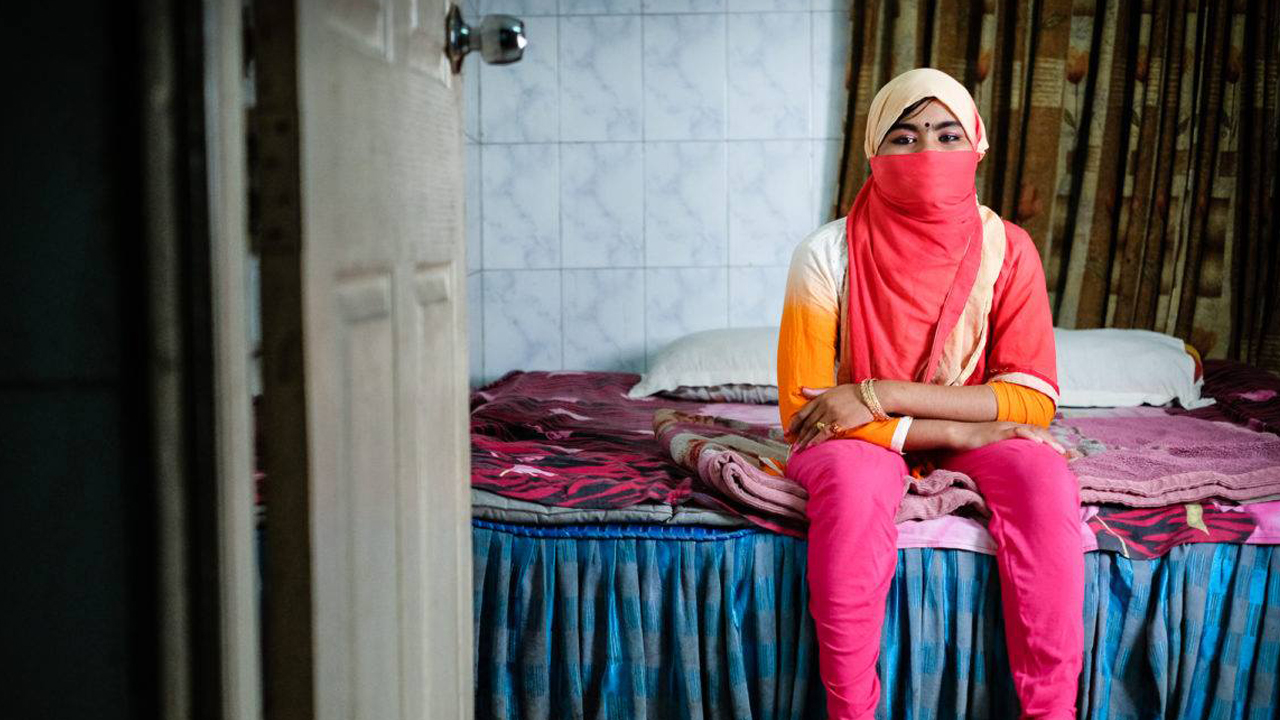
In part V & VI of this reportage, Subha Protim Roy Chowdhury shares his experience while visiting communal violence affected areas in Bhatpara in North 24-Pargana district of West Bengal, and the exploitative conditions of women in the Rohingya refugee camps in Cox Bazar in Bangladesh.
By Subha Protim Roy Chowdhury
Groundxero | Oct 26, 2025
V
It cannot be denied that communal emotions do exist. But, co-habitation for years, also often leads to a reality of diminished differences.
Tina Godown in Bhatpara is in North 24-Pargana district of West Bengal. The labour-line of the local jute mill consists of rows of houses. Each family has been allocated a room and a small verandah. The families keep growing, but the houses don’t. So everything, from the khatiya (bed) to the cooking stove, spills out into the common passage, alleys or the open space in between the two rows of houses. In the common space, there also exists a Hanuman temple and a mazar (shrine) of Satyapir. Children grow up into young men amidst these temples, mazars, common passages and khatiyas. Radha grew up playing in the lap of Maher dadi, Mustak drank the milk that came from Vijay Yadav’s cow. There is a common open bath, where both Hindus and Muslims take showers.
But even then, communal riots take place. Not one or two, but 12 people were killed in riots before the 2018 Lok Sabha elections. Riots, in the sub-continent, are the extreme manifestation of communalism. Is it true then that the ashes of communal hatred remain buried in our society, and then it comes out and flares up during riots? Otherwise, where does so much violence come from? For how long will we keep on blaming the ‘outsiders’ for coming and creating riots? These questions are not mine but they came from women in Bhatpara, who said, “The men of our families stay outside for a long time. We have to stay at home, in the neighborhood. My daughter, my son, have literally grown up in the house next door. How have they become our enemies today?”
These women didn’t only ask such questions, but have found their own answers too. The women riot-survivors of Bhatpara have started a common initiative. They have formed a self-help group, a cooperative, and a training centre for learning sewing – all these initiatives are being run simultaneously. Rani from Muzaffarnagar told us how a new village has been built on land they got for post-riot rehabilitation. Maleka from the Afghan refugee camp has also found refuge, to quote Tagore, on the ‘shore of this ocean of great humanity’.
But when the state itself becomes communal, the plight of the citizens often attains a more intense dimension. The passing of the Citizenship (Amendment) Act (CAA) was a naked display of the communal mindset of the current union government. The legislation contradicted the core principle of secularism enshrined in our constitution. The Shaheen Bagh protest becomes important in this context. Women, especially from the Muslim community, were in the forefront of this movement, opposing selective granting of citizenship on the basis of religion. There was a poster in the Shaheen Bagh protest area which said – I am the valour of Bhagat Singh, Ashfaq’s vow, Bismil’s song; O the ruler of the people, if you have the courage, look at my eyes, I am Shaheen Bagh!
With the idea of “on the shores of the ocean of great humanity” as its core principle, the movement of Shaheen Bagh became so popular that it soon spread across the entire country, and even outside. In Gramscian terms, it can be said that during these times of extreme despair, all kinds of “subalterns” came together in this movement determined to resist the dominance of the hegemonic order, to eventually overthrow it.
Shaheen Bagh became a pilgrimage site for those interested in the nation’s history of women’s political participation in social movements. The protesting women there created a space against religious oppression, patriarchy, casteism, and state sponsored communalism. From this resistance to the recent ‘Rat Dakhol’ (Occupy the Night) movement by women in West Bengal, the map of women’s resistance in this country has expanded considerably. These movements, often occurring independent of political parties, have remarkably strengthened women’s political agency.
Before concluding, we would like to enter upon a discussion of the place women are accorded in the worldview of the Hindutva fundamentalists. In the immediate aftermath of the Ram Navami violence (2023) in Howrah, we spoke to the local leadership of Durga Bahini, the women’s wing of the Vishwa Hindu Parishad. A photograph of Sadhvi Ritambhara, founder-chairperson of Durga Bahini, was hanging on the wall of their Howrah office. Most of us are aware of the leading role played by three women who led the movement to demolish the Babri Masjid and the eventual construction of the Ram Mandir in the same space. Uma Bharati, Vijaya Raje Scindia, and Sadhvi Ritambhara were the icons who had often popularized Hindu nationalism among women. We remember how Uma Bharti had celebrated after the demolition of the Babri Masjid. Political scientist Amrita Basu had written, referring to these three women, how a certain paradigm of masculine violence had become an inextricable part of the women’s movement. The three women became symbols of sacrifice and violence, and soon their following amongst women grew rapidly.8
Interestingly, although the women did get a call for doing peripheral works during the inauguration of the Ram Temple in Ayodhya, the local leaders of the Durga Bahini were not invited on 22 January, the ‘Pran Pratishtha Diwas’ or the consecration day. ‘No one invited us and it’s humiliating. In the 90s, women were at the forefront of the movement to build the Ram Temple. We were arrested. We opened our homes to the Kar Sevaks. And today, we are forgotten,” said Vartika Basu, president of Durga Bahini, Ayodhya.9 Whether it is the inauguration of the new Parliament building or the consecration of the Ram Lalla temple at Ayodhya, the way the President of the country was been excluded from all of these events, precisely because she is an adivasi woman, reveals the mindset of the Hindu nationalists.
In this ever-expanding map of violence, women are, at some places, victims of rape. At others, they witness the killing of their near and dear ones. She is humiliated, both outside and within her home by men. But in many places they are also in the forefront of resistance. The same spirit that leads a woman to be anxious for the youth of a different religion held hostage by her community in Asansol, allows her to look critically into the tides of communalism sweeping by in Basirhat. Yet, wherever we talked with women, be it during fact-finding missions or while collecting victim-survivor testimonies, I don’t know why, but it always seemed, they have been far more successful in retaining their human values, in preserving whatever good sums us up as the human race.
VI
Relief camps are often unsafe for women. In a relief camp, even the minimum level of privacy can be a luxury. There have been repeated incidents of women being sexually assaulted in relief camps. However, the most alarming stories have come from the Rohingya refugee camps in Cox Bazar, Bangladesh. There is a report by the renowned journalist Taniya Rashid, which reveals how in those refugee camps, teenage girls are forced to become sex workers. The report is based on the testimony of a woman working as a sex worker in one such relief camp. I had the opportunity to translate this report, which was published in ‘Manabadhikar Patrika’ in 2018. My time in Bangladesh gave me the opportunity to witness firsthand the conditions in these refugee camps. Below is a brief account of that experience –
It was mid-night in Cox Bazar, the beach town that had been facing economic recession for a long time. Only recently has it seen a little bit of good time. Officials from International Aid Agencies frequently visit the city to inspect the Rohingya camps set up on the town’s periphery. Around seven lakh (700,000) Rohingyas had entered Bangladesh in 2017 after fleeing Myanmar.
But despite the support of aid organisations, the number of Rohingya women entering into sex work has increased along with increasing rates of black marketeering. Inside the refugee camps, during the night, the men from outside are seen moving around freely – none of them are stopped by the security or volunteers from aid agencies.
The leader of Kutupalang camp took me to several brothels, where the vulnerable women from the camps have been made to engage in sex trade. I saw young women smoking cigarettes, standing in front of small cubicles, and the pimps moving around laden in gold jewelry. It was unbelievable to see women from conservative Muslim Rohingya families thus.
We went to a brothel run by a Rohingya woman. She had married a Bangladeshi man. The cubicle was made of bamboo, and was covered with plastic sheets on top. Four girls worked for her each day. They had both Bangladeshi and Rohingya customers. I talked with a girl named Sumaiya (name changed).
She told me that she entered this profession out of frustration, after her abusive husband left her. She said, she had done sex work to survive. ‘The quantity of food given in our camp is not enough. So what do I do when my children cry for food? Where will I get the food that they need?,’ she said and began to cry. ‘I came to this profession to save my children. I know this is a sin, but tell me what else could I have done?’ Sumaiya earned 200 to 600 taka per day if she got at least two clients. Her customers were mostly Rohingya men, but she had Bangladeshi clients too.
While walking through the lanes in that area, I noticed a sign with the word ‘mother’ inscribed in it. Apparently, this was to show reverence to a particular woman pimp in Bangladesh. The woman in question was bedecked in gold; she was holding two phones in her hands. The small cubicles overflowed with customers, the girls were mostly very young. I saw an old man too. I couldn’t talk to the girl. But the fear and pain in their eyes were quite obvious. The pimp accompanying me said most of the girls are Rohingya refugees.
My local contact had arranged a meeting with a Rohingya sex-worker. For obvious reasons, I won’t divulge her name. Let’s call her Hasina. She lived in a hotel run by a Bangladeshi pimp. When we met, it was around ten at night; most of the girls were in the rooms with the tourists.
The room was on the second floor. When I came in, Hasina was looking anxious. She was wearing a Salwar-kameez, her face was painted in bright makeup. She thought I was a customer. I told her, I wanted to hear her story, if she is willing to talk.
Our conversation began. We sat on the bed, each taking a corner. The smell of the room was overwhelming. Mostly, it stank of the odour of the human body. A dry patch of red colour was smeared on the wall. Was it blood? I wanted to throw up.
Hasina showed me her money bag; she keeps a make-up kit and lubricant inside. She keeps a wooden stick to tackle drunken customers. It was normal for them to beat a Rohingya girl. A few days back, one girl was even beaten to death.
She said, “That pimp used to give me steroids daily so that I could develop a muscular body. I used to take painkillers to become numb.”
I asked her, “How did you come here? Hasina told me her story.
“They tied me down and started beating me. There was a girl right next to me; they kicked her on her belly and over her vaginal area. Then they cut her breasts and put them in a plastic bag. I screamed out in fear, and one Burmese soldier bit my cheeks. Then they gang raped me. After three days, I regained consciousness. I was lying beside a river. I didn’t look anywhere; I jumped into the river, and after swimming across, I reached Bangladesh.”
“Here, another painful episode began. I met my family in the refugee camp, but there was also total chaos. It was impossible to get food for the family. I joined a drug racket. I used to sell drugs to Rohingyas and Bangladeshis. I was caught and put into jail for a few months. I came back to the camp from prison, but again, a life of uncertainty began.”
“An acquaintance told me that I don’t have to stay in the camp. She asked me, if I would be willing to work in a garment factory? I felt this woman was a trafficker, I didn’t believe her words, but I had no other option. A car came to take me. I left the camp, the car drove past the roads of Cox Bazar. The Bangladeshi Army stopped somewhere in the middle, but the trafficker bribed them. The car moved on. I was brought to a brothel.”
“Now I work seven days a week. I get about one dollar per client. A part of it goes to pay that pimp woman her commission. I was gang raped by the military in Myanmar. The only difference is here I get paid for it. Even today, five people came together. They raped me like the army did. The pimp wants to earn more, so she said nothing. They tied my hands, and parted my legs forcefully from both sides.”
Hasina cried out, “Oh Allah, to which Muslim country have you brought me? The army men in Myanmar were Buddhist, from a different religion. But the ones here are Muslims, but they are no different. I will die, you see”
Hasina was not the only girl at this place. Most of them had entered Bangladesh illegally. Consequently, the police, the pimps and the customers – everyone – took advantage of their peculiar kind of vulnerability. A male pimp had said – ‘It is easy to dupe these young Rohingya girls. When they came here, they knew nothing about this country and the local language.
They were very innocent and scared. I have told many of them, as you have nobody here, I will marry you. They believed in what I had said. I slept with many of them, I took their virginity. Then I shared them with the clients.’
This pimp, who wanted to remain anonymous, told me, ‘most of the clients are Bangladeshis. Sometimes foreigners also come. We don’t talk directly with the Western white people. They stay in big hotels and ask for girls for two or three days. The hotel manager calls us, we send them photographs of the girls; we have to pay a commission to the hotel manager too.’
I couldn’t forget the horrible reality I had witnessed at Cox Bazaar. Even after coming back, I kept thinking about it for days on end. The words of Hasina still echo in my ears, “I will die, you see; a normal life with a husband and children is not for me; I know that I will never have a happy life; every night some random stranger ‘kills’ me anyway. This is how I will die.”
Does writing about conflict-zones change anything? For years, I have visited such places, have written about them. But nothing has changed the realities of the victims and the survivors. What I have written brings me fame and publicity. Each and everything I write about them, makes me more aware of my selfishness. Thus, I, too, will end here. I am finding it difficult to write any further. Pardon me. That helpless looking old man in the Kokrajhor relief camp, who, abandoned by his family, is still yearning to go back. There is no peace or joy in the life of Hasina or Tamanna. Maleka will never get Indian citizenship. I have seen a pervasive absence of love and empathy everywhere. And within such a context, I had to accept my own failure and incompetence.
Many things have remained unsaid. These incidents stir up deeply personal and emotional feelings in me. Dear editors, I haven’t presented any theoretical analysis of the incidents and the circumstances. I couldn’t. Perhaps, this is the kind of work that doesn’t end in the course of one’s life-time. I beg for your forgiveness. Again. In the words of Lalan Fakir–
“After falling in deep troubles, oh merciful! I chant your name again and again. Pardon my sin, pardon, pardon.”10
Reference
8 Women and Right-wing movements: Indian Experiences, Tanika Sarkar and Urvashi Batulia, 1995
9 Where are the women in Pran Pratishtha? Durga Vahini says they are side-lined, The Print, 10 January, 2024
10 The song by Lalan Fakir has been translated by Dipankar Choudhury
________________
Subha Pratim Roy Chaudhury is a researcher and writer, concerned primarily with conflict and peace studies.
(The article has been translated from Bengali by Subho Maitro.)
Read the earlier parts here and here.