
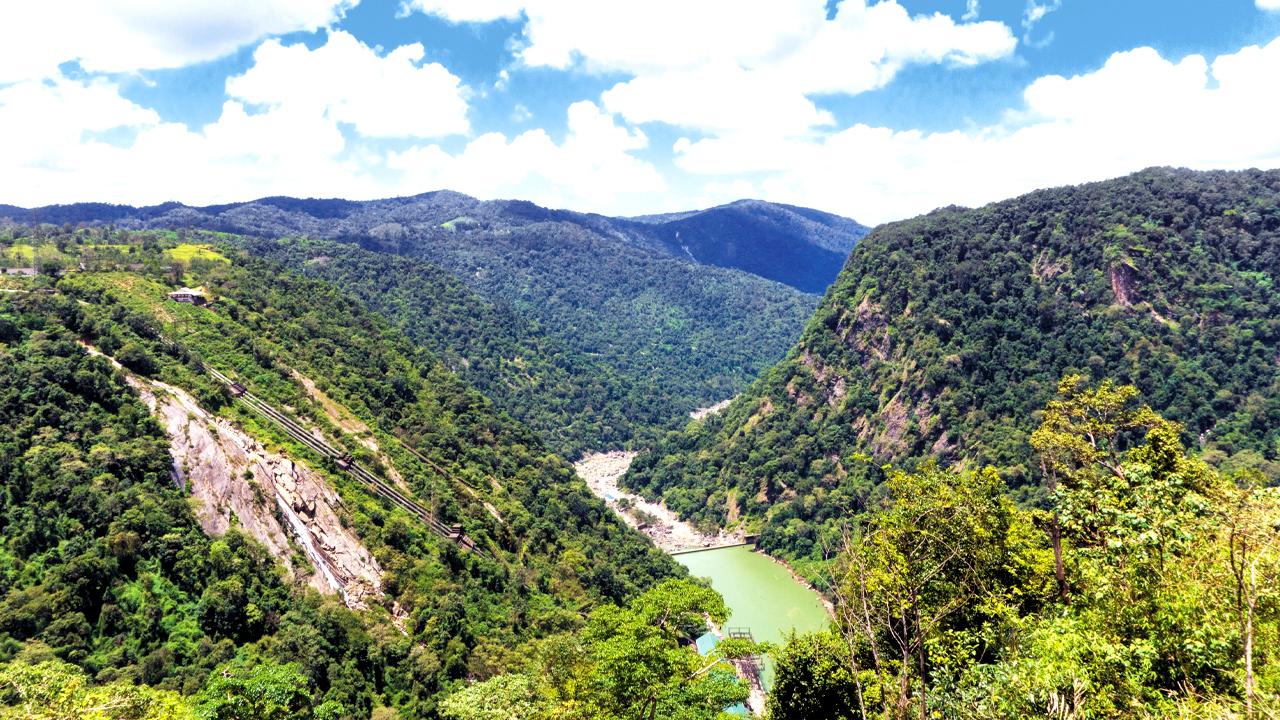
Environmentalists warn of irreversible damage to Western Ghats and Lion-Tailed Macaque habitat; urge Union and Karnataka governments to scrap the project.
Groundxero | October 24, 2025
A coalition of environmental groups, scientists, and local communities has sounded a stark warning over Karnataka’s proposed 2000 MW Sharavathy Pumped Storage Project (PSP), calling it an ecological and social catastrophe waiting to happen.
In an urgent appeal sent to the Union Ministry of Environment, Forest and Climate Change (MoEF&CC) and Karnataka Chief Minister Siddaramaiah, the National Alliance for Climate and Ecological Justice (NACEJ) — a coalition of ecologists, activists, and climate researchers affiliated with the National Alliance of People’s Movements (NAPM) — urged both governments to refuse clearance and cancel the project, citing grave threats to biodiversity, forests, and local livelihoods in the Sharavathy river basin of the Western Ghats.
The Alliance warns that the project, proposed by the Karnataka Power Corporation Limited (KPCL), would devastate the Sharavathy river valley — one of the most ecologically fragile and biodiverse landscapes in India.
The Sharavathy valley, part of the Western Ghats UNESCO World Heritage Site, harbours dense evergreen forests and a wealth of endemic life forms — including the endangered Lion-Tailed Macaque (LTM), found nowhere else in the world.
The proposed project site lies within the Sharavathy Valley Lion-Tailed Macaque Wildlife Sanctuary, and according to NACEJ, its construction would involve tunnelling, blasting, and felling of over 15,000 trees — actions that could irreversibly fragment the macaques’ habitat.
“The Sharavathy Valley sanctuary supports the largest remaining population of Lion-Tailed Macaques. Disturbing it further could push the species to the brink of extinction,” the Alliance cautioned in its letter.
Environmental scientists note that the Western Ghats are not only a biodiversity hotspot but also a critical carbon sink and watershed that sustains peninsular India’s rivers. “To damage this ecosystem in the name of storing energy is ecologically unsound and strategically short-sighted,” said a Bengaluru-based conservation biologist involved in the campaign.
“The Sharavathy project represents the worst form of destructive development — one that tears through the heart of a global biodiversity hotspot under the guise of ‘green energy’,” said Medha Patkar, NAPM convenor. “You cannot call something renewable when it destroys rivers, forests, and species that have existed for millions of years.”
Adding to the controversy is the treatment of internal forest reports. In May 2025, Praneetha Paul, Deputy Inspector General of Forests at the MoEF&CC Regional Office, submitted a scathing inspection report urging rejection of the project.
Her report listed numerous reasons for rejecting the project — including felling of over 15,000 trees in a dense forest, landslide vulnerability, incomplete project data, and the risk of “disastrous” ecological fallout. “The project can be disastrous not only to the ecology of the area but also to human habitations,” her report noted.
“As the ecological fallout far outweighs the economic benefits that may be accrued by commissioning the project, it is recommended that the project should not be approved,” she recommended.
Yet, her detailed findings were reportedly overruled by a one-page note from S. Senthil Kumar, Deputy Director General of Forests, MoEF, who endorsed the project citing the recommendation of the Karnataka wildlife officers to endorse the project.
“This is a case of selective bureaucracy — when science and due process are set aside to push a predetermined agenda,” said an environmental lawyer associated with NACEJ, calling for the revocation of the approval and a transparent review process.
Flawed Environmental Impact Assessment
The project’s Environmental Impact Assessment (EIA) has also come under fire from independent reviewers and civil society groups in Karnataka, who describe it as “deeply flawed, misleading, and incomplete.” “The EIA reads more like a project brochure than a scientific document,” they said.
A detailed critique of the EIA by Karnataka organizations notes that the EIA fails to justify the need for the project, omits maps showing project components within the sanctuary, and ignores critical risks — such as landslides, chemical contamination from 18,000 tonnes of explosives, and the project’s impact on protected archaeological sites under the AMASR Act.
Even the public hearing held in September has been criticized for procedural lapses. Local residents allege that no Kannada version of the EIA or Detailed Project Report (DPR) was provided — effectively excluding those most affected from informed participation.
The critique of the EIA concludes:
“The Sharavathi PSP EIA fails not by accident, but by design. It systematically conceals or downplays catastrophic ecological, hydrological, social, and cultural impacts. It makes false factual claims, ignores statutory requirements, and omits critical assessments mandated by the Terms of Reference, the Forest Advisory Committee, and the National Board for Wildlife. Instead of providing a scientific basis for informed decision-making, it reads like a project brochure—prioritizing approval over accuracy.
We demand that the government drop this project. Since alternatives for peak power management exist, this project is not indispensable. Building such a project in a wildlife sanctuary is unacceptable”.
Farmers’ groups, including the Karnataka Rajya Raitha Sangha (KRRS) and Harisu Sene, have also held demonstrations in Shivamogga opposing the project, and warned that the project would destroy farmland, forests, and livelihoods in the name of development.
Residents of Gundibail, Marathi Keri, Henni, Hire Henni, and Vadanbail villages in Sagar taluk, wrote to the Chief Minister, Siddaramaiah last month appealing to cancel the proposed project. For many residents, the project reopens old wounds. “These communities were first displaced for the Linganamakki dam in the 1960s and were moved to Talakalale village, and later displaced for the second time when the Talakalale reservoir was constructed,” said a local activist. “Now, they are being threatened with a third displacement. It’s an injustice that keeps repeating itself.”
Alternatives Ignored, Costs Questioned
Beyond ecological damage, NACEJ argues that the Sharavathy PSP is economically unviable. With a projected cost of Rs 10,200 crore, experts claim that it may consume more energy than it generates, especially during pumping operations.
They also point out that 4.7 times the required pumped storage capacity is already in the environmental clearance pipeline across India, making the Sharavathy project redundant.
Instead, the Alliance has proposed cleaner, safer, and more decentralized alternatives — such as Battery Energy Storage Systems (BESS), rooftop solar installations with local storage, and demand-side management using time-of-day tariffs.
“True energy transition cannot come at the cost of forests, rivers, and people’s lives,” said a NACEJ representative.
A Call for Accountability
In its concluding appeal, the Alliance urged the MoEF&CC to deny environmental, forest, and wildlife clearances for the project and ensure that no pumped storage projects are permitted in legally protected or ecologically sensitive areas of the Western Ghats.
It also called on Chief Minister Siddaramaiah to hold dialogues with local communities, scientists, and civil society groups, and to “pursue alternatives that are ecologically sustainable, economically viable, energy-efficient, and socially just.”
“The Western Ghats are not just Karnataka’s lungs — they are India’s natural heritage,” the Alliance stated. “To sacrifice them for a redundant project would be an irreversible mistake.”