
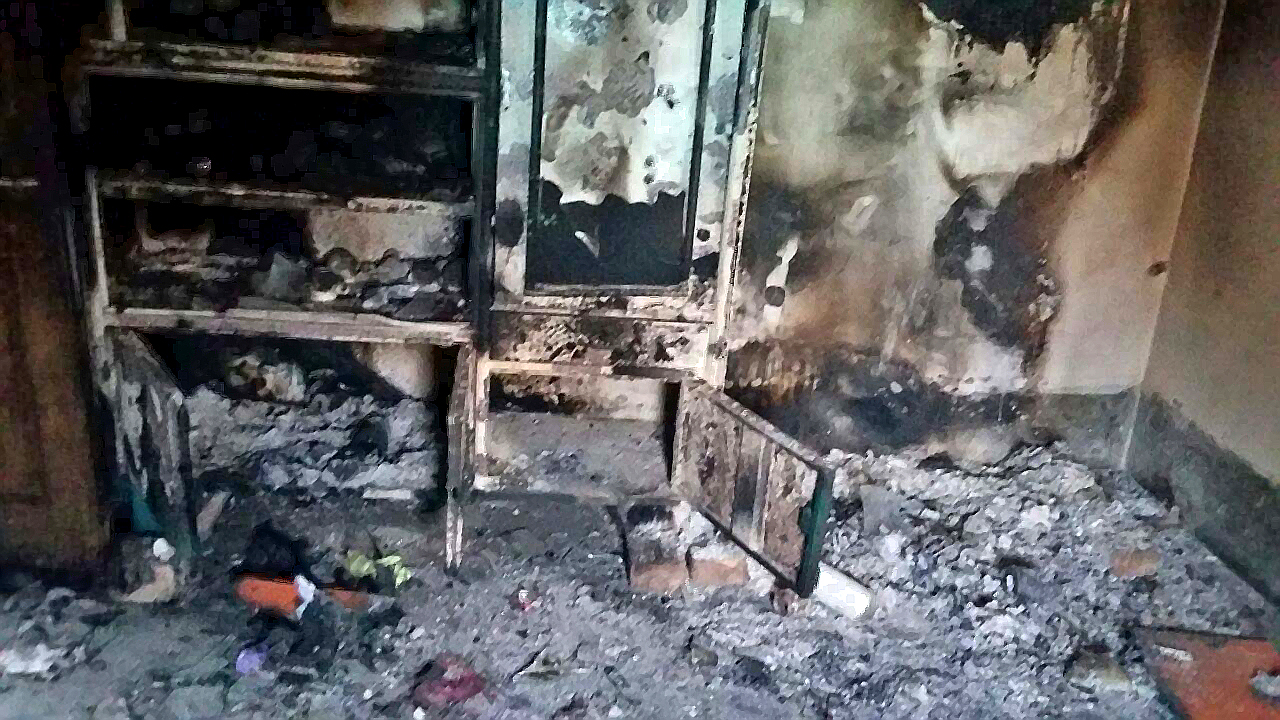
In this part III & IV of the reportage; Subha Protim Roy Chowdhury shares his experience while visiting communal violence affected areas in Basirhat and Asansol in West Bengal.
By Subha Protim Roy Chowdhury
Groundxero | Oct 20, 2025
III.
It was in the year 2017. Two months after the communal riots in Basirhat6, we were sitting face-to-face with a riot-affected mother and her twelve-year-old son. They were the only ones present when a riotous mob entered their house. The mob looted all the money and smashed the furniture in front of them.
We talked with Riya Mandal (name changed).
– How are the children now?
– They still cry at night. They wake up suddenly and become restless in bed.
– How are you trying to dispel their fear?
– How can I? They are small children; I hold them close. They know everything.
It was fairly obvious that the fear had remained. If there is a little trouble or commotion somewhere during Durga Puja, and there are many drunkards who create ruckus, the children get scared – we were informed. They fear that violence will erupt again.
– Now we don’t go out after dark; we are afraid. We are women, if someone taunts us, our husbands will not let it go. What if the unrest starts again!
– Have there been any separate attacks on women, do they tease you?
– No, no, nothing of that sort has happened, our house is right on the road, and it’s not even a concrete one. But nothing like that has happened.
We then spoke to two school-going children. One was Gopal Mandal, who happens to be the son of Riya Mandal, studying in seventh class, and the other one was in class nine. It is worth noting that Quader Hazir’s daughter-in-law Rehana teaches at the same high school where Gopal happens to be a student. There are also many Muslim students.
– Do you have any Muslim friends in school?
– Yes, we have, but we don’t talk to them a lot.
– Do you talk to them at all?
– Yes, a little bit.
– Was it like this before the riots?
– No, before that we talked a lot; now we don’t.
– Do they come to talk to you?
– Yes.
– Do you make fun of them or rag them?
– We fight if they win (at games).
– Oh! Why do you fight after losing? It’s natural that you would lose sometimes.
– (After a pause) Earlier, we didn’t fight, but now we do.
They played Ludo – a board game – at school.
– We talked to your other friends – Arif and Afrazul – from your school. They said you do not hang out like before.
Riya replied, “Unrest may erupt again from anything.Thinking of that riot still makes us tremble.”
We asked the children, “Have you stopped hanging out with Muslim friends yourselves, or did your parents tell you to do so?”
– No, we don’t hang out on our own. We feel scared. What if any words come out while talking to them and they tell their parents?
– Do they also feel scared like you?
– No, only we feel scared. They come to talk to us.
– Then why don’t you talk? Are they saying anything bad to you?
– They say bad things about our gods, about our family. They say, see, we have been successful in kicking your gods. We never speak back. What if we say something and they inform their people? The trouble will continue, and even escalate. Do you know that we had an idol of Goddess Kali; during the conflict they broke it and played with its head as a ball.
– Were you here at that time?
– You mean, when the violence started? The elder child stopped me and asked – Are you a Hindu?
We were at a loss of words at this question, which appeared seemingly from nowhere. The child’s mother was also there. We didn’t say anything. The mother was visibly embarrassed. Then the child started to speak again.
– When the violence began, they came with weapons. My father closed the front-door of our house. We were locked inside a room. But my father didn’t dare to step out even with a machete and an axe. Later, he took us to my aunt’s house.
– And your mother?
– Mother protected us.
While this conversation was going on, the children became conscious whenever a Muslim person walked or cycled past the road. They would fall quiet. Riya Mondol and the other women were also on alert. Later, Riya Mandal told us, “How can we live like this? Why should the children divide their benches according to community? The school must do something.”
We talked with Taribul Mandal’s grandson, Habibullah, from the neighbouring village. During the riot, the elderly Taribullah somehow escaped and survived. We were talking to the elders of that family; they were describing how a mob of more than a hundred Hindus came and attacked their house, and how they escaped with their old and disabled father. As we spoke, we noticed that the five-year-old Habibullah was getting restless. We asked him if he remembered anything. He started sobbing. He was taken inside to his mother and aunt’s room. Our female team members talked to the women inside. Habibullah calmed down seeing his mother talking to them. He told us that he was afraid of Hindus, and became angry seeing so many Hindus together.
To break the ice, our field researcher asked Habibullah “How will you recognize who is a Hindu or a Muslim?” She covered her head with her dupatta and asked. “Tell me, what am I? Then she removed the dupatta and asked, “And now, do I look like a Muslim or a Hindu?”
Habibullah’s mother came forward and stood beside him. Both of them laughed. Habibullah said, “You are looking like a Muslim, but you are a Hindu.” Our field researcher asked in a lighter vein, “You are angry with me then?”
Habibullah didn’t answer, but smiled. He fixed his gaze on his mother. She was stunned to hear such words coming out of his mouth.
“Oh Allah! Will they grow up with such hatred!” she exclaimed with a sigh.
“Mother had protected us”– these words, spoken by a child, had made us more aware of the role women and mothers play during the times of communal violence. While the fathers were busy defending or planning retaliatory attacks, the mothers kept their children safe. Communal feelings prevailed for months after the incidents, and the women were not insulated from such feelings. But when we interviewed them again after a year, the scars were beginning to heal.
Students no longer sat on benches divided along religious lines, which was the case when the schools had re-opened after the riots. This was true both for the hundred-year-old Tentulia High School and the Pifa BM High School. As Gopal’s mother had said, “Both sides participated in the violence; why should children suffer? We couldn’t think of separate benches in our school days! How can someone live like this?”
Habibullah now goes to a kindergarten school in a Hindu neighborhood. His mother takes him to school, and his father brings him back home. A tutor comes home in the evening to teach. Habib learns his lessons sitting on her lap. He doesn’t get angry because she happens to be a Hindu.
IV.
“The men of the house were very excited. I couldn’t even recognize my own husband. There was fear all around, sound of bombs exploding. Men were keen for retaliation. I tried to stop my husband. I said, ‘Don’t go, what will I do if something happens to you?’ But he pushed me aside and went out”– Sahana Bibi (name changed) was telling us. We were in Asansol. It was 2018.
“They (Hindus) killed the son of our Imam. Even before the Imam’s son was killed, a Hindu boy was held here too. How can I describe the situation! It was so heart-wrenching to see that boy; he was also someone’s son. I was telling the men “Don’t kill him, swear in the name of Allah”–middle-aged Sehnaz Begum was talking to us, as we gathered in her small shack.
“We have lived here together for a very long time. We are both from Naodah in Bihar. We may not be from the same village, but we are from the same district. The funny thing is that we came to live in the same locality here too. We never knew each other before. But, here we became friends. But this communal violence somehow separated us. Even on the day this violence broke out, we two old women had a chat in the afternoon. The sound of bombs filled the air in the evening. After eighteen days, we met again. But even when everything was closed, we used to call each other surreptitiously over the phone,” said Malati Thakur and Selina Bibi.
These are the accounts of women from the riot-stricken area of Asansol, who talked to the female members of our fact-finding team.
Here we had also met Tasneem (name changed), a teacher at a local private school. Her house is next to the Noorani Mosque in the railway slum. When we went to her neighbourhood, women from other houses came out, asked us to sit and gave us water. But no one uttered a single word about the riot.
– If the riot hadn’t happened, would you have visited our slum?
– Will the Imam-sahib get his son back with your report?
– As you have come from Kolkata to know the truth, tell us what you want to know.
– Tell us about those troubled times. What was your situation? What assurances were you given by the administration?
– See, let it be clear; we have to take care of our own security. Nobody will come to help us; we know that. There were no police at the entrance of our “Basti”; what can we say? We knew–we have to protect our slum on our own by staying awake all night.
– There were no police anywhere! Not even in the Hindu localities?
– There were no police here. We don’t know if they were there or not, but we have heard that they [the Hindus] also didn’t get any help from the administration. They too suffered a lot. Their houses were also torched and looted.
– What about the Reliance Mart in the front of the slum?
– Nothing happened to it. They have their own private security guards. The rioters didn’t go there. Why would they!
A girl named Uzma was in the next room. We could sense the fear and insecurity in her eyes. That fear was totally unfamiliar to us; we have rarely encountered such direct expressions of fear. She was literally trembling. As she remembered the violence, tears rolled from her eyes.
Uzma said, “Didi, we never thought we would have to face such a situation. When we were in college, we knew this as a ‘city of brotherhood.’ Here the Bengali-speaking, Urdu-speaking, and Hindi-speaking people all live together. We were never divided along Hindus and Muslim identities. People here are poor, but there was unity among us. We never thought this could happen here. Now there is a wall between them and us. I don’t know when it will become normal, and if it ever will become alright again?”
She took a pause, and started again, “Do you know, we had two of their [Hindu] boys here? We fed them and kept them well. They also could have done the same with the son of the Imam-sahib; how could they kill him! We didn’t let any harm come to those two boys.”
– If it had been known that the Imam-sahib’s son was killed, would the boys have been spared?
– Maybe they would have been tortured, but we would have stopped our men from killing those boys. Whatever may happen, whether they are ours or theirs, they are also sons of some mother! Maybe we (the womenfolk) would have helped them escape, somehow. Actually, at that time, we were scared of the men from both sides. The men in our neighborhood suddenly became strangers, and we couldn’t stop them.
The male members of the families were not picking up our phones. They were saying, “Aurat logo ko isme dimaag nehi lagane ko hain, ghar me bandh raho” (the women need not engage their brains in these matters; stay locked in homes). There were also rumours that they would come from outside (the Hindus) and would enter our slum at night, armed. During those days, we were equally scared of both groups of men, ours and theirs. Now everything is peaceful, but we still can’t sleep at night. That unfamiliar Asansol is so deeply etched in our minds; it is hard to forget.7
We found it difficult to continue our conversation with Uzma. What can be said after what she had said!
Reference:
6 Communal Riot of West Bengal, 2017: Bashirhaat Baduria; Amra Ak Sachetan Prayash
7 West Bengal: post-Ramnavami communal violence series-3, Amra ek Sachetan Prayas, 2024
_______________
Subha Pratim Roy Chaudhury is a researcher and writer, concerned primarily with conflict and peace studies.
The article was translated from Bengali by Subho Maitro.
Read Part I & II here.
(The full article has been published in the 3rd print issue of Groundxero. To get a copy of the print issue contact us 9830311525.)