
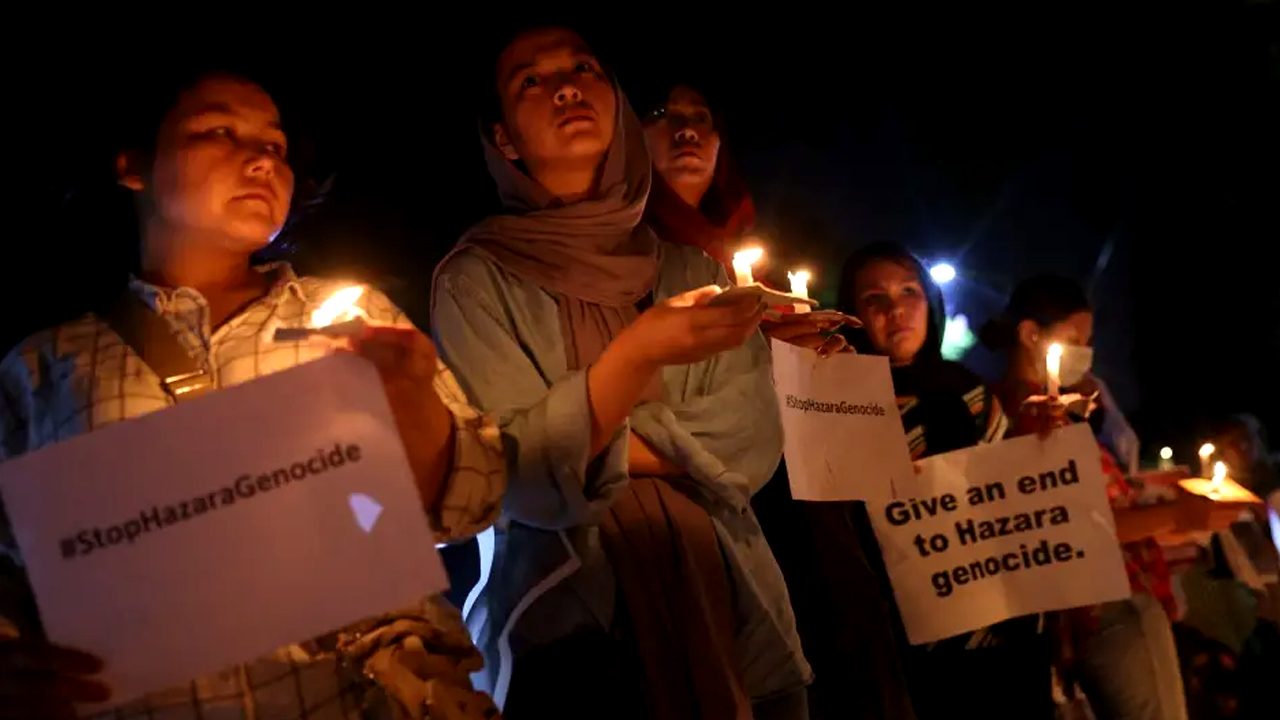
Maleka from an Afghan refugee camp in Delhi, and Anwara, Murshida, Tamanna, Ramaiya, Saba, Arifa in a riot victims shelter camp in Uttar Pradesh — each came from a different background. Their perspectives are different, but they face the same reality of insecurity and vulnerability.
By Subha Protim Roy Chowdhury
Groundxero | Oct 17, 2025
I.
“Despite thousand lightnings,
and lakhs of storms
those flowers which are destined to bloom
will bloom nevertheless”1
I first heard this poem, written by Urdu poet Sahir Ludhianvi, in 2004, in an Afghan refugee camp in Delhi. I could not have imagined hearing such a poem amidst all the anxiety and uncertainty that characterized the place. Most of the refugees from Afghanistan live in Lajpat Nagar, Delhi. Hindus and Sikhs make up about 90% of them. The remaining 10% are Muslims, mainly Hazaras and Pashtuns. Some had come after the Soviet invasion of Afghanistan in 1979. After the fall of Najibullah’s government and capture of power by the Talibans, the influx of refugees began again.
I was talking to an elderly Hussain Hazara, who was staying at the refugee camp. His daughter Maleka was sitting next to him. She was studying Urdu at a college in Quetta, Pakistan. Maleka recited the poem to me. She said “Whether there is a storm or a lightning strike, the flowers will bloom.” I recited to her a few lines by the Bengali poet Subhash Mukhopadhyay: “Whether flowers bloom or not, today, it is spring.” Our conversations continued.
Maleka did not come here with her father, she came later. She was staying at her aunt’s house in Quetta in Pakistan. There, she studied at Girls’ Degree College. She had a Pakistani passport, and would occasionally come to meet her parents in Delhi, although it was very difficult to get a visa. She said that she won’t return back to Quetta.
But why, I asked. She said, “Hazaras are also being attacked in Pakistan. Many of us came to Pakistan from Afghanistan, but there is no peace there either. In 2001, Lashkar-e-Jhangvi attacked Hazara Town in Pakistan.2 Our community has been living in Afghanistan since as far back as 1880. Our only crime is that we are ethnically different; we belong to the Turko-Mongol group. We look different from them. After the rise of the Talibans, many have fled to Pakistan. Most people from our community settled in Balochistan. Pakistan proudly claims that it has succeeded to build a country upon Islam. But look, we faced genocide there too, even though we are also Muslims. My father and mother escaped that fate by coming to Delhi. I managed to come too,” said Maleka in one go.
Once the interview was over, I told her, “Did you know that your favorite poet, Sahir Ludhianvi had also settled in Lahore before the Partition of India?” Maleka and Hussain Hazara were eager to know what happened to him there. I told them that he fell out of favor with the Pakistani government because he was a communist. So, he came back to India. Kishan Chander and Gulzar were his friends. He later made a name for himself in the Bombay film industry. Hearing my words, the eyes of the father and daughter lit up. “Isiliye na hum bhi Hindustan ko chuna (That is why we chose Hindustan),” said the old man.
I went to that UN-sanctioned refugee colony again in 2021 after the Delhi riots. Meanwhile, Hussain Hajara had died. Maleka was working for an NGO, and she had begun her education again. Her face was filled with despair. A persistent fear lingered in her that she might have to leave this country anytime. There was no provision for Muslim refugees coming from Pakistan or Afghanistan in the new Citizenship Law passed by the Indian Parliament. I felt sad. It seemed like the melody of Sahir Ludhianvi’s poem had faded, as had the old man’s faith in “Isiliye na hum bhi Hindustan ko chuna.” I left with an immense sense of guilt.
The next day I was to return to Kolkata by train. But on the way to the station, my auto-rickshaw got stuck in a traffic jam in front of India Gate, where thousands of people had gathered. It was like the whole city was out on the streets, protesting against the Citizenship law. I got out of the auto-rickshaw, and joined the crowd. I added my voice to their slogans. There were many distinctly separate groups, but the slogans were the same. In the crowd, I noticed Maleka. She was also there with her friends. Everyone held the tri-colour national flag; and slogans rose in the air like flames.
The crowd was chanting –
‘Iye desh hamara – Hindustan
Pyara pyara – Hindustan
Dil ka dharkan – Hindustan
Gulshan Gulshan – Hindustan’
(This country of ours – Hindustan
So beloved – Hindustan
Our heartbeat – Hindustan
Our garden – Hindustan)
I had to leave, as I had a train to catch. But, even from a distance, I could hear: “This is the Hindustan of Khuda-i-Khidmatgar,” “This is the Hindustan of Gadar Party,” “This is the Hindustan of Azad Hind.” And, the loud response of the crowd – “Hindustan, Hindustan” – shook the night of Delhi. “This is the Hindustan of Bhagat Singh, Ashfaqulla, Khan Abdul Ghaffar Khan”– the slogans slowly faded away, as I inched towards the railway station. Maleka, yes, Maleka was my India at that moment.
II.
Men and women from Muzaffarnagar, Shamli, and Bagpat district in Uttar Pradesh had come in large numbers to the Islamabad slum in Shahpur. These are their temporary homes–rows of huts in the open fields. A slum. Muslims from various villages have fled their homes and have taken shelter here during the riots in August 2013.
It was May or June 2014. Children aged five to twelve were running around in scorching heat. Tents or shanties have been put up on the empty spaces in the slum. A hand pump was visible in the distance; it had to be pumped ten to twelve times before water would gush out. Ramaiya Ram, in her fifties, has come with a plastic jerry-can to get water from that hand pump. Ramaiya is not a resident of this “basti” or slum; she lived on the other side of the wall. There is no water in her basti, so she has to come here every day.
A persistent sound of someone crying was coming from a nearby hut. Ramaiya said, “Arifa Bibi. The Jats lynched her son to death. That old woman is crying.” “That old woman cries a lot, saab,” she said. There was a touch of the Bhojpuri dialect in her compassionate voice.
Many of the men in the families have ‘disappeared’. Although the camp was not completely without men, but, their number was quite low. The rioters were still keeping vigil! Many women have left their village homes, leaving everything behind. Dead bodies of men lay on village roads, as mothers fled with their children. Those who survived took shelter in the camps.
How can we stand in front of Arifa Bibi? Can we even talk to her? We were in a terrible dilemma. We were confused.
Yet, we spoke to her.
“They beat my son to death right in front of my eyes,” Arifa said and stopped. She couldn’t say more. He was her only son. Arifa Bibi was a widow; the son was the only earning member in her family. In the last few months, her tears have dried up; she has forgotten how to cry. How differently a riot and its horror affect different people! Arifa Bibi had tried to kill herself twice in the camp, but the rat poison she had consumed, didn’t kill her. “Her life is not so fragile that the rat poison could kill her,” Ramaiya had said.
Ramaiya was around forty. They had come here from a remote village nearly forty kilometers away from the town of Ara in Bihar. It would be more apt to say that they were forced to come, leaving everything behind. The torture by the upper castes was always a social reality in the village, but after the Bathanitola massacre (1996) her family didn’t have the courage to stay back. They then came to this part of Uttar Pradesh.
It seemed, the pain of forced displacement had somehow connected two women. Ramaiya was not consoling Arifa, she wasn’t saying anything to her. She was only stroking her head gently, as they sat in silence.3
We also talked to a group of Muslim riot-victims in another camp in Shahpur. They came from various villages around Muzaffarnagar district. This camp had become a temporary refuge for them. There were nearly 300 families in this camp, living in horrible conditions.
On the first day, we mainly talked to a few elderly women. Murshida Begam (67) narrated how they had escaped, leaving everything behind, literally with just clothes on their backs. Her sixteen-year-old granddaughter has been severely traumatized and trembles in fear in her sleep ever since.
She, Tamanna Parvin (name changed), didn’t want to talk to us initially.
“No, I will not say anything. Media persons, students from universities (researchers), so many like you come and talk to us, ask us questions. To how many am I supposed to tell the same thing? Please go away.” Tamanna screamed.
We were shocked. Murshida Begum tried to calm her down. A female psychologist, Sabiya, was in our team, and had witnessed Tamanna’s outburst. We moved to the other side of the camp. Sabiya stayed with Tamanna for a long time. Sabiya is from Kashmir, and from her own lived experiences, she could understand Tamanna’s mental state much better than all of us.
Later, she told us that it was a kind of avoidance symptom. This can happen when something suddenly reminds a person of a traumatic event.
On that day, we didn’t go anywhere else. We realized how ‘inhuman’ these ‘fact-finding’ missions could become for the victims.
Tamanna couldn’t forget that horrible night. The screams of her loved ones and the fire that burned everything in her home, still haunts her in her sleep. She screams. Sabia spent more than an hour with her, and said, her condition is what is known as Post-Traumatic Stress Disorder (PTSD). PTSD often involves a re-experiencing of symptoms that remind the affected person of that traumatic event again and again. Even after a year, there was no respite for Tamanna. Asking her to talk to us would then also mean that we are taking her back to that night of horror.
Murshida had said, “We left our home and everything, and came here, but nobody is telling us when we can go back to our homes. There is nothing here, not even water. Youth from the Jat community loiter around here on bikes. The young girls hide in fear inside.”
They are not only affected by past traumatic memories, they also don’t feel safe inside the camps. Even here, they fear the possibility of arson, murder or rape.
Murshida asked, “How long can we live in fear?”
– Is there no police?
– Police work only for the Hindus. If the army hadn’t come, we wouldn’t be alive today.
– Where is the army now?
– The army patrols have reduced in number. When they come, we tell them about our plight. The Jat youths don’t come close when the army is present.
– But, if you go back to your village, there could be trouble again.
– Why do you still want to go back?
– It is our forefathers’ land, beta. What will we eat here?
– Will you get your land back? Hasn’t it been grabbed already?
– No, there are still a few people in the village who support us. Dalits are there, Yadavs are there, even a few Jats too. They are asking us to come back. Nothing like this had ever happened in our village before; it all happened so suddenly. Outsiders created the trouble. We were living in peace.
But why didn’t the Jats of the village stop the rioters on that particular day? We didn’t want to embarrass her with this question, as we didn’t want to shatter her dream of going back to her village.
With us in the team were Rani and Usman Mehedi from ‘Astitwa’–an organisation which fights for the rights of riot-affected women. They related to us something quite shocking, that we didn’t know about before. We knew about the Khap Panchayats–local governing organisations prevalent primarily amongst the Jats. In the name of protecting family honor and clan traditions, these Panchayats often order “punishment” for “crimes.” Such crimes might include adults falling in love, or marrying outside of their caste or community. Rani and Usman informed us, the khap culture is equally present amongst the Muslim Jats. ‘Astitwa’ provided us with more than one case history showing that like in the Hindu Jat community, Muslim jats also perpetrated atrocious attacks on individuals in cases of inter-community or caste marriage. Though they didn’t have formal khap structures like the Hindu Jats, they also retained a khap- like system of preserving family honor.
Following the trails of one such case history, we met a young couple who had fled such conditions. We met them in Delhi. Anawara (name changed), a girl from a Muslim Jat family, fell in love with another Muslim youth, Ashfaq. Ashfaq was from a different ethnicity. His family is a Sayed-Pathan family. They used to be students in the same college. Ashfaq got a job as a salesperson in a private bank near Delhi, and then Anwara informed her family about their relationship. Trouble began to brew from that point onwards. Their relationship was not accepted by their families. But, before any action could be taken against them, Anwara and Ashfaq fled.
Anwara told us that they stayed at the waiting room of the Hazrat Nizamuddin Railway Station in Delhi for two nights and two days. Out of fear, they didn’t even leave the waiting room.
Anwara said, “I would stay awake all night, in case my family came looking for me. If they had found me, they would have killed me. One night, I suddenly realised Ashfaq was not there. Two to three hours passed by. We had no mobile phones back then, and I couldn’t come out of the waiting room out of fear. I became anxious, I was thinking, ‘Did someone find him?’ At other times I began to have other kinds of doubts, ‘Did he leave me?’ He had said that nobody would say anything to him if he went back to his home, but if that had happened, where would I go?”
One could trace a deep sense of vulnerability in every word that Anwara was uttering. Leaving a well-to-do family, taking an uncertain path, facing sure death if found out or if she returns home — these things could have befallen her. Still, she had chosen her own path in love. But even then, the vulnerability she had internalized since her childhood terrorised her. Protecting family honour implied restrictions on a girl child, a family honor, so fragile that marrying a person not chosen by the family would come to mean dishonor. And in cases of such dishonor, a father’s hands wouldn’t shake to kill his own daughter.
Ashfaq came back in the morning. He had gone to find a safer shelter for them. But who was responsible for the suspicion that rose in Anwara’s mind during that brief period?
The “Dangapirita Sangharsha Samiti” was formed to help the riot victims of Muzaffarnagar, Shamli, and Bagpat districts. Our eyes stuck on one clause of their demand-charter from 10 October 2014:
“150 girls from the riot-affected families in Camp Number 1, 2, and 3 of Shahpur Islamabad have been married off. The families in camps, which have marriages or deaths, should get financial help or compensation.”4
Could marriage and death be in the same line of a demand charter! After shaking off our initial shock, we enquired why so many girls are being married off in such a short time span. The secretary of the organisation answered, “What else can we do? Who knows what will happen here? They are targeting our girls. Do you know how many girls they have taken away?”
These fear-driven marriages of premature girls connect this place to another conflict-torn region in other part of the country: the India-Bangladesh border of Murshidabad. “69% of the women in the bordering villages believe that the lack of security is the main reason behind child marriage” – said a survey report. The survey was conducted in the bordering villages of the Raninagar 1 and 2 blocks, Jalangi, and Bhagwangola block of Murshidabad district. It was found that the average number of child marriages is higher in border-villages than in villages farther from the border. The primary reason has often been identified as the ‘sexual terror’ by the border security force, the booming local economy of ‘trafficking’ and such. Muzaffarnagar and Murshidabad, two places thousand miles apart, thus, can come to reside within the same bracket, when it comes to the insecurity of women. [Child Marriage in borderland eroding Land and Culture, Masum, 2016]
Data from the National Crime Records Bureau 2013 showed that there were 3050 cases of rape in UP, apart from the cases of kidnapping and dowry related crimes. The first incidence of gang-rape in the Muzaffarnagar riots 5 was reported in the Fugana village of Jogia Kheda. Sixteen people were killed, six incidents of gang-rapes reportedly occurred. Even after two months, no one was arrested, journalist Furkan Amin Siddiqui informed us.
Saba (name changed) said, five people had entered her house, dragged her by her hair, and raped her consecutively. Even after two months, not a single person has been arrested, though all were roaming out in the open, Saba had said.6
We met Saba a year after the incident, but no action had been taken till then. There were two other women with Saba, who also spoke during our conversations. “Whether it is war or riot, rape comes as a ‘natural’ part of it.” This shocking truth was uttered by Saba to Rani, our team member. “Because the property of the enemy community is for looting, young men are for slaughter, and women are for rape. Men start riots, what can we [women] do?” she asked, looking at us directly.
The stories of Mohor Singh of Shamli and the Sayed-Pathans of Thanabhawan, who fought together against the British in the Great Revolt of 1857, still echoes in the smallest of the alleyways of this place. They had freed the Tehsil of Shamli from the British, though the English forces in a brutal attack re-conquered it. How come that Muzaffarnagar became synonymous with communal riot today? No one knows the answer.
Anwara, Murshida, Tamanna, Ramaiya, Saba, Arifa—each came from a different background. Their perspectives are different, but they face the same reality of insecurity and vulnerability, they are imprisoned within the same frame.
(To be continued)
Reference
1 The English translation of the Urdu poem by Sahir Ludhianvi is by Nisitha Tripathi.
2 Insight: Pakistan death squads spur desperate voyage to Australia, Reuters, December 8, 2023
3 Muzaffarnagar: Victim’s Testimonies: AAMRA Archive, 2014
4 5th line of Dangapirita Sangharsha Samiti’s Demand Charter, Muzaffarnagar Document: AAMRA Archive 2014]
5 https://thewire.in/gender/in-riot-hit-muzaffarnagar-an-ngo-focuses-on-female-victims-of-violenc
6 Communal Riot of West Bengal, 2017: Bashirhaat Baduria; Amra Ak Sachetan Prayash
_______________
Subha Pratim Roy Chaudhury is a researcher and writer, concerned primarily with conflict and peace studies.
The article was translated from Bengali by Subho Maitro.
(The full article has been published in the 3rd print issue of Groundxero. To get a copy of the print issue contact us 9830311525.)