
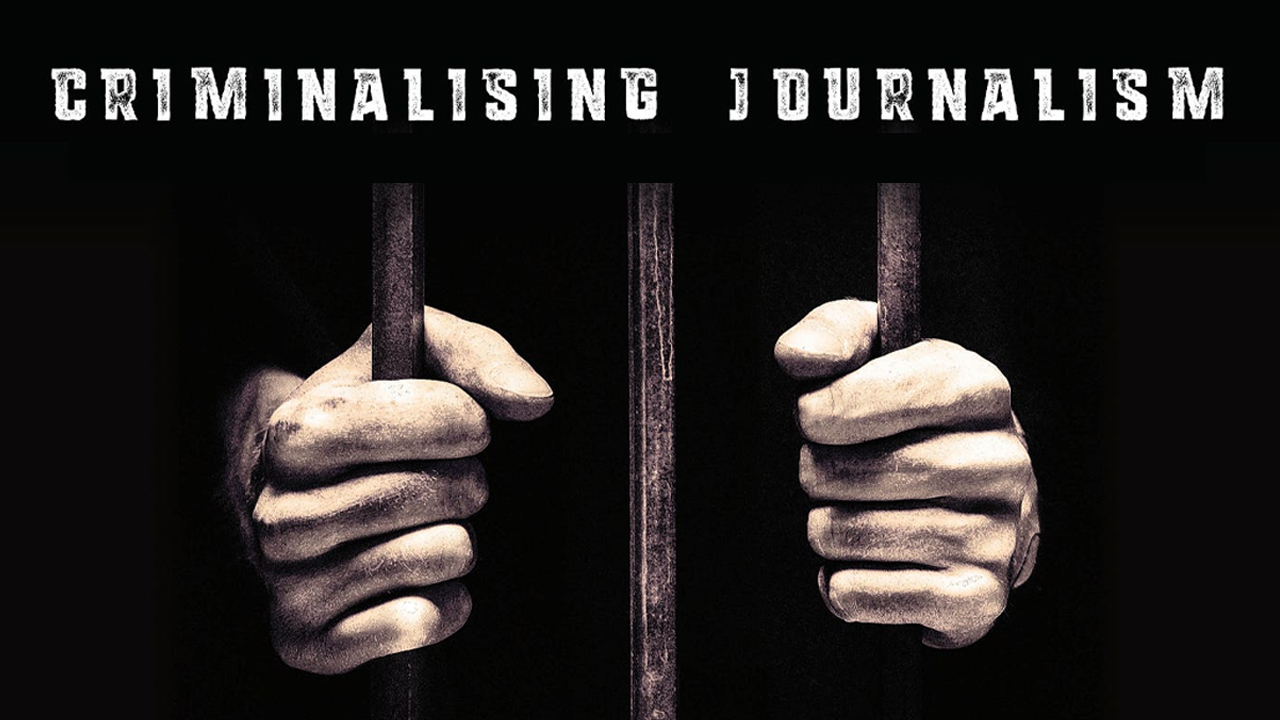
The recent targeting of journalists by the BJP-ruled Assam state government is aimed at creating a chilling effect on press freedom, and to intimidate independent voices and silence criticism.
August 24, 2025
Right-wing fascists and authoritarian rulers dislike free media, critical and rational voices. They love cheerleaders, hate dissent, and hence weaponise law to silence questioning of state policies by the media and citizens.
The recent targeting of well known journalists – Siddharth Varadarajan and Karan Thapar from the independent online news portal The Wire and You Tuber Abhisek Sharma – under a new rebranded sedition law by the BJP-ruled Assam state government is aimed at creating a chilling effect on press freedom, and to intimidate independent voices and silence criticism.
FIRs charging journalists with sedition
The Supreme Court of India, on Friday (22 August), put a stay on any coercive action against senior journalists Siddharth Varadarajan and Karan Thapar and members of the Foundation for Independent Journalism (the Trust owning The Wire) by the Assam Police’s Crime Branch in an FIR invoking sedition charges under Section 152 of the Bharatiya Nyaya Sanhita (BNS) 2023 against them.
This relief came days after the apex court had protected Varadarajan from arrest on August 12 in another FIR filed against him on July 11 by Morigaon Police Station of Assam.
On the same day (12 August), the Assam Police’s Crime Branch issued summons on the basis of an earlier FIR filed by a BJP officeholder on May 9, also on sedition charges, against Siddharth Varadarajan and Karan Thapar. This FIR listed 14 interviews and articles as against the sovereignty and integrity of India. But, no action was taken on that FIR till August 12.
While the Morigaon FIR was filed by the Assam police for an article on Operation Sindoor published in The Wire, the fresh summons by the Guwahati crime branch on August 12, in addition to sedition charges, pressed BNS sections pertaining to charges of promoting enmity between different groups, publishing false or misleading information and criminal conspiracy.
The SC bench comprising Justices Surya Kant and Joymalya Bagchi, while protecting the Varadarajan and Thapar from arrest, asked them to join the investigation and file a status report to the court on the next date of hearing on September 15.
Continuing its vindictive action against journalists, the Guwahati Crime Branch also filed an FIR against another well known journalist and YouTuber Abhisar Sharma for a video criticising Assam and Union governments. According to the complaint, Mr. Sharma uploaded a video on YouTube accusing Assam Chief Minister Himanta Biswa Sarma of relying on communal hate and violence to further his politics, as well as mocking and ridiculing the principle of Ram Rajya etc. The FIR invoked Sections 152 (sedition), 196 (promoting enmity between different groups) and 197 (prejudicial to national integration) of the Bharatiya Nyaya Sanhita, 2023 (BNS).
Responding to the FIR against him Sharma wrote on X, “The FIR filed against me by [Assam Police] is completely baseless. It will be responded to legally! In my show, I had mentioned the statement of an Assam judge, where he referred to the Assam government giving 3,000 bighas of land to Mahabal Cement and had criticized it. I had also highlighted Chief Minister Himanta Biswa Sarma’s communal politics with facts — based on his own statements.”
Assam – a new laboratory of communal-corporate fascism
What is interesting to note is that all the three FIRs against the journalist were lodged by the Assam police based on complaints by residents of the state. While the first complaint was lodged by Biju Verma, a resident of Guwahati, the second complainant, Partha Pratim Patar, is a lawyer whose Facebook profile shows he is an active BJP functionary. The FIR against YouTuber Abhisar Sharma was filed by Alok Baruah, reportedly associated with the ABVP – the student wing of the RSS. And all the FIRs invoked BNS section 152 – a rebranded version of the sedition law – among other charges.
Himanta Biswa Sarma, an ex-congressman turned BJP leader of Assam has emerged as the new charismatic face of saffron politics. Sarma is reportedly a blue-eyed boy of Amit Shah and is being groomed and projected as part of the second tier national leadership of the BJP.
Assam under Hemanta Sarma has been turned into a new laboratory for communal-corporate fascist offensives on people’s rights and democratic ethos. The state under him is witnessing a sharp and deeply concerning escalation in hate speech, targeted harassment and violence on Bengali-speaking Muslims, in the name of identifying and deporting “illegal Bangladeshi infiltrators.”
Hemant Sarma is also waging a large-scale campaign of forcefully evicting tribals and Bengali-speaking migrants from their homes, handing over vast tracts of land to corporates and big business, and enforcing this dispossession through brutal police repression.
The attack on independent media and well known journalists, critical of the BJP governments, is to project his image of a strong hardcore Hindutva leader, not only in Assam but beyond it. No doubt, he is doing this with the blessings of his godfathers in Delhi.
Outrage over the FIRs
The Section 152 of the BNS is in essence the colonial Section 124A (sedition) of the erstwhile Indian Penal Code and the operation of this section had been stayed in May 2022 by the Supreme Court, given its frequent use by governments against journalists and activists. The court referred the matter to a Constitution Bench for judicial scrutiny and an authoritative pronouncement. Varadarajan has approached the Supreme Court challenging the constitutionality of Section 152 BNS on the ground that it was a re-branded version of the old sedition law.
The politically motivated FIRs imposing sedition charges against reputed journalists have drawn strong criticism from press bodies, civil liberty organisations, members of Parliament, political parties and the mass movements.
The International Press Institute (IPI) in a statement on August 19 had warned that the continued weaponization of Section 152, which criminalizes actions tantamount to sedition, risks creating a chilling effect on press freedom in India, and calls on the Supreme Court to take permanent steps toward preventing abuses of the law. IPI Executive Director Scott Griffen said “Critical reporting and free expression is essential to the function of democracy. The court must act, or risk emboldening further exploitation of this law and creating a chilling effect on press freedom in India.”
The Editors Guild of India (EGI) expressing concerns over issuing of summons to the journalists said it is deeply disturbed by this continuing trend of the law enforcing agencies across states registering FIRs against journalists by invoking multiple provisions of the criminal code. This practice effectively muzzles independent journalism, as the very process of responding to notices, summons, and the prolonged judicial proceedings becomes a form of punishment, said the Editors guild.
Incidentally, on August 2025, senior journalist and Editors Guild of India’s Secretary Ruben Banerjee’s channel was removed by YouTube. His Odiya-language channel “Mu Ruben Kahuchhi” highlighting social and political issues and critical of the ruling party was taken down on alleged violation of the social media platform’s ‘circumvention policy’. The action was taken without any prior intimation, notice or warning.
The Press Club of India (PCI) and the Indian Women Press Corps also expressed dismay at the FIR against senior journalists Varadarajan and Thapar. In a joint statement PCI and IWPC demanded immediate withdrawal of these cases against the senior journalists, as well as the withdrawal of the “draconian” Section 152 of the BNS, which “threatens freedom of expression as enshrined in Article 19(1)a of Indian Constitution”.
The PCI on Friday (August 22, 2025) also demanded withdrawal of the FIR lodged by Assam Police against journalist Abhisar Sharma. The press body accused the Assam Police of turning “a blind eye in not taking cognisance of what the apex court has directed in a similar case pertaining to The Wire editors”
Eighteen members of Parliament from the opposition political parties released a statement expressing concern at the BJP-led Assam government’s repeated use of a ‘repackaged’ sedition law to intimidate independent voices and silence criticism.
Tamil Nadu chief minister M.K. Stalin tweeted: A democracy cannot survive if asking questions is treated as sedition.
RJD MP Manoj Kumar Jha wrote on X: The freedom of the press is not a privilege granted by those in power, but a right that safeguards the people against arbitrary authority.
The PUCL in a statement said “Freedom of the press cannot be deliberately, arbitrarily and vengefully curtailed by police action”. It demanded that the Assam police stop this vindictive, malicious and unconstitutional persecution of the press, and withdraw the FIR against Varadarajan and Thapar. PUCL called the two FIRs, a part of a pattern to attempt to stifle the independent voice of ‘The Wire’. It pointed out that on 9 May this year, The Wire’s website was temporarily blocked for nearly 12-15 hours in India on government orders following the publication of an article regarding Rafale jets in Operation Sindoor. The website was restored few hours later after a huge outcry.
People’s Union for Civil Liberties (PUCL) in a statement called the FIRs a capricious attempt by the State to weaponise the law to silence questioning of state policy by the media and citizens, thereby curbing media freedoms and causing a ‘chilling effect’.
PUCL pointed out that Section 152 gives the government a wide latitude to arbitrarily criminalise media reporting alleging that sedition under the section includes ‘encouragement’ of ‘feelings of separatist activities’ and the endangerment of the ‘sovereignty or unity and integrity of India’, which strikes at the very basis of media freedom and freedom of speech and expression.
PUCL said Section 152, like the previous sedition law has no place in a constitutional democracy, and demanded repeal of Section 152 of the BNS which is nothing but the sedition law in neocolonial garb.
15 members of Parliament, including John Brittas, A. A. Rahim, and V. Sivadasan of the CPIM signed a letter condemning the harassment of Siddharth Varadarajan, Karan Thapar, and other journalists of The Wire who are being targeted with the rebranded sedition law by the BJP government in Assam.
The CPI (ML)-Liberation called it a deliberate attempt by the BJP regime to criminalize journalism and intimidate the press. It said the Assam Police issuing summons in another similar case on the same day the SC granted protection to the journalists from “coercive action” makes these actions of the Assam police especially brazen and contemptuous of judicial authority.
The Samyukt Kisan Morcha (SKM), a joint platform of farmer unions which led the historic Farmers’ Movement in 2020-21, observed that these FIRs invoking sedition charges against journalists have exposed the efforts of the Chief Minister of Assam to convert India into a Police State. SKM accused the Assam CM of unleashing onslaught on democratic rights of the people even by challenging the Supreme Court. “It seems the Chief Minister of Assam thinks himself above the rule of law and does not respect even the apex court,” SKM said in a press release. SKM pointed out that the united kisan movement also was accused of sedition charges during the farmers’ struggle of 2020- 21.
SKM has called upon all the kisan organisations, trade unions and unions and associations of all other mass sections including journalists to consider joining hands, assess the deterioration of civil rights of the people under the ruling alliance of NDA-BJP combine and a belligerent bureaucracy, and ensure building massive resistance to protect democracy.
Fate of common journalists and YouTubers
Criminalizing independent journalists is nothing new for the BJP-ruled state governments. It has become a norm. A large section of the journalists have succumbed to this threat and have become willing cheerleaders of the regime. Those who have refused to bow down are routinely harassed, intimidated, viciously trolled and charged under various sections of criminal laws, including the draconian UAPA – the law meant to charge terrorist activities.
In December 2024, a criminal case under various sections, including Section 152, was filed against Alt News co-founder Mohammed Zubair by the Ghaziabad police in Uttar Pradesh over his social media post in which he shared a clipping of a provocative speech by controversial priest Yati Narsinghanand.
Zubair has won the 2023 Freedom of Expression Awards for his fight against fake news and disinformation, which has led him to face such attacks, slander and even jail.
On 27 June 2022, Mohammed Zubair was arrested by the Delhi Police over a tweet of an image from a 40-year-old film posted by him in 2018. The arrest came just a few days after Zubair exposed a national spokesperson of the BJP making hateful and Islamophobic utterances on national TV. Six FIRs were lodged against Zubair, resulting in him being under arrest for 24 days. He was set free only after the Supreme Court granted him bail on 20 July 2022 and ordered his release, as there was no justification for keeping him in custody.
Another journalist Siddique Kappan was arrested in October 2020 while he was on his way to Hathras in Uttar Pradesh to report on the gang-rape and death of a 19-year-old Dalit girl. At the time of his arrest he was working with the Malayalam-language news portal Azhimukham, and was the Secretary of the Kerala union of working journalist’s Delhi unit. Beside sedition, he was arrested on two charges – under the draconian anti-terror UAPA for allegedly being a member of Kerala based banned radical Muslim outfit Popular Front of India (PFI) and the Prevention of Money Laundering Act (PMLA) for allegedly receiving money from PFI to “incite riots”. He was granted bail in both the cases – by the Supreme Court in September 2022 in the UAPA case and by the Allahabad High Court in the PMLA case in Jan 2023. Siddique was finally released from prison only in February 2023 more than two years after his original arrest.
A year after his release from Uttar Pradesh jail, Siddique told The Hindu that he continues to live in an open jail. “This is because I have to travel to Lucknow three or four times in a month as part of the case process,” he said.
The Free Speech Collective’s (FSC) Tracker reveals that in the first four months of this year alone, two journalists – Mukesh Chandrakar and Raghvendra Bajpai – were killed, four were attacked, and six were arrested while there were at least five instances of threats and harassment.
Tushar Kharat was arrested in Mumbai on March 10, 2025, for airing allegedly defamatory content against rural development minister Jayakumar Gore in his Marathi YouTube channel ‘Lay Bhari’.
Pogadadanda Revathi, Managing Director of online news channel Pulse News, and Thanvi Yadav, a reporter with the channel, were arrested in Hyderabad at 5 am on 12 March 2025, for broadcasting allegedly abusive content against Revanth Reddy, Chief Minister of Telangana. They were granted bail after five days on 17 March 17.
On March 25, journalist and assistant secretary of Guwahati Press Club, Dilwar Hussain Mozumder, was arrested by Assam Police for covering a demonstration against alleged corruption at the state-run Assam Co-Operative Apex Bank. After the protest was over at the bank, Dilwar was summoned to Panbazar police station in Guwahati (Assam) and arrested. Assam CM Himanta Biswa Sarma is the Director of the bank and its Chairperson is the BJP MLA Biswajit Phukan. Mozumder was finally released on bail on March 29.
A study examining 423 criminal cases registered against 427 journalists between 2012-2022 in India found that 58% of journalists in small towns were arrested compared to only 24% in major metropolises; only 3 % of small-town journalists could secure interim protection from arrest compared to 65% in major cities, journalists working in Hindi and regional languages faced more severe outcomes compared to those working in English.
These journalists are not nationally reputed. They either run or are associated with independent YouTube media channels. The harrasment they face seldom become national news. They are not even acknowledged as journalists. The administration deny violation of press freedom and question the credentials of journalists working for such independent and online news portals and channels. Hemanta Sarma took to ‘X’ to “clarify that Assam police has not arrested any journalist in recent times.” Maharashtra CM Fadnavis said the arrested journalist was indulging in “extortion”. Reddy, CM of Telengana, went a step further threatening “so-called journalists” on the floor of the state assembly and calling for them to be stripped and beaten in public.
Conclusion
The precarious state of freedom of journalists must be seen in the context of the general attack on free speech in India that target academics, students, authors, stand-up comics, satirists, actors and film-makers etc.
At this point, apart from many activists, journalists – Rupesh Kumar Singh of Jharkhand and Irfan Mehraj of Kashmir, arrested on July 17, 2022 and March 23, 2023 respectively, under the draconian Unlawful Activities Prevention Act (UAPA), Mahesh Langa, senior journalist with The Hindu, arrested under the Prevention of Money Laundering Act (PMLA) on 9 Oct 2024, and Tushar Kharat of Maharashtra arrested under criminal defamation charges on March 9, 2025 – continue to remain in custody.
Reporters Without Borders (RSF) presented a damning analysis of the state of press freedom in India following the release of its 2025 World Press Freedom Index. Out of 180 countries assessed, India is ranked at 151.
Meanwhile, the governments are busy weaponizing the law further, consciously keeping the definition for alleged unlawful activities broad and vague. These laws will be misused to criminalise independent voices and silence criticism, including that of journalists – a hallmark of any fascist regime.