
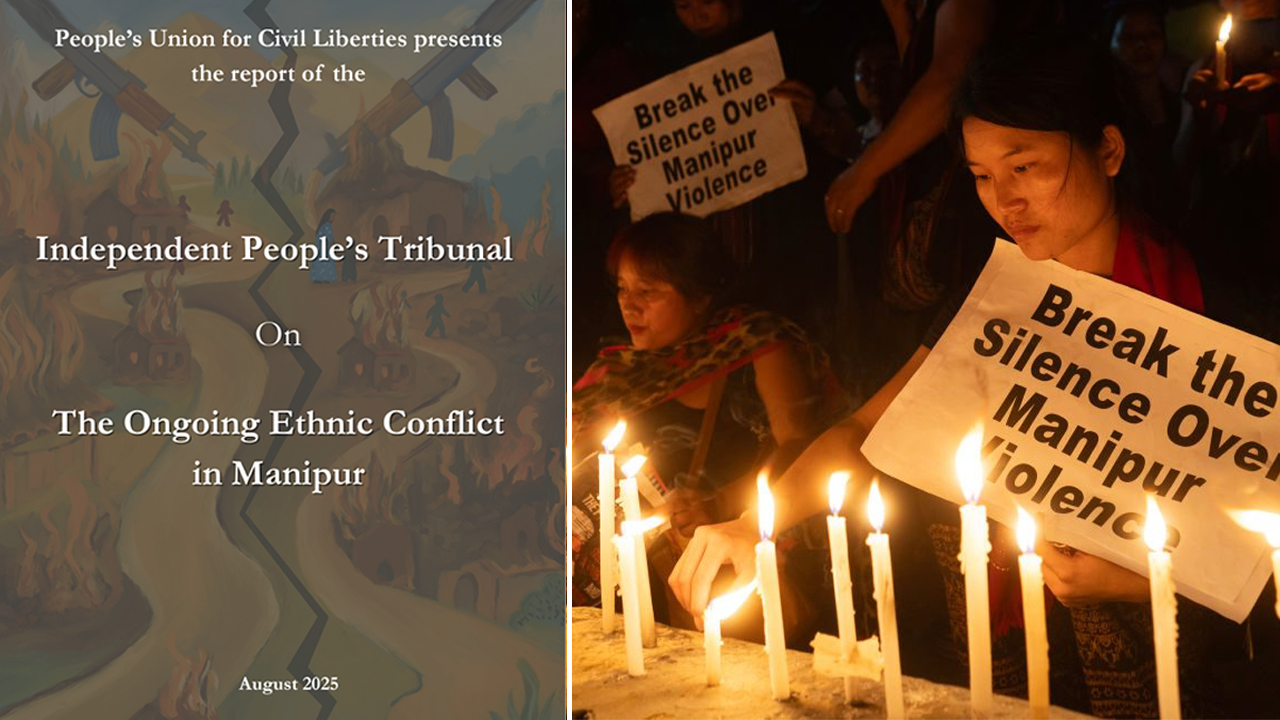
The overwhelming evidence placed before the Tribunal lays bare the gruesome and systemic nature of the violence, the role of the radical groups, the failure of state institutions and the failure of the Central government to fulfil its constitutional responsibility to ensure that Manipur remained under the regime of both rule of law and the Constitution.
Groundxero | Aug 20, 2025
Manipur violence was not spontaneous, but planned, ethnically targeted and facilitated by state failures, says a report by the Independent People’s Tribunal on Manipur released on Wednesday (August 20, 2025) at the Press Club of India, New Delhi. The Tribunal on Manipur was constituted by PUCL in 2024, in the context of prolonged state-wide violence and serious issues of failure of constitutional governance in the state of Manipur.
A press release by PUCL stated that in light of the serious concerns raised on the response of the government functionaries to the devastating violence that shook Manipur following May 3, 2023, between the Meitei and Kuki-Zo communities, and the role played by the various stakeholders, the Independent People’s Tribunal endeavoured to understand and document the conflict and the precarious situation prevailing in Manipur, with a view to ensure accountability, justice and redressal for the people of Manipur.
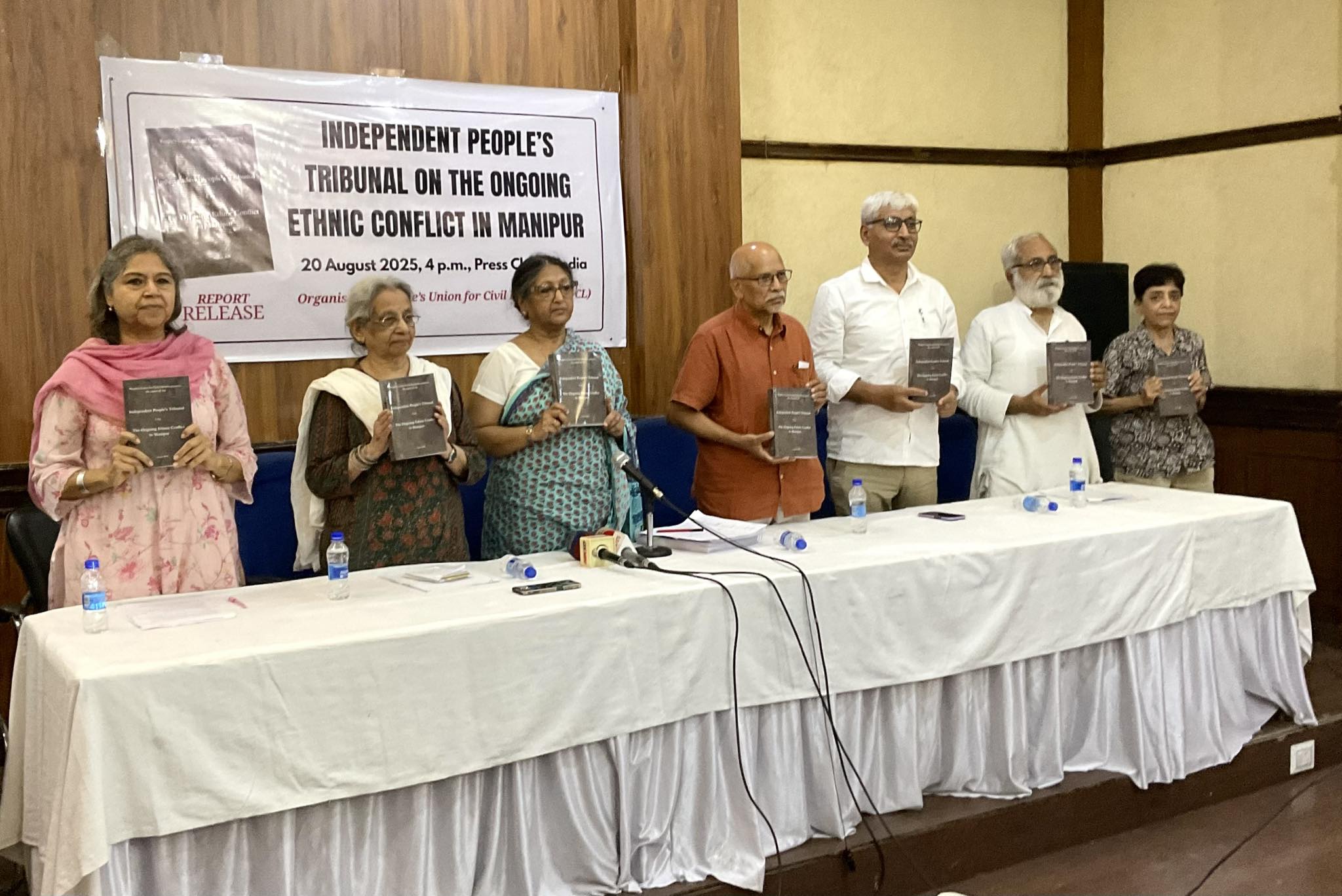
The Independent People’s Tribunal was chaired by Kurian Joseph, former Judge, Supreme Court of India, and the jury members included former Judges of High Courts, retired IAS and IPS officers, social scientists, feminists, academics, peace and human rights activists, advocates and journalists among others.
More than 150 victims and survivors of the conflict in Manipur individually deposed before the Tribunal. Additionally many more joined group discussions both physically and virtually. Others contributed by sharing documents and insights before the Tribunal.
The overwhelming evidence placed before the Tribunal lays bare the gruesome and systemic nature of the violence, the role of the radical groups, the failure of state institutions and the immense humanitarian fallout that followed, says the report. The testimonies of the survivors present a stark picture of the failure of the state authorities and institutions to protect them, leaving them to fend for themselves. The jury also noted the failure of the Central government to fulfil its constitutional responsibility to ensure that Manipur remained under the regime of both rule of law and the Constitution.
Observations and findings in the Report
Apart from the pre-existing factors – historical ethnic divisions, socio-political marginalisation and land disputes – leading to the eruption and escalation of the ethnic conflict, what led to escalation of feelings of mistrust and enmity between the communities were the systematic hate campaign played out through digital media and statements made by the political leadership in the prelude to the conflict, observed the Tribunal’s report.
The report stated that the Manipur High Court’s directive on March 27, 2023, recommending Scheduled Tribe (ST) status for Meiteis served as a vital trigger, as it was perceived by the tribal groups, including the Kuki-Zo groups and the Nagas, as a threat to their constitutional protections. This is in turn sparked protests across all tribal districts leading to a major protest programme on 3rd May, 2023 in all the Hill districts. While by and large the protests ended peacefully, violence erupted in a few places which soon engulfed the whole state.
The tribunal pointed to a stream of narratives that dominated the discourse around the conflict. The narrative of continuous immigration of Kuki-Zo communities from Myanmar, was heard commonly across testimonies by Meitei deponents. The jury, however, found that the allegation of population influx raised by Meiteis and also propagated by the political leadership, holds little ground.
The report stated that another contending narrative was that of the involvement of Kukis in poppy cultivation, in line with the then Chief Minister Biren Singh’s ‘war on drugs’ which translated into popular propaganda against Kukis. This narrative was strongly countered by Kuki deponents who called it a conspiracy to criminalise and demonise Kukis, when in fact the key players came from different communities, especially those who occupied key government and bureaucratic positions.
The jury found strong evidence that these narratives and hate propaganda incited feelings of enmity and mistrust between the Meiteis and Kukis. The jury has also attributed a significant role to the media in the conflict, who actively shaped public perception and escalated tensions. While the print media was partisan and lacked investigative rigour, digital channels and social media were used to spread unverified and inflammatory content.
The deponents to the tribunal also expressed a strong suspicion that a larger agenda was at play, pointing toward geo-political considerations influencing the prolonged violence. The marked reluctance of the government to take concrete measures to strictly enforce the rule of law in an objective, unbiased manner and put an end to the violence, also sowed seeds of suspicion in the deponents, said the tribunal’s report.
The report highlighted that the violence was not spontaneous, but planned, ethnically targeted and facilitated by state failures. The Report documented a deep-rooted belief among survivors and victims, that the state either allowed the violence to happen or actively participated in it. Many deponents to the tribunal attributed the flare-up of violence to the political and administrative decisions of former Chief Minister Biren Singh. The state government downplayed the violence, made no significant arrests of radical groups like that of the Arambai Tenggol and Meitei Leepun, stated the report.
The report documented widespread sexual violence during the conflict which occurred both in the Valley areas as also in the Hills, and pointed that many incidents of sexual violence were unreported due to fear, trauma and lack of institutional support. The jury noted that even when women sought protection from the police and security forces, they were not only refused help them, but there were instances when the police handed them to violent mobs. Due to the complete loss of trust in the state machinery, the women survivors instead of reaching out to police stations, sought protection from their own communities, which displays the extent of state failure, observed the report.
The jury members found the relief and rehabilitation measures for the violence-struck communities in Manipur, grossly inadequate, delayed and unevenly distributed. The jury also found that the recommendations of Joint Rapid Needs Assessment (JRNA) and Gita Mittal Committee covering shelter, nutrition, sanitation, education and psychological support were largely unimplemented.
The report narrates how the already fragile healthcare system in Manipur crumbled completely in the face of violence which was marked by attacks on hospitals and clinics, looting and destruction of medical supplies and ambulances, and a complete breakdown in referral networks and transport infrastructure. The `Internally Displaced Persons’ (IDPs) were forced into relief camps where healthcare became even more limited exacerbated by inadequate nutrition, which in particular affected women, children, elderly and the differently abled, stated the report. The report records how patients were also denied healthcare on communal lines. The jury observed the deep psychological impacts of the violence on the people, including Post Traumatic Stress Disorder (PTSD) in survivors, acute anxiety and depression among displaced people and the lasting consequences of the violence on the mental health of children and women survivors of sexual violence. The jury noted the complete lack of mental health intervention in place to address this.
The jury found that the conflict-ridden state of Manipur also witnessed a complete breakdown of legal, judicial and constitutional mechanisms when it most needed it. The key symptoms of the collapse identified in the report include the failure of the courts to issue urgent directives to protect life and property, delayed or absent investigation into serious crimes, FIRs being selectively filed, and active participation of law enforcement officers in the violence. The report documents the extent of police complicity and failure of security forces to maintain neutrality.
The report indicts both the State and Central governments for their failures to implement the rule of law and adherence to the Constitution, which has led to denial of justice and continued displacement of affected people for over 27 months. The jury found that compounding the failure of justice was the lack of external judicial oversight. The Supreme Court appointed a Committee led by Justice Gita Mittal, and also ordered CBI investigation in specific rape cases, however, these interventions were narrow in scope and lacked follow-up, said the jury. The jury concluded that the absence of legal redress and the collapse of constitutional mechanisms have deepened ethnic divisions.
Jury recommendations and strategies for justice, peace and accountability
Accountability and justice is foundational to rebuilding the trust, democracy and coexistence in Manipur. The report calls on India’s Judiciary, Parliament and civil society to reclaim this duty and ensure that Manipur does not become a template for future impunity. Towards this, access to justice needs to be ensured for all and a permanent bench of the Manipur High Court needs to be established in the hill region. A Special Investigating Team (SIT) needs to be set up to conduct independent investigation of the thousands of cases arising from the conflict and to enquire into the role of the armed forces, security officers and police. The hate propaganda and inflammatory speeches that led to incitement and escalation of violence need to be prosecuted along with action against the authorities who failed to exercise their powers to prevent it. Meanwhile, a restorative justice framework is essential for addressing grievances and promoting healing, that is hinged on acknowledging harm, reparations, and reintegration over mere punishment. The Report emphasises that lasting peace in Manipur requires structural changes, community dialogue, legal accountability and sustained moral leadership.
The Report expresses disappointment that even more than 27 months after the ethnic violence first erupted, Manipur remains a disturbed state. This constitutes a collective failure, which can no longer be disregarded. Detailed recommendations have been provided in the report by the jury, towards ensuring justice and accountability, and addressing the concerns raised in the report in the various chapters.
(The full Report is available on the PUCL website on https://pucl.org/manage-reports/independent-peoples-tribunal-on-the- ongoing-ethnic-conflict-in-manipur/.)