
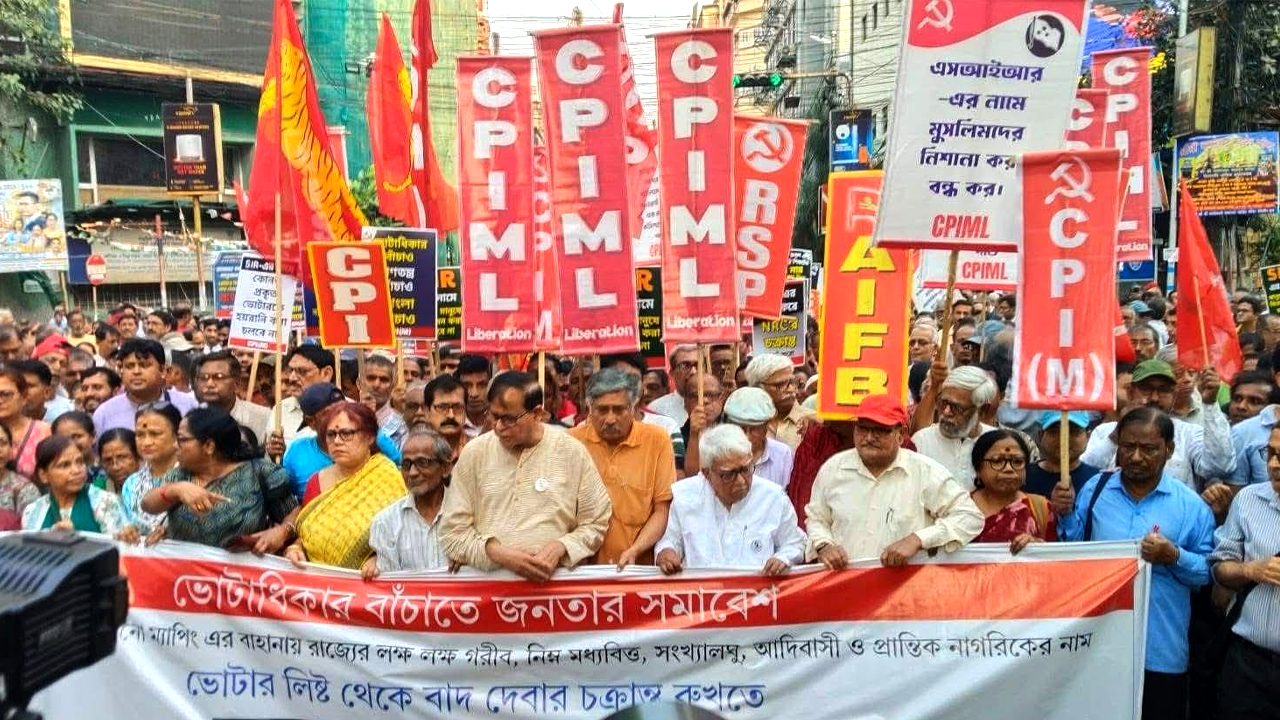
As West Bengal’s Left struggles to recover from years of electoral decline and political marginalisation, the coming together of CPI(M) and CPI(ML)-Liberation in the upcoming assembly elections signals a tentative attempt at forging left unity. This piece examines the historical weight, present compulsions, and uncertain possibilities of this emerging alignment.
by Subho Maitro
A handful of left-minded people gathered in a decrepit hall of a two-storied dilapidated building on Creek Row with a new hope of left consolidation in the state of West Bengal. The location was near Sealdah station; one of the busiest termini of Indian Railways, and amidst the hustle and bustle of the day, intense discussion was going on regarding the formation of a platform to support the Left candidates in West Bengal. They were enthused by a new development: for the first time in West Bengal, the CPIM-led Left Front shared seats with CPIML Liberation, a Naxalite party. This may not be something extraordinary if we see the current pattern of electoral alliances in India, and these Left parties are fighting together against the BJP and its NDA coalition in different states, and are also present in the INDIA bloc. But the significance of sharing seats is something totally different in West Bengal.
Firstly, if we see the history of the communist party, it split for the second time in the late sixties; one of the major issues was participating in elections. CPIM, the newly formed party which broke away from CPI, got split again and the Marxist-Leninist party was formed. The ML group came to be known as the Naxalite party after the armed peasant uprising of Naxalbari. CPIML Liberation carries the legacy of Naxalbari in more than one way, and though it has participated in elections, it has ideologically opposed the politics of the Left Front and CPIM. The wound and scar of that separation are deep here in the state.
Secondly, Liberation took part actively in the Singur and Nandigram movements, which resulted in the ousting of the Left Front from power in West Bengal and brought the TMC to power. Here the rift is not only ideological but also one of direct power politics, as CPIM thinks it was a grand conspiracy in which the Naxalites aligned with the TMC to bring them down. So, when parties from two opposite camps of the Left share seats in West Bengal, it has some significance.
The common ground for seat sharing was reached as the threat of the BJP and NDA loomed large over the country, which leftists think of as a fascist threat. The same threat also looms over the state of West Bengal. This catastrophe is bringing them together. Even if not a merger, many hope at least unity is the need of the time, and this should reflect not only in movements but in electoral politics too.
This is not an easy task, though. The Left overall has become anaemic in the last one and a half decades in this state, with mainstream Left parties like CPM, CPI, and others rapidly losing their cadre base and voters. Electoral politics in the state has become polarised between the BJP and the Trinamool Congress. The percentage of the Left vote has come down to a single digit. Only one ally, ISF, won a seat in the last Assembly election, while the rest remained at zero. In the case of the mass or civil movement surrounding the incident of R.G. Kar, though CPIM leaders initiated the struggle, they could not provide strong leadership to it, and the movement took an apolitical turn and eventually died down, with the mother of the victim now standing as a BJP candidate. I was talking to a CPIM cadre from Rashbehari, an assembly constituency in South Kolkata, where ML candidate Manas Ghose, supported by the Left Front, is contesting. He admitted that their voters and supporters have dwindled there. “The demography of this place has changed; the new gated apartments have people who don’t even care who comes to power and who does not.” There are still some pockets where working-class people stay, and the Left is trying to reach out to them with utmost urgency.
The usual slogan of CPIM has changed, and now I heard a new slogan: ‘bam oikya, bam oikyo zindabad’ (Left unity, long live Left unity). Rita Sen Chaudhury, a veteran CPIM leader, said, “Yes, there are problems, and some of them are quite practical, like the voting symbol. The three-star symbol of Liberation is not what CPIM voters are aware of, so one major task is to make people aware of that symbol.” This is not an easy task, as, like the other big parties, they don’t have the financial power to get LED billboards and massive flexes. Instead, they are depending on graffiti, handbills, and smaller flex banners, with the name, photo, and symbol of the candidate on them. At the ground level, there seems to be, for the first time, a buzz for this Left unity. “Cadres of both parties are trying to understand each other,” Malay Tiwary, a veteran Liberation leader, said smilingly. “We are trying to focus on the issues where we have the same opinion, like the SIR, lack of development in the state, issues of employment, labour law, etc.” Both parties together are holding street-corner protests against the SIR and the disenfranchisement of legal voters.
This election in West Bengal is not only about fierce fights between parties but also about the voting rights of citizens. SIR, or the Special Intensive Revision of the electoral roll, has created fear and panic in the minds of citizens, as till now nearly 90 lakh people’s names have been deleted, and over 27 lakh are still waiting for hearings in tribunals to know their fate. Many on the Left think SIR is a ploy of the BJP to undermine the Constitution of the country and make Muslims, minorities, and women second-grade citizens without the right to vote. At a street corner, one CPM leader said in his speech categorically, “This is not a revision but rigging by the BJP; SIR means Special Intensive Rigging.” So, along with the fight for votes, the combined Left has to fight against the deletion of millions of voters’ names. There is a call within a section of the Left to boycott the election, as they are of the opinion that parties participating in this farcical election, where millions will be unable to cast their votes, are legitimising this farce. Not that CPIM and Liberation are exactly on the same page about SIR in Bengal. CPIM initially said that SIR is necessary to weed out false voters from the list, but that shouldn’t be an excuse for deleting legitimate voters. Liberation, on the other hand, has staunchly maintained from the beginning that SIR is a tool being used by the central government to bring back CAA and NRC through the backdoor.
“Yes, the Left Front had this perception before the declaration of the election that this revision can weed out false voters, but we never believed that,” said Abhijit Mazumdar, the State Secretary of Liberation. “Our experience in the Bihar SIR and election showed us that the BJP has a different purpose. All these terms such as ‘logical discrepancy’ and ‘under adjudication’ seem to be tools for flouting constitutional rights. Now the priority is to get back the right to vote,” he added. Both parties are emphasising the question of disenfranchisement, which is affecting the citizenship of millions of people. “Some left-minded people and organisations think we should boycott this election, but we think that will give the BJP a free hand, and this boycott will hamper the fight for the right to vote, which is a constitutional right granted to the citizens of India,” said Mr Majumdar. He, on the other hand, wants a broad Left movement keeping the fight for citizenship at the forefront. To him, this seat sharing is not only for the election but also a demand of the time. The BJP and NDA are the number one enemies of democracy, and all these — be it SIR, or amendments surrounding labour rights and labour laws, or the changing of MNREGA to VB-GRAM-G — are part of a fascist scheme. To fight these, a broad Left coalition is needed, and the election is a part of it, opined Mr Majumdar.
It is not that a new coalition has been formed, or that a merger between the parties is happening, nor that all differences have dissolved or been sorted out. There are differences in the economic models proposed by the two parties. Even concerning the question of TMC, the ruling party, there are differences of opinion. Unlike CPIM, Liberation doesn’t equate TMC with the BJP, but they admit that this binary between BJP and TMC is hampering the basic issues of the people from coming to the forefront and weakening the Left position, which has to be addressed.
Mayukh Biswas, a dynamic young leader of CPIM who is contesting from Dumdum in this Assembly election, said, “We realised that we have to bring in more people — firstly the other Left parties, then secular parties and progressive people — and broaden the circle to combat the BJP. We know that some people in Delhi think Mamata Banerjee is the messiah against the BJP, but we saw in the state how, under her rule, RSS and BJP gained ground.” Mayukh is a young leader who had been the All India secretary of the Students’ Federation of India (SFI). He has experience of handling different Left parties and groups, and it is interesting that these young leaders, especially those who came into politics post Singur-Nandigram movement, are interested in a greater coalition among Left parties and secular-minded people. “The issues of Deucha Pachami or the deforestation of North Bengal are happening now, and we have to fight the ailments of today by coming together, forgetting what happened in the past. We have seen many Left parties coming together in Latin America and elsewhere in the world,” said Mayukh Biswas. He believes seat sharing in this election can facilitate the formation of a broader Left coalition for mass movements in the future. He emphasised that not only political parties but also various rights-based activist groups like mid-day meal workers and ASHA workers’ associations have to be included, and an overall consolidation of Left and secular forces is needed. It seems that the younger generation, which does not carry the baggage of old grudges, is rooting for Left unity in Bengal, the resonance of which can be felt across the state.
So, there seems to be both scope and space for a new turn in Left politics in the state of West Bengal, which has become heavily polarised between two parties — BJP and TMC. The election result is not the only indicator of this relationship, and one has to wait to see how this moves forward in the future. One interesting indication is that Liberation candidate Sumanti Ekka is contesting from Phansidewa Assembly seat, the place which, along with Naxalbari and Khoribari, saw the uprising of 1967 that led to the split of CPIM and the birth of the Marxist-Leninist party. In Phansidewa, these two parties are coming together to contest an election, which, even though symbolic, can be the beginning of a new reunion among long-separated comrades.
Subho Maitro is a writer and freelance journalist.