
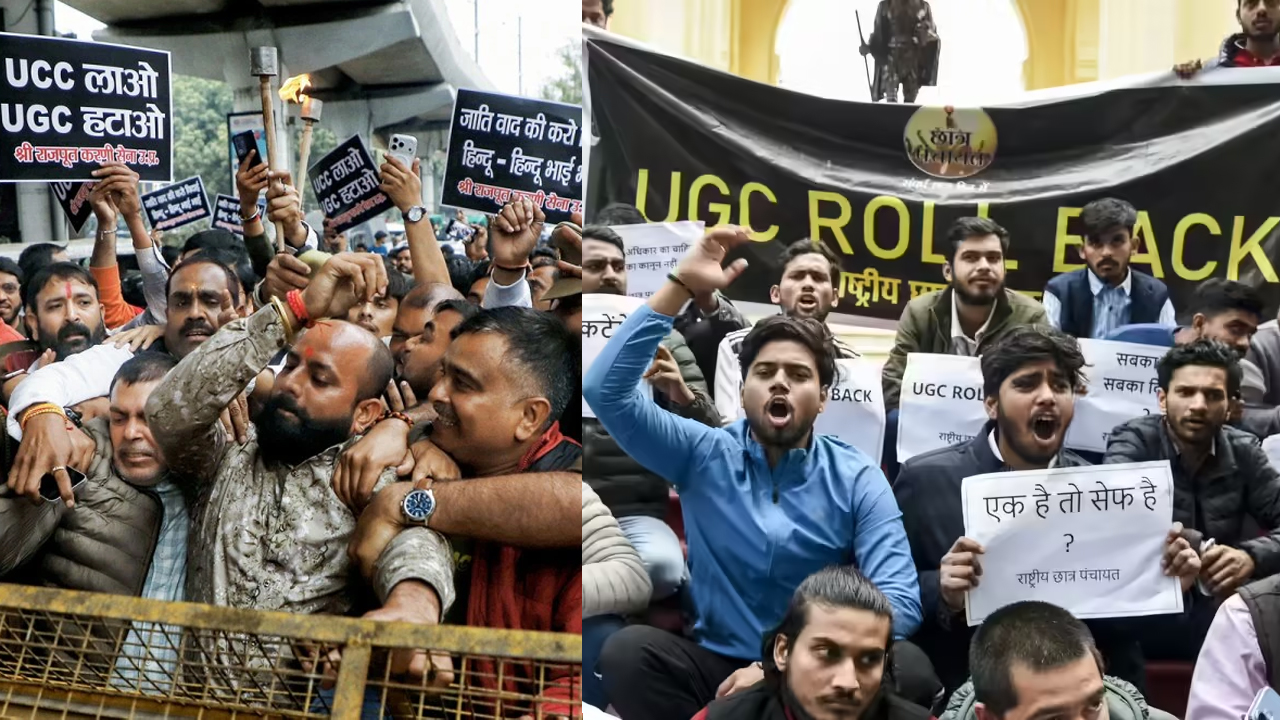
The coordinated violence in Indian university campuses in February 2026 following the UGC’s notification of new equity regulations in context of caste discrimination in educational institutions reveals the nature of the present moment: a systematic assertion of savarna neo-fascism—an ideological project that seeks to violently erase any challenge to caste supremacy, even when such challenges emerge through minimal, formal, institutionally sanctioned mechanisms.
By Tinku Khanna
Groundxero | Feb 21, 2026
Introduction: Naming the System
Between January and February 2026, Indian university campuses witnessed coordinated violence that demands precise naming: not isolated casteism or institutional failure, but a systematic assertion of savarna neo-fascism—an ideological project that seeks to violently erase any challenge to caste supremacy, even when such challenges emerge through minimal, formal, institutionally sanctioned mechanisms.
On January 29, the Supreme Court of India stayed the UGC’s Promotion of Equity in Higher Education Institutions Regulations, 2026—regulations that responded to 98 student deaths by suicide from marginalized communities between 2019 and 2021. The regulations proposed modest accountability: Equal Opportunity Centres, complaint tracking, and annual reporting. There was no structural transformation, no redistribution of power—merely a requirement that institutions record discrimination and demonstrate action taken. But, within sixteen days, they were stayed.
Within days of the regulations being notified, campuses erupted in organized violence. On February 10, ABVP members physically attacked historian Professor S. Irfan Habib at Delhi University for defending academic freedom. On February 14, upper-caste students wielding sticks and stones violently attacked Dalit, Bahujan, and Adivasi students who were peacefully demonstrating for the implementation of SC/ST Protection Committees, while chanting casteist slurs.
These are not discrete events but manifestations of systematic fascism: the construction of a Hindu state based on savarna ideology, where any assertion of constitutional rights by those marked inferior in the caste hierarchy triggers coordinated institutional and extra-institutional violence to restore dominance.
This article analyzes savarna Hindutva as neo-fascism—not as rhetoric, but as a precise description of an ideological formation sharing fascism’s core characteristics: mythological purity, mobilization through victimhood narratives, organized street violence against internal enemies, state institutional capture to legitimize this violence, and the framing of any challenge to supremacy as an existential national threat.
The question is not whether individual caste discrimination occurs in universities—it does, overwhelmingly, as documented by 98 deaths and over 13,000 SC/ST/OBC student withdrawals from premier institutions. The question is: why does even formal, institutionally sanctioned, legally mandated accountability trigger such swift, coordinated, and comprehensive backlash? Because what we face is not isolated prejudice but networked institutional power—caste as the foundational architecture of a fascist project consolidating in India.
Theorizing Savarna Neo-Fascism: Structural Characteristics
Classical European fascism (1920s–1940s) displayed specific structural features: the construction of national/racial purity mythologies corrupted by internal enemies; mobilization of dominant groups through victimhood narratives promising restored greatness; organized paramilitary violence as strategic intimidation; state institutional capture providing legal cover; and a defensive framing—protecting the nation from internal destroyers.
Savarna Hindutva displays these characteristics, adapted to caste hierarchy.
First, mythological purity: “Sanatan Dharma” and “Vedic civilization” are invoked as a golden age in which Brahmins maintained divinely sanctioned authority over knowledge and social organization. Constitutional equality is reframed not as justice but as civilizational betrayal. The Purusha Sukta positions varna hierarchy as cosmic creation—challenging caste thus becomes equivalent to challenging universal order itself.
Second, victimhood mobilization: despite overwhelming representation in faculty, judiciary, and bureaucracy, upper-caste mobilizations frame themselves as victims of “reverse discrimination.” UGC regulations protecting vulnerable students are portrayed as attacks on merit and Hindu dharma. Union Minister Giriraj Singh’s remark—that the regulations were “dividing Sanatan dharma”—reveals how constraining Brahmanical dominance is equated with attacking Hinduism. This inversion—where the powerful claim victimhood—is psychologically foundational to fascist mobilizations.
Third, organized violence: the attacks at Delhi University were not spontaneous but coordinated actions by RSS-trained ABVP cadres functioning as campus paramilitary forces. Violence serves multiple purposes: it intimidates dissenters, demonstrates institutional impotence, emboldens perpetrators, normalizes violence, and creates an environment where constitutional rights exist only on paper.
Fourth, state capture: the Supreme Court’s rapid stay, university administrative inaction, and police failure to act all indicate institutional alignment with dominant-caste interests. This is not institutional breakdown but a state functioning in accordance with savarna supremacy while maintaining a constitutional façade.
Fifth, caste-religious nationalism fusion: savarna Hindutva constructs a specifically casteist Hindu civilization where hierarchy is seen as dharmic order. Challenging caste supremacy is reframed as attacking Hindu civilization itself.
“Neo-fascism” here is analytical precision, not rhetorical escalation. We witness a Hindu state—not merely Hindu Rashtra as territorial aspiration but comprehensive social formation—based on savarna ideology operating through constitutional nullification: rights exist formally but are unenforceable against organized supremacist violence; legal protections exist nominally but are stayed or ignored; institutions exist structurally but are captured ideologically.
This is fascism adapted to Indian conditions: racial nationalism becomes caste-religious nationalism; Jews/Roma as enemies becomes Dalits/Muslims; imperial glory becomes Brahmanical order; totalitarian rule becomes electoral democracy captured by supremacist ideology.
February 2026 Violence: Fascism in Action
The Delhi University attacks exemplify savarna neo-fascism in operation. They were not random acts of prejudice but strategic assertions of dominance — coordinated to signal who has authority to speak, who can demand accountability, and consequences when marginalized communities refuse subordination.
Professor Habib—whose work challenges communal historiography—was targeted as a Muslim scholar defending secular education —represented everything savarna fascism seeks to eliminate. The attack asserted that academic freedom does not protect those who challenge Hindutva narratives; institutions cannot / will not protect designated enemies.
The subsequent attack on Dalit students made the message explicit. These students weren’t organizing revolutionary resistance—they were demanding SC/ST Protection Committees, formal institutionally mandated bodies. They asked the institution to follow its own policies. That even this formal, procedural demands triggered coordinated violence reveals fascist logic. The violent reaction was not about preventing genuine threat (Protection Committees would likely prove as ineffective as existing frameworks failing to prevent 98 deaths and 13,000+ withdrawals) it was about denying the legitimacy of any demands by the Dalit students. The violence was to assert that their proper role is silent endurance, that asserting constitutional rights triggers would trigger physical retaliation.
The symbolism was deliberate: students peacefully demonstrating for protection from caste violence were subjected to caste violence—beaten while casteist slurs were chanted. The message to marginalized students was clear: institutions won’t protect you, police won’t defend you, and constitutional rights exist only if you don’t exercise them.
Institutional responses were equally revealing. Administrative calls for “peace and restraint from all sides” erased distinctions between perpetrators and victims, framed systematic supremacist violence as conflict between equals, positioned administration as neutral arbiter rather than institution legally obligated to protect students from discrimination. No disciplinary action was taken against ABVP attackers or upper-caste assaulters. No FIRs were filed.
This “both-sides” framing is central to fascist plausible deniability. Refusing to name attackers as perpetrators and victims as victims, treating organized supremacist violence as equivalent to demands for constitutional protection, institutions preserve neutrality appearance while effectively siding with power. This is not institutional failure—it is institution functioning as designed in savarna neo-fascist system. Universities staffed overwhelmingly by upper-caste administrators/faculty operate to reproduce caste hierarchy.
DU violence must be understood contextually with the January 29 Supreme Court’s stay order. It signaled to upper-caste mobilizations: even modest accountability will be blocked institutionally. Even if regulations exist on paper, organized violence will ensures its non-implementation. Even if Dalit students have constitutional rights, savarna forces ensure they remain abstract.
This is the essence of fascist operation: formal democracy and constitutional governance structures remain, providing legitimacy to the ruling structure, while actual power operates through extra-institutional violence in coordinated and complicity with institutions.
The UGC Crisis: Systematic Fascist Erasure
The UGC regulations crisis must be understood not as a policy dispute but as a revealing instance of how savarna neo-fascism systematically erases minimal challenges to dominance.
The UGC regulations emerged from documented trauma: 98 marginalized community student deaths by suicide (2019-2021); 55% of suicides in elite institutions (2014-2021) from SC/ST/OBC communities; 13,000+ SC/ST/OBC withdrawals from premier institutions (2018-2023); 118.4% jump in discrimination complaints (2019-2023).
The mothers of Rohith Vemula and Payal Tadvi filed a PIL in 2019 demanding stronger protections. Even the Supreme Court acknowledged that the 2012 regulations have failed catastrophically. The 2026 regulations resulted—seven years after filing of the PIL, a decade after their sons died.
The regulations proposed among other things Equal Opportunity Centers, complaint tracking via MANAS-SETU portal; annual reporting; penalties for non-compliance. They expanded discrimination definition to include religion, race, gender, disability while pointing out caste-based discrimination as asymmetric—targeting SC/ST/OBC—reflecting basic reality that caste hierarchy operates directionally.
These didn’t propose redistributing faculty positions, curriculum changes, creating autonomous Dalit organizations, or funding anti-caste movements.
The proposed measures were minimal and defensive. They asked institutions to record complaints, establish formal bodies to address discrimination, and report annually. Even this triggered massive backlash. Within days, coordinated national mobilization of various upper-caste/ savarna groups erupted: campus protests, social media campaigns framing regulations as “anti-merit”/”anti-national,” legal petitions filed in the Supreme Court petitions, upper-caste BJP leaders threat of resignations demanding withdrawal of the regulations. Rather than defending discrimination directly—politically untenable—they argued regulations were discriminatory, divisive, and unconstitutional. Legal challenges centered on asymmetric definition “excluding” general category students, violating constitutional equality. They framed protections as discriminatory against upper-caste students—a reality inversion typical of fascist logic: dominant groups claim victimhood justifying violence against those seeking protection.
Within sixteen days of the UGC notification, on January 29, the Supreme Court stayed the regulations. No established legal tests were applied (prima facie case, irreparable injury, balance of convenience). The Court raised concerns about “ambiguity” and “misuse possibility”—grounds never considered sufficient for a stay on legislation, particularly in civil rights cases.
Chief Justice Surya Kant asked: “After whatever we have gained in the past 75 years towards forging a casteless society, are we going for a regressive policy now?” This assumes substantial progress toward castelessness—contradicted by every data point on institutional monopolies, student deaths, discrimination complaints, hostile environments. It treats caste visibility as regression rather than recognizing that violence operates with impunity precisely because institutions refuse naming it.
The stay effectively means the 2012 guidelines will “operate in the meantime”. The status quo will continue. Given endemic judicial delays, this “interim” arrangement is likely to persist indefinitely.
Remarkably, the same day, the identical bench refused PIL seeking minimum wages for domestic workers—overwhelmingly Dalit/OBC/Adivasi women. The CJI observed: “How many industrial units in the country have been closed thanks to trade unions? Let us know the realities. All traditional industries in the country, all because of these ‘jhanda’ unions, have been closed, all throughout the country. They don’t want to work. These trade union leaders are largely responsible for stopping industrial growth in the country,” He also expressed concern that extending legal protections such as minimum wages to domestic workers could result in trade unions dragging households into prolonged litigation, turning them into a “legal battlefield”.
Dalit students seeking protection against discrimination might “divide society”; Dalit women forming unions to seek fair wages might “reduce growth” – the Court’s observations echoing neoliberal economic arguments resembled the political-economic illogic of the ruling government – the burden of social harmony falls on the oppressed, enduring exploitation silently. This is not judicial failure but judiciary protecting caste and class supremacy while maintaining constitutional governance facade.
The UGC crisis exemplifies the savarna neo-fascist method: even formal, institutionally sanctioned, legally mandated accountability—threatening no structural reforms—triggers swift coordinated resistance through complicit institutions. Judiciary blocks legal protections; extra-institutional violence ensures even guaranteed rights can’t be implemented; the apparatus maintains its defending constitutional equality against divisive identity politics.
Fascism consolidates not through abolition of democratic institutions but through their systematic nullification, preserving structures while rendering them inoperative against majoritarian power.
Caste as Fascist Infrastructure
Understanding why savarnas feel threatened by measures like UGC regulations requires examining caste not as social hierarchy or prejudice but as comprehensive infrastructure reproducing dominance across generations.
The Indian society organized on the basis of varna system, access to education was part of caste practice and privilege. Brahmins claimed exclusive access and authority over knowledge; their literacy/learning monopoly was assumed to be divinely sanctioned. Lower castes were denied education not incidentally but fundamentally to maintain the social hierarchy. Brahmanical texts prescribed death for Shudras hearing Vedas, harsh punishment for violating this boundary. Controlling access to knowledge controls power hierarchy generationally.
Post-independence, Ambedkar understood that without educational access, political equality remains hollow. Reservations for Dalits were meant to break Brahmanical knowledge monopolies. Yet formal rights prove insufficient against systems designed for self-reproduction.
Statistics reveal systematic monopoly: 98% faculty at top five IITs is upper-caste (in a country where upper castes are perhaps 15-20% population). IIT Bombay: 6 of 735 faculty from Scheduled Tribes—0.88% against 7.5% constitutional mandate. IIM Indore: zero SC/ST professors despite explicit obligations. Twenty-one of twenty-three IITs and fourteen+ IIMs systematically violate reservation norms.
IIT Bombay’s dean of faculty affairs when questioned about 98% upper-caste presence, said: “equating under-representation with discrimination is incorrect. There is no discrimination.” This reveals: upper-caste dominance is invisible normalcy, natural merit/talent rather than outcome of structural privilege. Savarnas beneficiaries literally cannot see the system—they consider their position as individually earned excellence.
The overwhelming upper-caste composition creates campus environments where hierarchy operates as common sense. IIT Bombay has separate vegetarian/non-vegetarian seating—institutionalizing untouchability under sanitized language. IIT Madras has separate entrances and wash-basins. Hansraj College discontinued non-vegetarian food entirely. These institutionalize Brahmanical purity/pollution notions, making untouchability an official practice while claiming “dietary choice.”
Marginalized students are identified as “quota students” from day one. Their very presence in the campus is treated as unearned favor, not their constitutional right. Faculty questions their credentials/capabilities. And then there is Peer exclusion. Informal networks essential for success—study groups, lab partnerships, hostel friendships—operate along caste lines.
Reported discrimination is always dismissed as “ragging,” “personality conflicts,” “adjustment issues” rather than recognized as caste violence. Committee investigation findings invariably report “no overt discrimination”—qualifiers acknowledging discrimination exists while denying institutional responsibility. Each suicide triggers committees finding “no overt discrimination,” confirming unless violence is direct/documented, it doesn’t exist. After Darshan Solanki’s 2023 death, IIT Bombay said “no specific evidence of direct caste-based discrimination”—identical language as in the case of Aniket Ambhore’s death in 2014.
Formal committees threaten the system not because they’d transform power—decades of dysfunctional SC/ST cells prove they can be neutered—but because functional accountability would make the discriminatory system visible, record documentation, provide ground for legal challenge, acknowledge caste violence exists when perpetrators deny it.
Savarna neo-fascism requires violence simultaneously pervasive and invisible: pervasive enough to maintain dominance through daily degradation and systematic expulsion, invisible enough to maintain narratives that contemporary India is merit-based democracy where caste is archaic prejudice rather than foundational architecture of institutional power.
Caste as Fascist Infrastructure
Understanding why savarnas feel threatened by measures like UGC regulations requires examining caste not as social hierarchy or prejudice but as comprehensive infrastructure reproducing dominance across generations.
The Indian society organized on the basis of varna system, access to education was part of caste practice and privilege. Brahmins claimed exclusive access and authority over knowledge; their literacy/learning monopoly was assumed to be divinely sanctioned. Lower castes were denied education not incidentally but fundamentally to maintain the social hierarchy. Brahmanical texts prescribed death for Shudras hearing Vedas, harsh punishment for violating this boundary. Controlling access to knowledge controls power hierarchy generationally.
Post-independence, Ambedkar understood that without educational access, political equality remains hollow. Reservations for Dalits were meant to break Brahmanical knowledge monopolies. Yet formal rights prove insufficient against systems designed for self-reproduction.
Statistics reveal systematic monopoly: 98% faculty at top five IITs is upper-caste (in a country where upper castes are perhaps 15-20% population). IIT Bombay: 6 of 735 faculty from Scheduled Tribes—0.88% against 7.5% constitutional mandate. IIM Indore: zero SC/ST professors despite explicit obligations. Twenty-one of twenty-three IITs and fourteen+ IIMs systematically violate reservation norms.
IIT Bombay’s dean of faculty affairs when questioned about 98% upper-caste presence, said: “equating under-representation with discrimination is incorrect. There is no discrimination.” This reveals: upper-caste dominance is invisible normalcy, natural merit/talent rather than outcome of structural privilege. Savarnas beneficiaries literally cannot see the system—they consider their position as individually earned excellence.
The overwhelming upper-caste composition creates campus environments where hierarchy operates as common sense. IIT Bombay has separate vegetarian/non-vegetarian seating—institutionalizing untouchability under sanitized language. IIT Madras has separate entrances and wash-basins. Hansraj College discontinued non-vegetarian food entirely. These institutionalize Brahmanical purity/pollution notions, making untouchability an official practice while claiming “dietary choice.”
Marginalized students are identified as “quota students” from day one. Their very presence in the campus is treated as unearned favor, not their constitutional right. Faculty questions their credentials/capabilities. And then there is Peer exclusion. Informal networks essential for success—study groups, lab partnerships, hostel friendships—operate along caste lines.
Reported discrimination is always dismissed as “ragging,” “personality conflicts,” “adjustment issues” rather than recognized as caste violence. Committee investigation findings invariably report “no overt discrimination”—qualifiers acknowledging discrimination exists while denying institutional responsibility. Each suicide triggers committees finding “no overt discrimination,” confirming unless violence is direct/documented, it doesn’t exist. After Darshan Solanki’s 2023 death, IIT Bombay said “no specific evidence of direct caste-based discrimination”—identical language as in the case of Aniket Ambhore’s death in 2014.
Formal committees threaten the system not because they’d transform power—decades of dysfunctional SC/ST cells prove they can be neutered—but because functional accountability would make the discriminatory system visible, record documentation, provide ground for legal challenge, acknowledge caste violence exists when perpetrators deny it.
Savarna neo-fascism requires violence simultaneously pervasive and invisible: pervasive enough to maintain dominance through daily degradation and systematic expulsion, invisible enough to maintain narratives that contemporary India is merit-based democracy where caste is archaic prejudice rather than foundational architecture of institutional power.
The Hindu State: Savarna Ideology as Fascist Formation
DU violence, Supreme Court stay, systematic institutional impunity—all manifest a Hindu state based on savarna ideology. Not Hindu Rashtra as territorial aspiration alone but comprehensive social formation: systematically organized assertion that Indian nationhood equals Hindu identity equals upper-caste authority, and challenging this equation threatens national existence.
The emerging Hindu state is not defined by religious demography but by ideological fusion: Hindu identity equated with savarna dominance; capturing state institutions by savarna ideology; deploying organized extra-institutional violence coordinated with institutional complicity; framing all resistance as anti-Hindu, anti-national, anti-civilizational.
Union Minister Giriraj Singh’s statement—UGC regulations “dividing Sanatan dharma”—exposes this fusion. Singh understood instinctively: constraining caste violence is attacking Sanatan dharma. Not confusion but honest articulation of savarna Hindutva’s core: caste hierarchy is not a social problem within Hinduism but Hindu civilization’s essence, varna-vyavastha is dharmic, constitutional equality is therefore anti-Hindu imposition.
This fusion makes sense recognizing Brahmanical texts position varna hierarchy as divine creation, not reformable human made institution. Purusha Sukta: four varnas emerge from cosmic being’s body parts—Brahmins from head, Kshatriyas from arms, Vaishyas from thighs, Shudras from feet. Not metaphor but ontological claim: hierarchy is built into universal structure. Challenging caste therefore challenges cosmic order, commits civilizational suicide.
Savarna Hindutva mobilizes this mythology as state ideology. “Restoring ancient Indian civilization” or “protecting Sanatan dharma” means restoring social order where: Brahmins control knowledge/ritual/cultural legitimacy; Kshatriyas exercise political/military power subordinated to Brahmanical authority; Vaishyas control commercial wealth deferring to upper varnas; Shudras provide labor/service denied knowledge or authority. Not incidental reformable hierarchy—in this vision, hierarchy is Hindu identity.
Symbols chosen to naturalize this equation: Cow protection mobilizes vegetarian practices inseparable from Brahmanical purity/pollution notions. “Vedic knowledge” glorification positions Brahmanical texts as scientific/spiritual authority erasing non-Brahmanical traditions. Campus “cleanliness/discipline” campaigns enforce Brahmanical aesthetic/behavioral norms. Sanskritization weaponized: marginalized communities told to “improve” by abandoning their cultural practices adopting Brahmanical ones, positioning upper-caste culture as superior civilization to aspire to rather than structural dominance requiring dismantling.
The Hindu state operates through “constitutional nullification”—not formal constitutional suspension triggering opposition but systematically rendering them inoperative. Constitutional equality exists; reservations exist; anti-discrimination laws exist; SC/ST Protection Act exists. But when institutions systematically violate reservations they face no consequences; discrimination complaints disappear into dysfunctional committees; 98 marginalized students die with committees finding “no overt discrimination”; Supreme Court stays accountability regulations—constitutional framework exists as a facade while actual power operates through savarna supremacy.
The Hindu state is fascist not despite constitutional democracy but through it—using democratic forms and constitutional language legitimizing supremacist substance. Elections continue mobilizing Hindu identity against internal enemies (Muslims, Christians, “anti-nationals”). Judiciary exists increasingly siding with dominant-caste/Hindu majoritarian interests. Universities function as caste hierarchy reproduction sites not challenge sites. The apparatus maintains its defending constitutional values against divisive identity politics—precisely fascist psychological inversion.
Conclusion:
The events of February 2026 clarify the nature of the present moment: savarna neo-fascism is consolidating through both institutional power and organized violence. The state operates through “constitutional nullification”: rights exist formally but are unenforceable in practice. Institutions maintain legitimacy while enabling dominance.
The Supreme Court won’t protect marginalized students. Universities won’t hold perpetrators accountable. Police won’t register FIRs against upper-caste attackers. Committees and regulations can’t dismantle this system because they operate within it, seeking slightly less violence while preserving structural relationships generating violence. They promise individual victim protection while preserving victim-producing mechanisms. They name discrimination as a problem while refusing to name caste supremacy as a system.
February 2026 violence clarifies: appeals to institutional neutrality or benevolence are becoming meaningless when institutions themselves are embedded within the system. This clarification, while terrifying, creates opportunity: building collective power and formations capable of resistance and transformation.
Contemporary movements, we have seen in recent times, embody these principles: Dalit student organizations defending collectively not waiting for institutional protection; autonomous women’s collectives creating support structures outside captured state institutions; trans/gender non-conforming groups developing community survival systems; workers’ unions/farmers’ movements organizing against capitalist exploitation. The question is whether these struggles—across caste, gender, sexuality, religion, class—can recognize struggles as integrated and organize accordingly —capable of confronting a system that operates simultaneously through legality and violence.
Endnotes
[1] The Wire, “What Did the Supreme Court Say When Staying the New 2026 UGC Equity Regulations?” and The Wire, “Beyond Statistics, The Link Between Institutional Caste Discrimination and Student Suicides in India.”
[2] SARIM, “In 5 years, more than 13 thousand Dalit-Tribal-Backward students left IIT-IIM,” March 29, 2024; The Mooknayak, “Equity in Education: Confronting Caste-Based Discrimination in Premier Institutes of India,” May 16, 2023.
[3] Ankur Paliwal, “98% of faculty at top 5 IITs are upper-caste, reservation not implemented,” The Print, January 24, 2025.
[4] Gautam Bhatia, “(Yet Another) Troubling Stay Order: The Supreme Court on the UGC Regulations, 2026,” January 29, 2026.
[5] The Wire, “How Upper Caste Groups’ Backlash Against UGC’s New Regulations Highlight Unease With BJP’s Hindutva Politics.”
[6] Business Standard, “Trade union leaders responsible for stalling industrial growth: CJI,” January 29, 2026; LawBeat, “‘Trade Unionism Has Stalled Industrial Growth’: CJI Surya Kant Rejects PIL Seeking Minimum Wages for Domestic Workers.”
[7] B.R. Ambedkar, Annihilation of Caste (1936).
Tinku Khanna is a social activist and member of Groundxero Collective.