
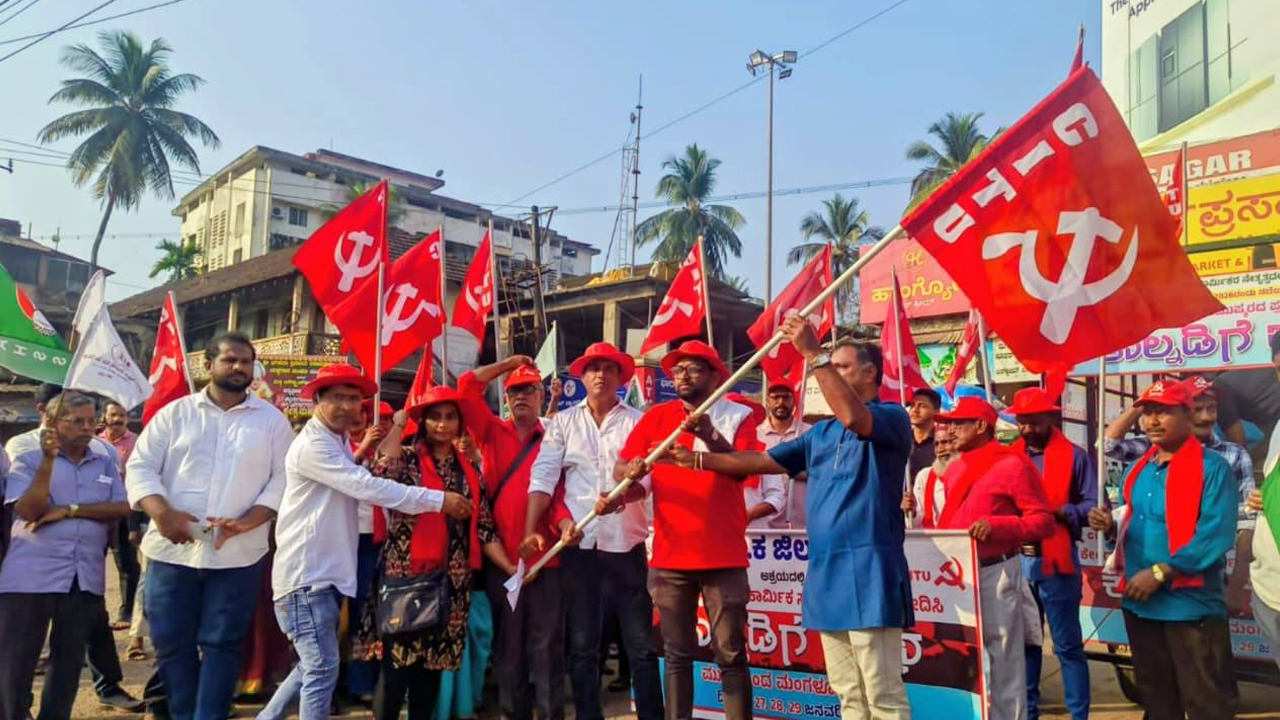
“The strike is to defend basic democratic rights, employment security and the welfare character of the Indian state,” CTUs said in a statement.
By Groundxero Desk
9 February 2026
As India heads towards a nationwide general strike on February 12, called by ten central trade unions and independent sectoral federations, the country’s organised working-class movement is framing the mobilisation as more than an industrial protest. It is, trade union leaders argue, a decisive political response of the working class to what they describe as the systematic dismantling of labour rights, welfare provisions and democratic institutions in favour of corporate interests.
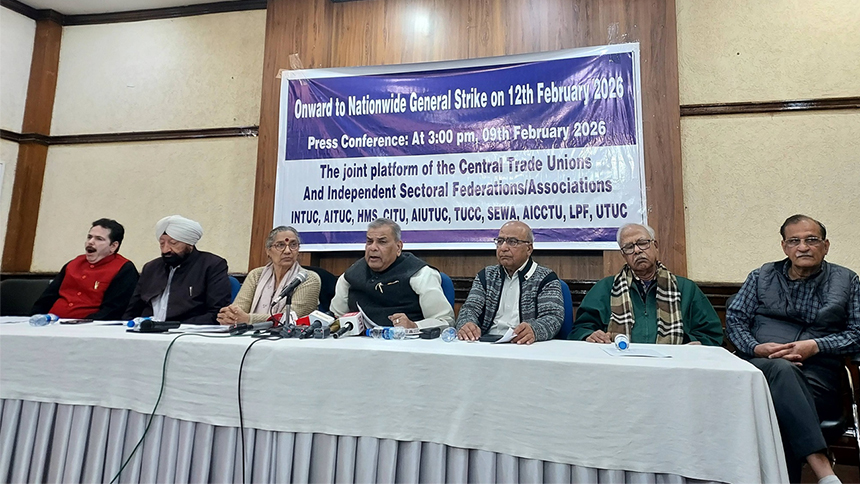
At a press conference held at the Press Club of India on February 9, the joint platform of trade unions reiterated its call for a nationwide shutdown across sectors—formal and informal, public and private, rural and urban. The strike has received full support from the Samyukt Kisan Morcha (SKM) and agricultural workers’ unions, signalling a renewed worker–peasant joint struggle to resist intensified attack on the working class and corporate takeover of agriculture.
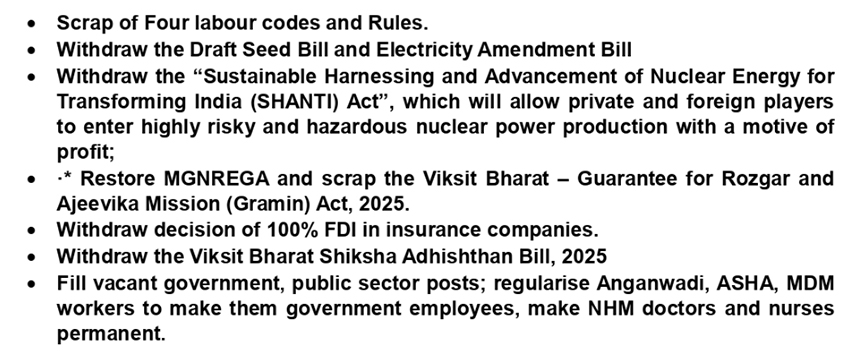
The immediate demands of the strike were focussed as:
At the centre of the unions’ opposition are the four labour codes, which they say were enacted without consultations, bypassing the Indian Labour Conference and violating International Labour Organisation (ILO) conventions to which India is a signatory. Passed during the Covid-19 period when public mobilisation was curtailed, the codes are widely viewed by trade unions as a structural assault on collective bargaining.
According to the joint platform, the notified codes restrict the right to strike, place nearly 70 per cent of factories outside the purview of labour law coverage, weaken wage protection mechanisms, dilute occupational safety norms and undermine social security. The proposed changes to trade union registration and recognition, they warn, would make unionisation cumbersome while granting employers sweeping powers to deregister unions and evade statutory obligations.
The recently unveiled Draft Labour Policy—Shram Shakti Niti 2025—has further fuelled concerns. Trade unions allege that the policy seeks to recast labour not as a right but as a form of “dharma”, while replacing regulatory enforcement with a loosely defined system of “employment facilitators”. In effect, unions argue, the state is retreating from its role as a guarantor of workers’ rights.
The February 12 strike is also being fuelled by mounting anger over privatisation and contractualisation. Trade unions point to alarming unemployment levels, alongside the government’s failure to fill nearly 65 lakh sanctioned posts. Instead, retirees are increasingly being rehired on contract, reinforcing precarious employment while shrinking permanent jobs.
The Union Budget 2026–27, the unions say, has continued this trajectory. Public sector undertakings and essential services—railways, ports, coal, oil, steel, banks, insurance, telecom and electricity—remain firmly on the privatisation agenda. The announcement of a high-level committee to “reform” banks has been interpreted by unions as a prelude to privatising public sector banks.
Budgetary priorities have also come under fire. Trade union leaders note that allocations for education, health and social welfare remain low and, in previous years, underutilised, while defence and infrastructure together command a disproportionate share of public expenditure. For unions, this reflects a shift away from welfare-state commitments towards a corporate-driven growth model.
The strike has broadened beyond traditional labour demands to encompass farmers’ concerns and opposition to recent trade and policy decisions. Unions and farmers’ organisations have jointly opposed the Draft Seed Bill, the Electricity Amendment Bill, and the decision to allow 100 per cent FDI in insurance. Agricultural workers’ unions are mobilizing rural workers with a special focus on the demand to restore the Mahatma Gandhi National Rural Employment Guarantee Act (MGNREGA).
The Unions, pointed to the government’s trade agreement framework with the United States involving zero tariffs on American imports into India, while Indian goods face an 18 per cent tariff. They said that the move will severely impact farmers, the animal husbandry sector and MSMEs—already reeling under rising input costs.
The proposed SHANTI Act related to nuclear energy has also been flagged as a concern, with unions warning that it could open hazardous nuclear power generation to private and foreign players driven by profit motives rather than public safety.
Beyond economic demands, the CTUs framed the February 12 strike as a defence of democratic rights. “The strike is to defend basic democratic rights, employment security and the welfare character of the Indian state,” the statement said. The joint platform situates the mobilisations in support of the strike in a wider context of shrinking civic space, attacks on dissent, and what it calls the “institutional capture” of democratic bodies. Rising communal polarisation and attacks on minorities, the unions argue, serve as a political cover for pushing through anti-people economic reforms. The unions at the press conference stressed that the strike is not merely about reversing specific policies, but about resisting the remaking of India into a economy designed to serve corporate capital—domestic and foreign.
Welcoming protest actions by opposition parties against the labour codes in Parliament, the CTUs have appealed to students, youth, farmers and citizens’ groups to join the strike in solidarity. According to the unions, extensive preparatory campaigns have been carried out across the country, covering government departments, public and private sector establishments, industrial areas, and rural and urban regions. State-level and sectoral conventions, jatha programmes, padayatras, tractor rallies, and leaflet distribution drives were organised in the run-up to the strike. Trade union leaders said strike notices have already been served in most sectors and that mobilisation efforts are “full-fledged”.
February 12 represents a critical test for the trade union movement: whether organised labour, alongside farmers and informal workers, can push back against a model of governance that prioritizes profit over workers right, and “ease of doing business” over employment security and welfare.
The statement was jointly issued by INTUC, AITUC, HMS, CITU, AIUTUC, TUCC, SEWA, AICCTU, LPF and UTUC.