

The arrest of Mukesh Malaud is aimed at weakening the growing land rights movement of the Dalits in Punjab and spreading fear among activists and marginalised communities.
Groundxero | Dec 30, 2025
The arrest of Mukesh Malaud, president of the Zameen Prapti Sangharsh Committee (ZPSC), by the Punjab Police in Delhi on Tuesday has sparked sharp criticism from Dalit organisations and democratic rights groups, who have termed the action a blatant attempt to crush the land rights movement of Dalits in Punjab.
Malaud was arrested at around 9:40 am at Nizamuddin Railway Station by the Central Intelligence Agency (CIA), a special investigation wing of the Punjab Police, while returning from an Ambedkar Mission event held in Nagpur between December 26 and 28. He was travelling with ZPSC leaders Bikker Singh Hathoya and Dharamveer Harigarh, along with three other members of the organisation. Hathoya himself had spent four months in jail earlier this year and was released shortly after Diwali.
The police have linked Malaud’s arrest to several old cases registered in Sangrur district, including a 2014 case related to a ZPSC-led agitation in Balad Kalan village demanding the legally mandated one-third share of panchayat land for landless Dalits. Another case cited by the police pertains to a proposed protest on May 20 in Bir Eswan village, where ZPSC had demanded distribution of 927 acres of land belonging to the former Jind Riyasat among landless Dalits under the Land Ceiling Act. Although Malaud was not present at the protest site, the police claimed he had issued the call for mobilisation. Over 400 activists were detained during that agitation.
Amandeep Kaur, secretary of the Stree Jagriti Manch and Malaud’s partner, alleged serious procedural violations in the arrest. She stated that the police neither informed her nor served any arrest memo to Malaud’s companions at the time of detention. “They were not told the grounds of arrest, nor informed about which police station he was being taken to,” she said, adding that different police officials later offered contradictory explanations for the arrest.
Malaud was produced before a Sangrur district court around 3 pm, without being given any opportunity to consult or be represented by a lawyer. He was subsequently remanded to judicial custody and sent to Sangrur Jail.
ZPSC leaders, farmer unions, student and democratic right organisations in Punjab have condemned the arrest as politically motivated and emblematic of what they describe as the “dual character” of the Aam Aadmi Party (AAP) government in Punjab. While projecting itself nationally as a defender of workers and the marginalised, critics argue, the party has resorted to the same coercive methods used by previous regimes when confronted with organised resistance on the ground.
Mukesh Malaud is widely regarded as a key figure in Punjab’s Dalit land rights movement. Under his leadership, ZPSC has spearheaded a sustained, democratic campaign to enforce existing laws that guarantee landless Dalits access to one-third of village common lands. Over the past 15 years, the organisation has helped establish cooperative farming on such lands in more than 150 villages across Punjab.
Activists point out that for decades panchayati common lands earmarked for Dalits were illegally leased out through proxy bidders acting on behalf of dominant upper-caste Jat landowners, often with the complicity of the administration. ZPSC’s efforts to break this nexus have brought it into direct conflict with entrenched caste and class interests.
“This arrest is not an isolated incident,” ZPSC leaders said in a statement. “Several of our members and leaders have earlier been jailed for months under false and fabricated cases. Arrest warrants continue to be issued to intimidate and weaken a legitimate mass movement instead of addressing it’s just demands.”
The manner of Malaud’s arrest—outside Punjab, involving intelligence agencies, and marked by a lack of transparency—has raised serious questions about violations of democratic norms and fundamental rights, including the right to dissent and organise. Critics argue that on the question of democratic rights, there is little to distinguish the AAP government in Punjab from BJP-led governments elsewhere. The repeated use of police cases, arrests, and intimidation reflects a consistent pattern of criminalising a democratic mass movement instead of addressing its just demands.
ZPSC and allied organisations including Campaign Against State Repression (CASR) have demanded the immediate and unconditional release of Mukesh Malaud, withdrawal of all cases against ZPSC members and activists, and an end to what they describe as systematic repression of Dalit and landless people’s movements.
Calling for wider solidarity, they have appealed to democratic forces, civil society organisations, and concerned citizens to speak out against the arrest and stand with the Dalit land rights struggle in Punjab—one that seeks not charity or concessions, but struggles for the lawful rights of the landless Dalits.
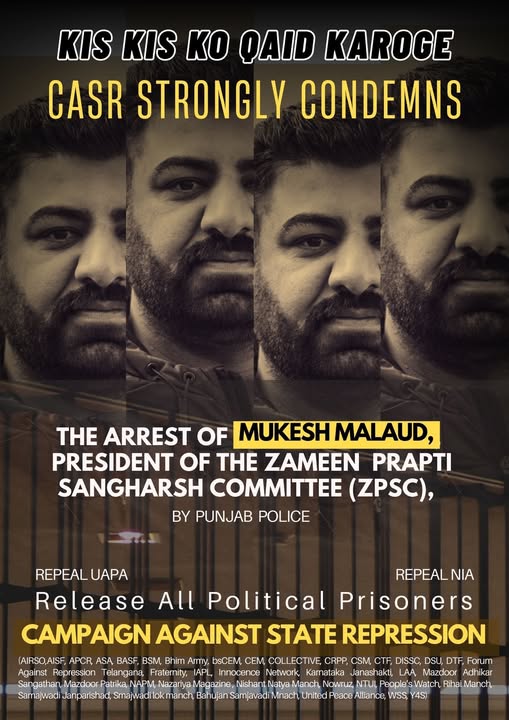
Campaign Against State Repression (CASR) poster condemning the arrest of MUKESH MALAUD