

“Let it be clear delivery workers are not slaves of algorithms. We will not accept unsafe ‘10-minute delivery’ models, arbitrary ID blocking, or denial of dignity and social security. If repression continues, our resistance will only grow stronger. The gig economy cannot be built on the broken bodies and silenced voices of workers.”
Groundxero | Dec 30, 2025
Gig and platform delivery workers across India have announced a renewed nationwide strike on December 31, following a countrywide protest strike on Christmas Day that unions say exposed the deep fault lines of India’s rapidly expanding platform economy. The strike, led by the Indian Federation of App-Based Transport Workers (IFAT) and the Telangana Gig and Platform Workers Union (TGPWU), targets major platforms including Swiggy, Zomato, Zepto, Blinkit, Amazon and Flipkart, and is backed by worker collectives, including platform worker unions from Maharashtra, Karnataka, Delhi-NCR, West Bengal and parts of Tamil Nadu.
In a statement, the Telangana Gig and Platform Workers Union said the strike has been called to protest “the worsening working conditions in the gig and platform economy and the continued denial of fair wages, safety, dignity, and social security to delivery workers.”
Union leaders say the December 25 strike was “just the trailer”, and will be followed by a far more impactful action on December 31, a peak-demand day for delivery platforms. A union post summed up the mood: “25 Dec was just the trailer – picture abhi baki hai.”
Christmas strike disrupts deliveries nationwide
According to unions, nearly 40,000 delivery workers participated in the December 25 strike, leading to 50–60% disruption in deliveries across several cities. The strike action, one of the largest coordinated protests by gig workers this year, coincided with heightened demand during Christmas, amplifying its impact.
In an indicator of the imapct caused by the protest, Swiggy’s share price reportedly fell by up to 2% in the aftermath of the strike. Union leaders argue that this underscores the economic leverage of delivery workers, who form the backbone of platform operations but remain largely excluded from basic labour protections.
Shaik Salauddin, Founder President of TGPWU and Co-founder and National General Secretary of IFAT, issued a sharp statement accusing platform companies of exploitation and repression.
“The nationwide flash strike has exposed the reality of India’s gig economy. When delivery workers raise their voice, platform companies respond with ID blocking, threats, police intimidation, and algorithmic punishment. This is nothing but modern-day exploitation,” Salauddin said.
He added that instead of addressing workers’ concerns, companies attempted to blunt the impact of the Christmas strike by deploying third-party delivery agencies, offering extra incentives, and reactivating inactive IDs.
“Let it be clear—delivery workers are not slaves of algorithms. We will not accept unsafe ‘10-minute delivery’ models, arbitrary ID blocking, or denial of dignity and social security,” he said, warning that continued repression would only intensify resistance.
At the core of the protest is a growing backlash against what workers describe as deteriorating working conditions in the gig economy. Unions have repeatedly flagged the ‘10-minute delivery’ model promoted by several platforms as inherently unsafe, forcing riders to take risks on congested roads to meet unrealistic deadlines.
Workers are demanding:
- Regulation of platform companies under labour laws
- Ban on unsafe “10-minute delivery” models
- An end to arbitrary ID blocking and penalties
- Transparent and fair wages
- Social security benefits, including health, accident insurance, and pension
- Improved safety gear
- Protection of the right to organise and collectivly bargain
IFAT has formally written to Union Labour Minister Mansukh Mandaviya, seeking urgent government intervention to curb what it calls the systemic exploitation of gig and platform delivery workers. The unions are demanding regulatory action to ensure accountability of platform companies and recognition of delivery workers’ rights.
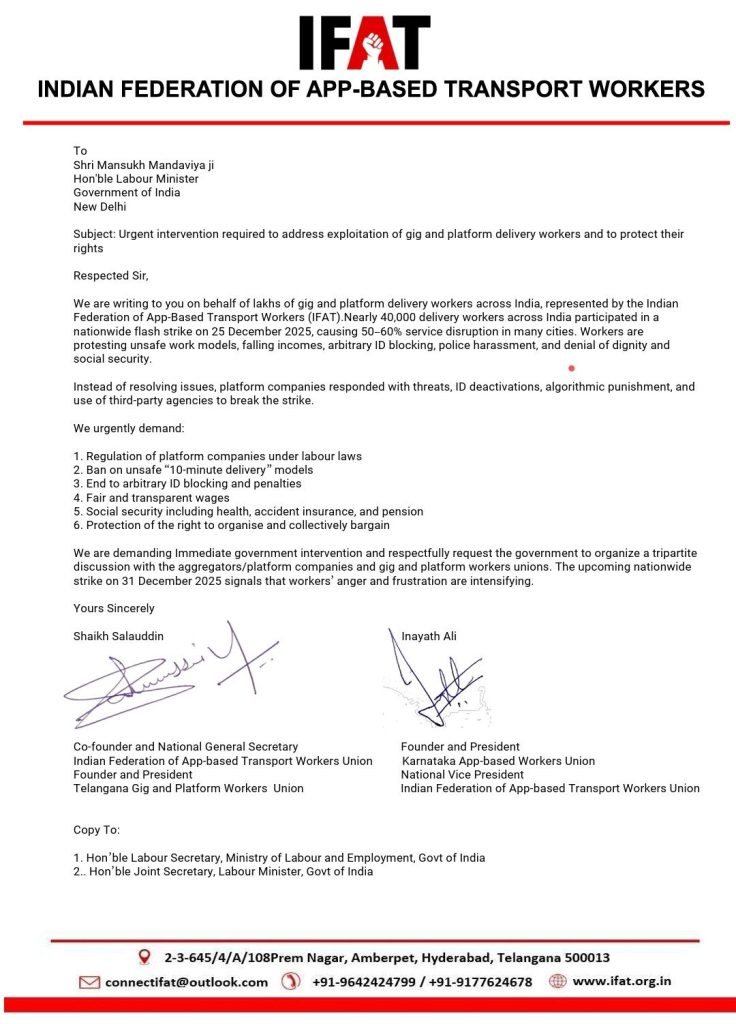
“The government must intervene immediately, regulate platform companies, stop worker victimisation, and ensure fair wages, safety, and social protection,” Salauddin said. “The gig economy cannot be built on the broken bodies and silenced voices of workers.”
December 31 strike action: a pressure point
With December 31 expected to be one of the busiest days for food and e-commerce deliveries, unions say the upcoming strike will further amplify disruptions and test the resolve of both platforms and policymakers. For many workers, the year-end protest is not just about wages or incentives, but about reclaiming dignity in a system increasingly governed by opaque algorithms and speed-at-any-cost business models.
As India’s gig economy continues to expand, the escalating confrontation signals a critical moment: whether platform growth will remain tethered to precarious labour—or whether workers’ resistance will finally force structural reform.