
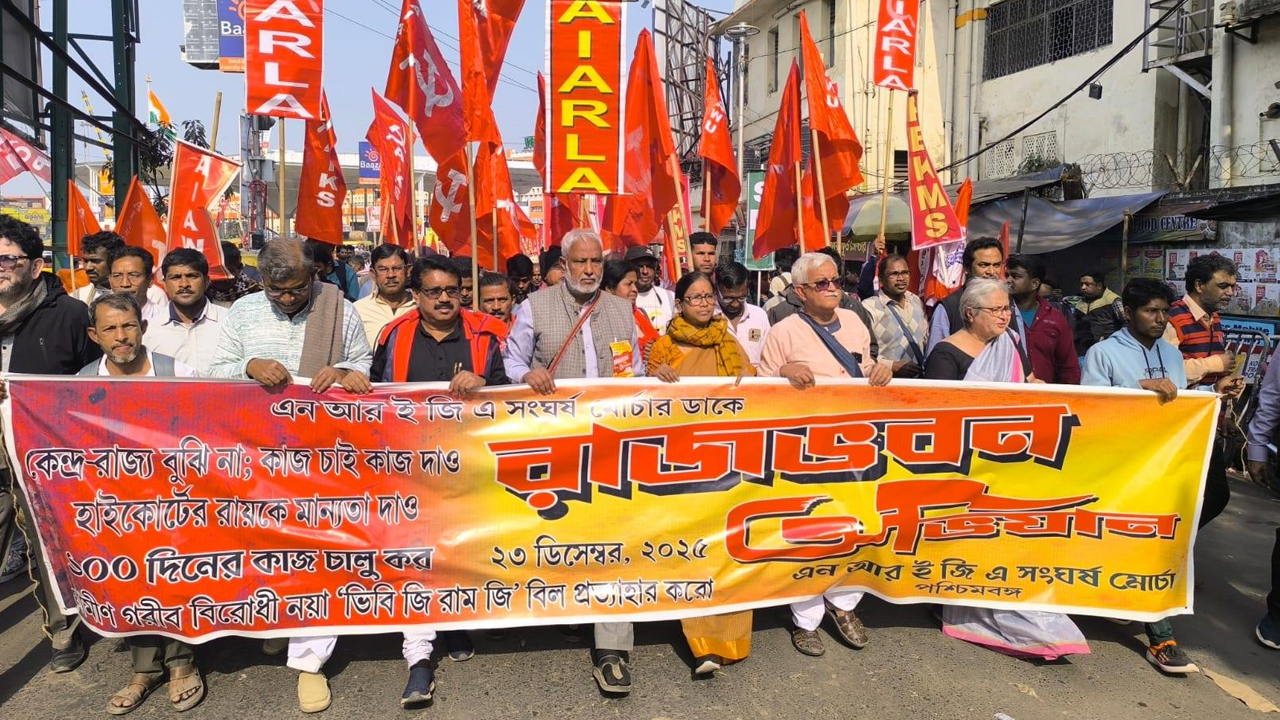
Opposition to the VB–G–RAM–G Act intensified as more than 10,000 rural agricultural workers marched to Raj Bhavan in Kolkata. Trade unions simultaneously called for a nationwide push to openly reject the law in upcoming Gram Sabhas and demand for a restoration of MGNREGA.
Groundxero | December 23, 2025
Opposition to the Viksit Bharat–Guarantee for Rozgar and Ajeevika Mission (Gramin) Act, 2025 (VB–G–RAM–G) intensified on Monday as more than 10,000 rural agricultural workers marched to Raj Bhavan in Kolkata, while trade unions simultaneously called for a nationwide push to reject the law in upcoming Gram Sabhas.
The massive mobilisation, organised by the NREGA Sangharsh Morcha, West Bengal, saw rural workers from across the state converge on the city in two big processions—one from Sealdah and another from Howrah. The march briefly brought traffic to a standstill at Dorina Crossing for over 20 minutes, before protesters proceeded peacefully towards the Raj Bhavan.
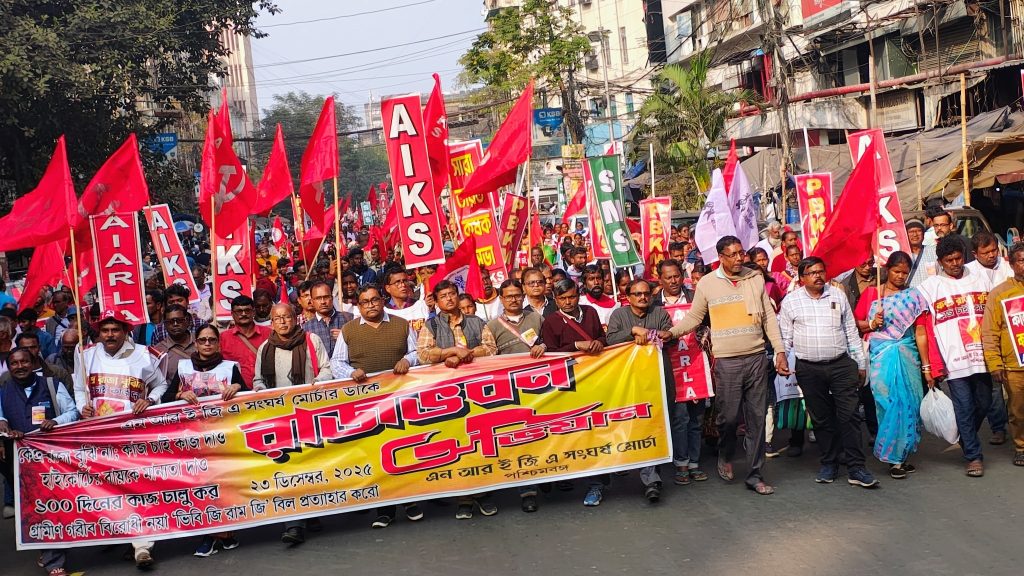
At the heart of the protest was the repeal of the Mahatma Gandhi National Rural Employment Guarantee Act (MGNREGA), 2005, and its replacement with the VB–G–RAM–G Act. Protesters alleged that the new law dismantles the legally enforceable, demand-driven Right to Work and replaces it with a discretionary, centrally controlled scheme.
The NREGA Sangharsh Morcha has condemned the VB–G–RAM–G Act introduced without any consultation with workers and workers-groups. The Morcha said that the Act is not a reform but a rollback of democratic and constitutional guarantees won by workers through decades of sustained struggles. “By replacing the statutory right under MGNREGA with a centrally-controlled, budget-capped and surveillance-heavy scheme, the Union government is seeking to dismantle a historic rights-based legislation and reduce the right to work to a discretionary dole” the Morcha alleged. “This Bill violates the spirit of the Constitution, undermines the 73rd Constitutional Amendment, and strikes at the core of social and economic justice by shifting power away from workers, Gram Sabhas, and States into the hands of the Union Government.”
A delegation of the Morcha attempted to meet the Governor of West Bengal to submit a memorandum detailing the implications of the new Act. Although the Governor was not present, the memorandum was formally received by an official of the Governor’s office. The Morcha warned that rural workers across the state would intensify their agitation if the new law is not withdrawn.
“The Right to Work is not charity. It is a question of dignity, survival and constitutional justice,” the Morcha said in a statement, accusing the Union government of pushing millions of rural households into deeper insecurity.
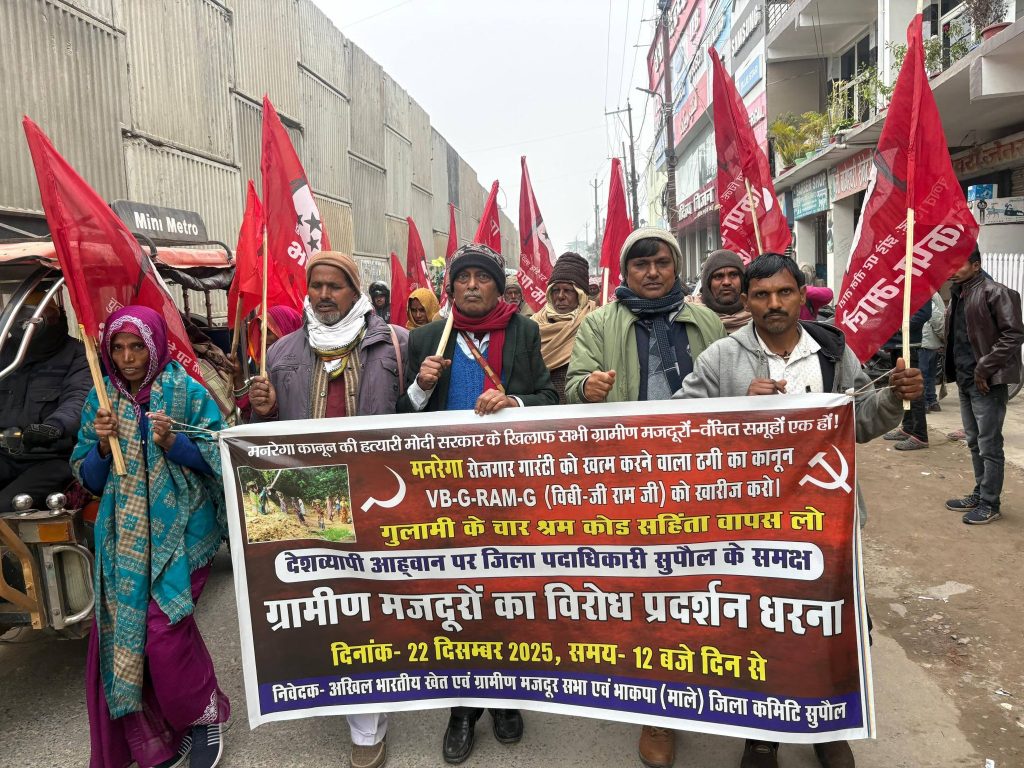
Protest marches and meetings were also held today in Bihar, Tripura and Odisha.
The street protests coincided with a broader call by the All India Agricultural Workers Union (AIAWU), which has urged rural workers across the country to openly reject the VB–G–RAM–G Act in “Special Gram Sabhas” proposed by the Union government. According to the union, the Department of Rural Development and the Ministry of Panchayati Raj have instructed states and Union Territories to hold these Gram Sabhas to build public opinion in favour of the new law.
AIAWU, however, say these meetings are designed to “deceive rural workers” about the true nature of the Act. In a circular issued after its Central Working Committee meeting, the union called on activists to intervene in Gram Sabhas, press for resolutions opposing VB–G–RAM–G, and demand the restoration of MGNREGA.
The union argued that while MGNREGA legally obligates the state to provide employment on demand, the new Act centralises control over funds, caps employment and shifts the burden of unmet demand onto state governments. “It marks a transition from a statutory right to employment to the right of the Centre to deny work,” the union said.
AIAWU also traced what it described as the systematic weakening of MGNREGA since 2014, citing Aadhaar-based payment systems, biometric verification, double attendance requirements and the deletion of lakhs of job cards, all of which, it said, have excluded the most vulnerable workers. Instead of addressing these failures, the government has chosen to dismantle the Act altogether, the union alleged.
Calling MGNREGA a hard-won constitutional guarantee, both the Morcha and AIAWU appealed to rural workers, peasants, youth and students to unite against what they see as a decisive rollback of the Right to Work. As protests spill from the streets into Gram Sabhas, the battle over the right to demand employment appears set to deepen in rural India in the months ahead.