
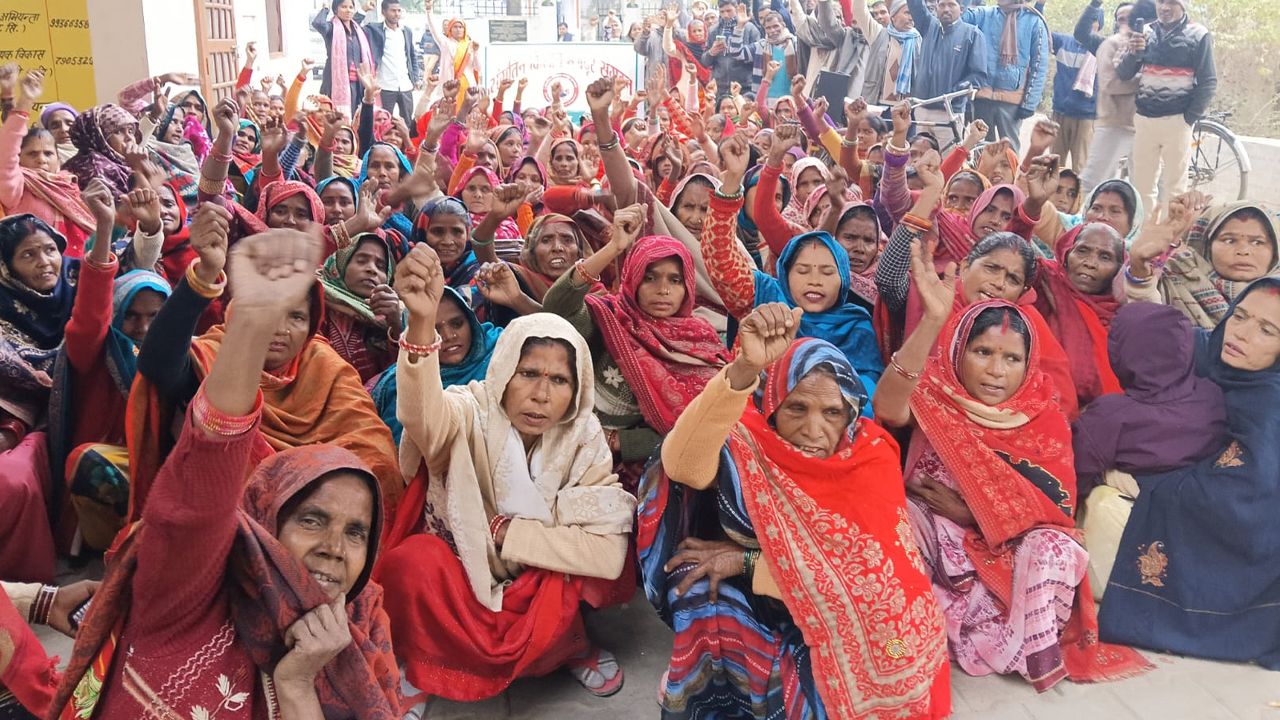
Calling worker–farmer unity the “primary weapon” against the union government’s policies, SKM calls to observe January 16 as ‘All India Resistance Day’ against NDA’s corporate push.
Groundxero | 22 December 2025
The Samyukt Kisan Morcha (SKM) on Monday announced a renewed nationwide mobilisation against what it described as the NDA government’s “authoritarian, anti-federal and corporate-driven assault” on farmers, workers and states’ rights, calling for January 16, 2026, to be observed as All India Resistance Day.
Addressing an online press conference, SKM said village-level padayatras and public meetings would be organised across the country to build resistance against a string of laws passed or proposed by the Union government, including the Seeds Bill 2025, Electricity Bill 2025, VB-GRAMG Act 2025 and the four Labour Codes.
The platform of farmers’ unions reiterated its demand for a statutory guarantee of MSP at C2+50% with assured procurement for all crops, along with a comprehensive farm loan waiver, warning that agrarian distress and rural-to-urban migration would intensify unless these measures were implemented.
“Bulldozing Rights, Centralising Power”
SKM accused the Modi government of dismantling welfare and labour protections through legislation pushed without public consultation or parliamentary debate. Central among its criticisms was the replacement of the Mahatma Gandhi National Rural Employment Guarantee Act (MGNREGA) with the Viksit Bharat Guarantee of Rozgar and Aajivika Mission (Gramin) Act, which the platform said effectively abolishes the statutory right to work.
The group also flagged the passage of the Insurance Bill 2025, which allows 100% foreign direct investment, and the SHANTI Bill 2025, opening India’s nuclear sector to large-scale private and foreign participation. According to SKM, these moves signal a deeper surrender of strategic and social sectors to corporate interests, including multinational companies.
“These attacks are not isolated,” SKM said, linking them to the government’s push for Free Trade Agreements under US pressure, the privatisation of the power sector and the imposition of labour codes that weaken collective bargaining and job security.
Push for Worker–Farmer Unity
Calling worker–farmer unity the “primary weapon” against the government’s policies, SKM announced its unconditional support to the Joint Platform of Central Trade Unions’ call for an all-India general strike against the four Labour Codes in February. It also extended support to agricultural workers mobilised under the NREGA Sangharsh Morcha, which is demanding restoration of MGNREGA with 200 days of guaranteed annual work and a daily wage of Rs 700.
SKM said its State Coordination Committees would meet before December 30, followed by district-level meetings to plan outreach campaigns from January 9 to 15, culminating in the Resistance Day.
Federalism Under Strain
A significant part of SKM’s critique focused on the erosion of federalism through fiscal centralisation. The platform pointed out that while states are entitled to 41% of the divisible pool, their effective share in the Centre’s gross tax revenue has fallen to around 31% due to the growing reliance on cesses and surcharges, which are kept outside the divisible pool.
Cesses and surcharges now account for 18.5% of the Union government’s tax revenue, up from 6.4% in 2011-12. SKM noted that 22 out of 28 states, including several BJP-ruled states, have demanded an increase in states’ share to 50%.
SKM demanded amendments to the GST Act to restore states’ taxation powers and called for states’ share in gross tax revenue—including cess and surcharge—to be raised to 60%, arguing that this is essential to address agrarian distress and unemployment.
Warning Against Repression
The farmers’ platform also warned against what it described as “authoritarian policing” by NDA-ruled states, accusing governments of misusing penal laws, filing false cases, imposing illegal fines and suppressing democratic protests to intimidate farmer activists.
SKM announced that its National Council meeting would be held in New Delhi on January 11, where the next phase of the agitation would be reviewed and expanded.