
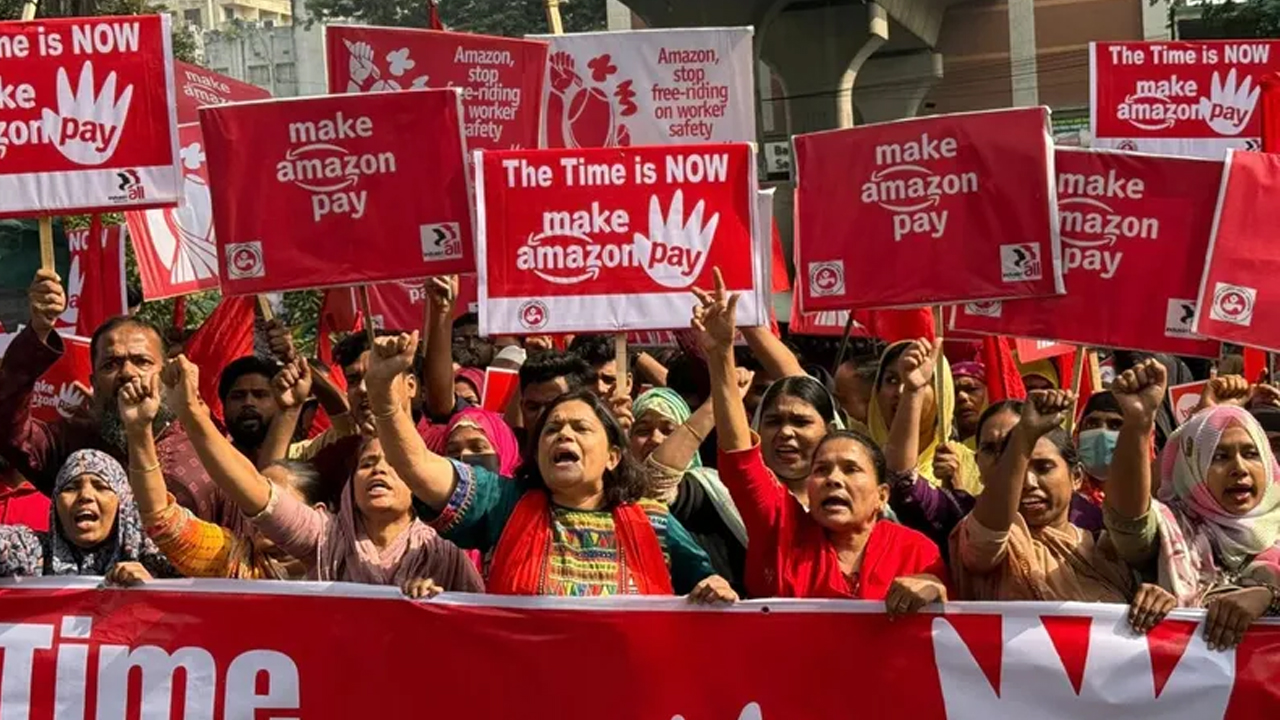
“We are joining Make Amazon Pay to demand the most basic rights: safety, dignity, and the chance to go home alive,” said one Amazon worker from India.
Groundxero Report | Dec 1, 2025
Amazon workers across the world once again turned Black Friday—the corporation’s busiest shopping day—into a day of resistance. From 29 November to 2 December, Amazon workers across the globe mobilised under the slogan Make Amazon Pay, demanding accountability for what they describe as a regime of labour exploitation, union-busting, and environmental destruction.
“We are joining Make Amazon Pay to demand the most basic rights: safety, dignity, and the chance to go home alive,” said an Amazon warehouse worker from India, underscoring the grievances that united workers from more than 30 countries this year.
A Trillion-Dollar Empire, Rising Profits, Deepening Workers’Anger
Amazon remains one of the most powerful corporations in the world, with CEO Jeff Bezos becoming the first individual to accumulate $200 billion in personal wealth. The company’s profits continue to skyrocket: last month it reported over $21 billion in profits for Q3 2025—up 38% from the previous year.
Against this backdrop, UNI Global Union and Progressive International have coordinated the annual Make Amazon Pay protests since 2020 with the goal of holding Amazon accountable for alleged labor abuses and seeking a future where workers’ dignity is prioritized over corporate profits. Amazon workers across the globe unite under the slogan — Make Amazon Pay — to protest the e-commerce behemoth’s exploitation of workers, relentless union-busting, contributions to the worsening climate emergency, and plans to replace employees en masse with robots.
“Amazon, Jeff Bezos, and their political allies are betting on a techno-authoritarian future,” warned Christy Hoffman, general secretary of UNI Global Union. “For years, Amazon has squashed workers’ right to democracy on the job through a union and the backing of authoritarian political figures. Its model is deepening inequality and undermining the fundamental rights of workers to organize, bargain collectively, and demand safe, fair workplaces.” “But this Make Amazon Pay Day, workers are saying: enough.”
Largest Mobilisation Yet
The 2025 strikes and protests, which organizers described as the largest mobilization against Amazon to date, mark the sixth consecutive year of global actions organized by the coalition. From Germany to Bangladesh, thousands of workers walked off the job on Friday and marched against Amazon’s labor practices to push for better wages, working conditions, and union protections. The strike in Germany was characterized as the largest in Amazon’s history in that country, with around 3,000 workers joining picket lines across the country.
In India, Amazon workers also organised protests across the country as part of this movement. They demanded Amazon to pay its workers fairly and respect their right to join unions. Amazon employs 1.5 million workers globally, including more than 100,000 people in India, from workers deployed for warehouse packaging and delivery drivers to executives managing sales and marketing and AI specialists working on Amazon’s cloud computing firm, Amazon Web Services.
Inside Amazon’s Warehouses in India
At the Manesar warehouse, which helps Amazon deliver products to the national capital region, there are more than 1,800 associates – a term the e-commerce global giant uses for its warehouse workers. The company has been accused of exploitative work conditions. Its warehouse and delivery workers in India have alleged inhuman corporate practices employed at its facilities, including workers in warehouses not being allowed enough time to take breaks and a lack of financial assistance for work-related injuries.
“During the heatwaves, the warehouse feels like a furnace—people faint, but the targets never stop,” said Neha Singh, an Amazon worker in Manesar, India, referring to the company’s productivity quotas. “Even if we fainted, we couldn’t take a day off and go home. If we took that day off, our pay would be cut, and if we took three days off, they would fire us. Amazon treats us as expendable.”
Amazon’s workers clock in a total of 10 hours at the Manesar warehouse. That includes two 30-minute breaks. However, their work requires them to stand for the rest of the nine hours.
A survey conducted last year by UNI Global Union in partnership with the Amazon India Workers Association (AIWA), found as many as 1,838 Amazon workers complaining about inhuman working conditions at Amazon’s facilities in India. In the survey, more than 80 percent of warehouse workers reported that their work targets are ‘very difficult’ to achieve. Of the total participants, 21.3 per cent of the workers and delivery executives said that they faced ‘unsafe’ working conditions under Amazon’s policies.
One warehouse worker detailed the coercion built into the system: “There is a lot of work pressure. We have shifts of 10 hours where we have to stand continuously to process 150 large items every hour: that’s our hourly target. If we are not able to achieve our hourly targets, the PA (Process Assistant) and the PS (Problem Solver) often force us to resign or fire us. The targets are unachievable; we have to continuously work and miss/skip washroom breaks; sometimes, we are not allowed to use the washroom if we are behind on our targets. There is no resting space in the facility. We don’t get breaks in between our shifts to rest or speak to anyone on the phone.”
“We are joining Make Amazon Pay,” said Singh, “to demand the most basic rights: safety, dignity, and the chance to go home alive.”
A Broader Political Fight
As Amazon expands automation, suppresses unions, and posts record profits, workers worldwide are escalating their struggle. The sixth year of Make Amazon Pay demonstrates a growing willingness to confront the political and economic structures Amazon now epitomises.
Progressive International, leading the movement, said on Friday, “This week’s actions point toward another horizon. One in which supply chains become sites of struggle, not submission; where warehouse workers link arms with tech workers, garment workers, Indigenous communities, and migrants; where a global labor movement is capable of confronting a global system of power.”
“The target is not only a company. It is the emerging system that Amazon now anchors: a techno-authoritarian order that fuses the power of Big Tech with the prerogatives of the far right—from Trump’s ICE raids to Israel’s genocide in Gaza,” the group added.
________________
Feature Image: Workers with the Sommilito Garments Sramik Federation march against Amazon on November 28, 2025. (Photo: Progressive International)
This report has been prepared with inputs from Common Dreams.