
Kamaljit, Research Scholar and Doctoral Candidate, Department of Philosophy, Punjab University (PU), talks on the ongoing student-led struggles to protect PU’s autonomy and democratic structure under attack from the Central government.
Groundxero | November 17, 2025
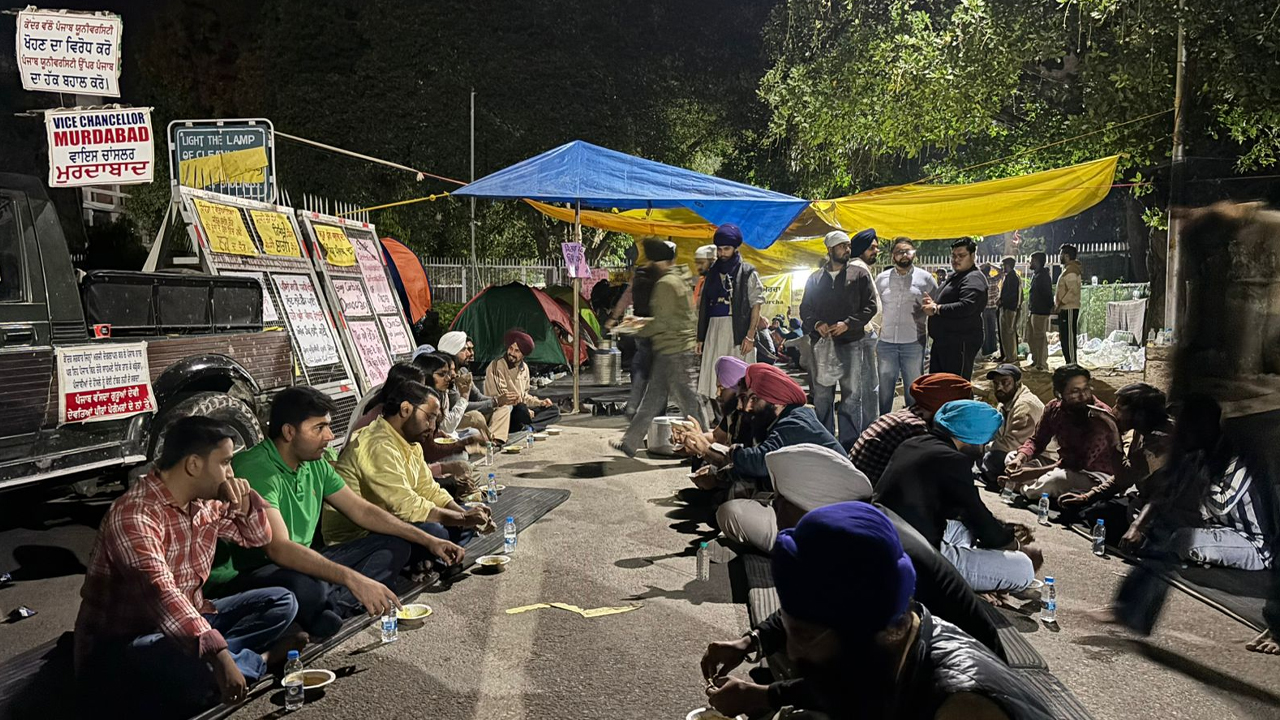
During the past several weeks, Punjab University has become the site of one of the most significant student-led democratic struggles in recent years. On 28 October, 2025, the central government issued a notification drastically restructuring the Punjab University Senate—downsizing it from 97 to 31 members and eliminating most elected seats, including the graduate constituency. In response, students, teachers, alumni, farmers and workers unions, and civil society groups across Punjab erupted in massive protests under the banner of the Punjab University Bachao Morcha.
What began as a protest to defend the Senate quickly developed into a wider battle over university autonomy, federal rights, and democratic governance. The students’ movement—drawing support from farmers’ unions, trade unions, social and political organisations across Punjab—forced the central government to withdraw the notification. But the agitation continues as protesters demand immediate restoration of Senate elections, dismissal of criminal cases against protesting students, and a moratorium on major administrative decisions until an elected Senate is constituted.
Against this backdrop, Groundxero spoke to Kamaljit, a research scholar and doctoral candidate in the Department of Philosophy at Punjab University, and a participant in the ongoing movement.
Transcript of the Interview
GX: Could you explain the structure, function, and constitution of the Senate and Syndicate of Punjab University?
Kamaljit: The Senate is the highest authority in Punjab University—above even the Vice Chancellor. It has largely two components, one is elected and one is nominated. The third component, we can say, consists of ex-officio members. Ex-officio members include the Chief Minister of Punjab, officials from the Ministry of Education, and representatives of the Central Government.
Nominated or non-elected members are appointed by the Vice Chancellor. These include subject experts and representatives of specific categories.
Elected members come from various constituencies. The largest is the graduate constituency, with 15 seats. Anyone who has done graduation or post-graduation from Punjab University can register themselves and they will become the registered graduates who are then eligible to vote and some among them can also be the candidates. So this constituency consists of voters from all across the country, and these are all the alumni and stakeholders of the University.
Punjab University has around 200 affiliated colleges. They are represented through constituencies of principals, professors, and others.
These elected representatives from the various stakeholders form a large democratic body and the Senate is responsible for major important decisions of the University.
GX: What are the functions of the Senate?
Kamaljit: If we are to talk about the functions, the Senate acts as a check and balance. Since the nominated posts are filled by the Vice Chancellor, there is a shift of power towards the administration, and often Vice Chancellors are under the pressure of the Central government. But the Senate has historically intervened to protect democratic rights.
For example, Punjab University administration had to delay the implementation of NEP because there was insufficient infrastructure and faculty to implement it. Even though the University had issued the notification to implement NEP, the senate had not endorsed it, and it could not be implemented for a long time. But the last senate implemented it.
Again, a few years ago, there was a fee hike of 1100% by the University, that hike had to be rolled back because of agitation by the students and opposition by the senate. See, the senate members are under pressure from the electorate.
Another important example is that the girls’ hostels used to have curfew timing of 7pm. Students protested against this and the protests went on for a long time. The University did not pay heed to the students. The wardens harassed the girls by calling their parents. The University said that they will hold a referendum amongst the parents and they will allow the women to go out at night if all the parents agree. Students protested against this proposal. The constitution guarantees us equality. Why should we put up such a question for a referendum at all? The protestors gheraoed the Senate meeting. The Senate members raised these questions in the meeting and finally the Senate passed a resolution opposing the curfew decision. The senators themselves come before the protesting students to convey their decision.
So, such things have happened in the past, and the senate has played an important role. No doubt that there can be a lot of criticism regarding the working of the senate as well, it does not have adequate representation of women, minorities, Dalits, etc. But the solution is not to do away with the Senate, rather to democratise it further.
GX: There’s been talk that this movement is about safeguarding Punjab’s rights. Do you see it that way?
Kamaljit: One of the narratives is that this is an attack on the rights of Punjab over the Punjab University. In one sense, this is not incorrect because Punjab does have a stake in Punjab University. Because of this, Punjab was more sentimental and more people from Punjab joined the movement. So, there is definitely the question of attack on federalism. But there is something more to it. Primarily, the objective of the attack is to dismantle the democratic decision making structure of the University. The attack on federalism is also through their attack on democracy, the democracy of the Senate. When the Senate was downsized, they downsized the elected portion of the Senate. The graduate constituency was completely done away with, other constituencies were crippled. The nominated members of the senate became dominant in the new structure proposed by the central government. So, they were attacking the state of Punjab by attacking the elected portion of the Senate. There was a consensus that we need to save the Senate first and only then can we protect the rights of the students, rights of Punjab and other rights.
At present, the Senate is the larger body; the Syndicate is the executive body of the Senate which takes care of the day to day functions of the University. Again, the Syndicate also has both elected and nominated members. But, at present there is no representation of the students in the Syndicate. So, one of our demands is also to include current students’ representation in the body.
GX: Tell us about the key issues that triggered the protests and the current status of the movement?
Kamaljit: On 28 October 2025, the central government issued a notification stating that the Senate will be downsized from 97 members to 31 members. Immediately, the protest started to save the Senate. The Punjab University Bachao Morcha —consisting of 16 organizations—was constituted almost immediately, by the next night itself. The Morcha gave a call for indefinite agitation. The central government immediately took down the notification and all the media began to report that the notification had been withdrawn. This was around November 4. The ABVP made a video from Delhi saying they spoke to the government and the notification was withdrawn. But within half an hour the notification was re-uploaded with a slight but significant change.
The earlier notification had a date of enforcement, but later the notification was uploaded with no such date, which essentially means that the notification is effective immediately. The ABVP tried to deliberately mislead the protesters saying that the absence of a date of enforcement means the notification will not be implemented. But the students realized it was all eyewash and continued their protest.
The students gave a call to all the mass organisations including peasant and farmer unions and trade unions, and they came out in heavy numbers to support us. We held a meeting on 7 November, and our next call was for people to join our movement from all of Punjab, Haryana and from other places on 10 November. But before that the government rescinded the notification on the night of 7 November on the ground that they received feedback from the authorities and the students in favour of withdrawal of the notification. Even after withdrawal, thousands marched on 10 November, because the real fight is to restore elections, not just stop downsizing of the Senate. The protesters decided to continue their protest till the Senate election is actually scheduled. This is because the last Senate was in force till 21 October 2024. Thereafter, the election was not conducted. The tactic was either to dismantle the Senate or to delay its constitution. So, on 7 November itself, we had decided that we will continue our protest even if the government rescinds the notification.
So, despite the propaganda that the notification has been withdrawn and there is no need to protest any longer, thousands of people came to the protest on 10 November. Chandigarh police tried to block them, Punjab police tried to block them, Haryana police tried to block them, but still people came in large numbers and it was a huge protest, and it was announced from the stage that the demonstrations will continue on the protest-site till the election schedule is announced.
The Morcha is currently continuing with the protests, and it will continue until the schedule for the Senate election is officially announced. The last meeting with the authorities took place on 12 Nov 2025 in which the Vice Chancellor was also present and he had assured us that by the end of this month they will be able to announce the schedule of the Senate election. We had other demands as well. Last year students had protested against the delay in conducting the Senate election and cases were registered against them. Our demand is that these cases be dropped. We have also demanded that reservation policies be enforced in the new Senate elections. We have also asked for a moratorium on important decisions until the newly elected Senate comes to power, and we have stated that all the decisions taken in the absence of the Senate will have to be reviewed by the elected Senate when it comes to power. The authorities have principally agreed to these demands.
Obviously, there are two operational parts. In order for the cases against the students to be dropped, the Registrar has to approach the High Court. Secondly, the schedule of the Senate election has to be officially issued.
GX: Is reservation in the Senate a new demand that has been raised now?
Kamaljit: See, reservation does not exist in the Senate but there are conversations and demands regarding the same. But since the issues of the Senate have opened up now on a large scale, students have decided to place this as a demand now, because they believe that the nature of the Senate should be egalitarian.
GX: What about the University’s mandatory affidavits to suppress students’ right to protest?
Kamaljit: Initially the University asked everyone to sign these affidavits, but then it was only restricted to the newly admitted students at the time of the admissions. On 29 September, we held the first protest against these affidavits. From 30 October, the protests turned into an indefinite demonstration. See, on 28 October, the notification dismantling the existing structure of the Senate was issued. The University realized that there will be agitation, so on 29 October itself the University withdrew the decision regarding the mandatory affidavits. So, the earlier protest against the mandatory affidavits got merged into this agitation against the downsizing of the Senate.
GX: How do you analyse the recent ABVP victory in Punjab University? How do the students see this victory?
Kamaljit: When we analysed the victory of ABVP in PU, we noticed a few things. One major factor was the division of the opposition student organizations which could not properly unite against ABVP.
Secondly, there was a huge manipulation of the system. All the wardens openly instructed all the students to vote for ABVP, they announced it to hostel groups, and even called students personally.
Then, we have an organisation of research scholars called SHODH which consists of a lot of professors from the Sangh [RSS]. These professors acted with a heavy hand, and it became very difficult for the research scholars to defy their guides.
One more important factor is that the ABVP did not raise any of the issues or slogans which they traditionally raise. No Vande Mataram, no Bharat Mata ki Jai, no Kashmir slogans. So, ABVP basically hid their true colours and their true agenda and objective.
But their true colours came to light in this agitation. Just within two months of their victory, the students raised slogans asking where the ABVP leaders were when the student body was protesting. Even when the students were protesting the mandatory affidavit, ABVP and Gaurav Veer Sohal, who was elected as the President of the PUCSC, said that they will also oppose the affidavit. However, on the day when students were sitting on dharna, Gaurav Veer Sohal was organizing dandiya. He did not turn up to the protest and the students immediately raised slogans stating that the leader is missing after elections.
So, when the protest against the notification began, the students’ united front did not at all entertain the ABVP. Instead, it was clearly stated that everyone other than the RSS-BJP would join the protest and that they need not protest because it is their government at the Centre and if they want to oppose the notification they should ask their party to withdraw the notification. They got badly isolated by the students in the process.
If today, we hold a re-election, then ABVP will not be in a position to win over the students in Punjab University. I feel, in today’s time, it is pertinent to state that just like JNU is seen as a model of students’ resistance, Punjab University is also turning up to be such a model of resistance. After the farm laws, this notification was a big issue, and the Centre had to withdraw the notification completely. It is very difficult to get such a clean victory. And if you see what the symbol of the protest is, it is a khaki half-pant with RSS written on it hung inside the campus. The message is clear.
There are a total of 16 organisations involved in the protest and every decision is taken democratically through a voting process. But there was no need to vote on the question of who the common enemy is. Everyone is in complete agreement that the common enemy is the RSS. This is a stark feature of this protest at Punjab University. It is resolutely against the RSS ideology.
GX: Any final message for readers?
Kamaljit: A narrative is being spread that this is only Punjab’s agitation. In one sense, it may be true because the immediate effect will be felt by Punjab. Punjab has always been active in challenging unjust laws by the Centre, whether it is the farmers’ protest or this. Punjab has constantly felt that the Centre is trying to destroy the rights of the people, the federal structure and democracy. But, in the larger sense, this is a question of democracy. Further, even when we look at it from the angle of federal rights, even if one state loses federal rights, every state is vulnerable to similar treatment and similar loss of rights. So, many of us have started to raise awareness that this is not just about one state and that other states should also participate in this movement and identify the divisive politics of BJP-RSS. The whole federal structure is being dismantled, and this message should reach the rest of the country as well. Just because Punjab is agitating against these measures does not mean these are questions only concerning Punjab. These questions concern the whole country and others should also fight against these injustices.
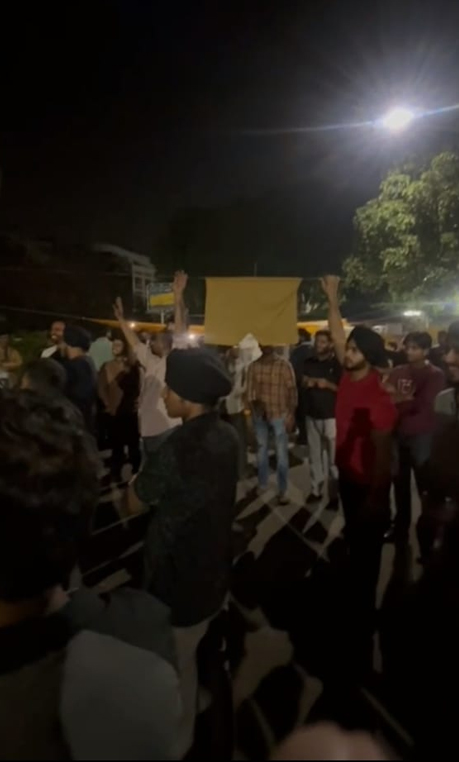
Lifting of khaki half pant by the students which continues to be the symbol of protest against the RSS
________________
Feature Image: Students having dinner at a langar (community kitchen) set up at the protest site in front of the VC office iside PU.