
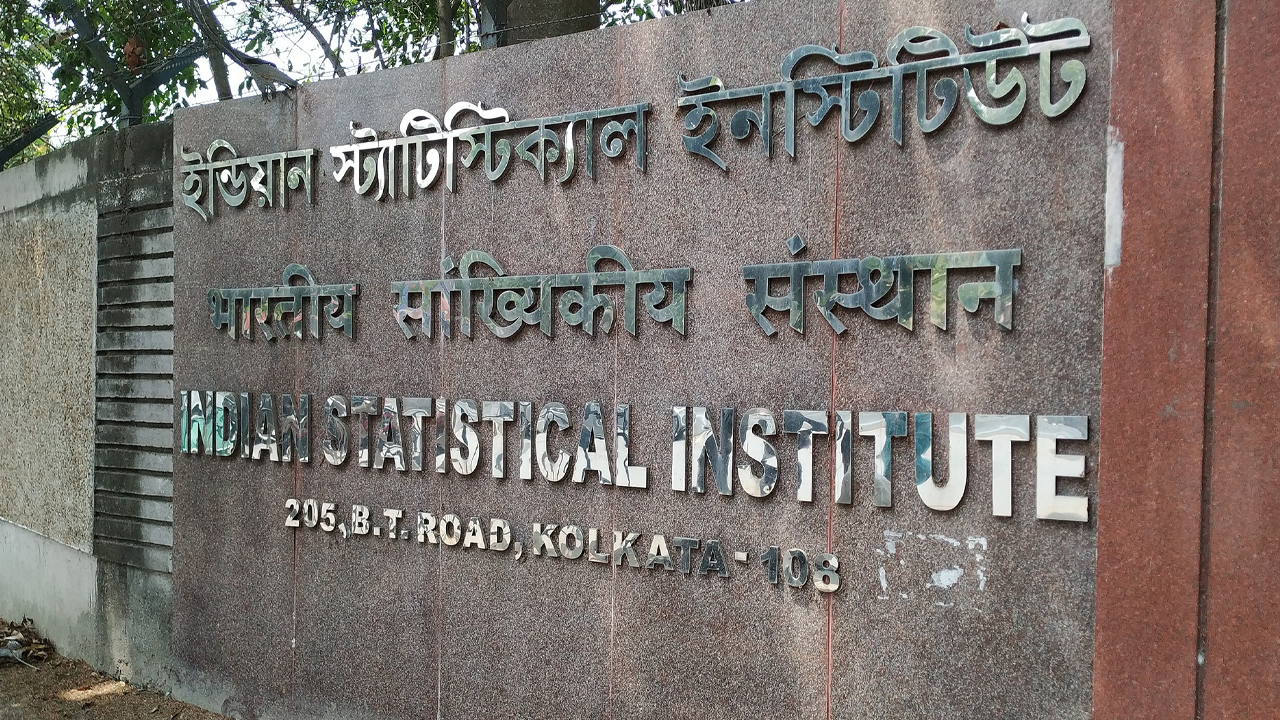
The Indian Statistical Institute Bill, 2025, represents a legislative attempt to undermine and dismantle an institution that has contributed immensely to India’s intellectual and scientific growth, erode ISI’s autonomy and its long-standing culture of academic freedom.
Shyamoli Jana
Groundxero | November 10, 2025
A ghettoised sweatshop is exactly what the name suggests: a workplace, a sweatshop, where low-skilled workers are exploited within an inch of their lives, situated in a place where there is a complete breakdown of public services, and lives are barely held together by patchwork. Essentially, the two principles of public services, namely, a comfortable life for all members of the citizenry and a space for the intellectual growth of the populace, are completely abandoned in favour of unbridled exploitation. In such a place, there is no need to invest in public education, and public services are replaced by services which only money and power can buy. The recent attack on the fabric of the Indian Statistical Institute (ISI) must be seen in the context of the ongoing attempt to turn India into a ghettoised sweatshop.
What is really happening with the Indian Statistical Institute?
The Ministry of Statistical Planning and Implementation (MoSPI) has introduced a draft ISI Bill that aims to completely revamp the institute on several key factors, such as:
- Course fees for students
- The kind of research work done at the institute
- Control over the operations of the institute
We shall go over the key changes that the bill seeks to introduce, alongside a discussion on how the changes fit in the context of reducing India to a ghettoised sweatshop.
“Self-sufficiency” is code for cutting off government funding
The new ISI bill states that ISI must be “self-sufficient” as much as possible. “Self-sufficient” is a positive word employed to disguise a cruel plan to scuttle free and scholarship-supported education that is currently offered at ISI. The new bill tells ISI to earn the money required for its operations. ISI is an educational and research institute. How is ISI going to balance its books? By imposing fees on students, by cutting down or abolishing scholarships, by reducing the number of new hires, and by collaborating on corporate and government projects, the contribution of the latter, of course, will only diminish over time.
This is not a wild imagination. This is happening all over India, where education is not seen as a right that must be accessed freely, but a lucrative commodity that only money can buy. The project of building an educated, skilled citizenry is gone from the government’s agenda. And, to maintain a ghetto and work in sweatshops, not much skill is required anyway; all that is required is back-breaking labour.
If this draft bill becomes an act, then ISI will have to rely on corporate projects to fulfill its funding requirements. Corporate projects are very different from public service. The work done on these projects is often proprietary, unlike most academic work done at government institutes. Also, the nature of research that will happen at the Institute would also depend on the sort of work that gets the most funding, and that ties research to corporate profits, not public welfare.
A diverse governing body rejected in favour of government control
Under the current framework, ISI is a registered society under the Societies Act. Under the existing framework, the ISI Council, which is the governing body of the institute, consists of representatives of the Government of India, Department of Science and Technology, scientists who are not employed at ISI, representatives of the Indian National Science Academy, the Planning Commission, the University Grants Commission, elected representatives of the members of the Institute (not employed by the institute) as well as employees of the Institute, officers of the institute, along with the president, chairperson and secretary.
Under the new bill, ISI will be turned into a body corporate. The Council will be replaced by a Board of Governance, which will be the principal executive body of the Institute. The Board will consist of the Visitor, who is the President of India, a chairperson nominated by the President of India on the recommendation of the Central Government, three representatives of the Ministry of Statistics Program Implementation, Department of Science and Technology and Ministry of Finance, four persons nominated by the Central Government, the Director of ISI (who would again have to be chosen from a list of names given by the Central Government), the Dean (who would be picked by the Board of Governance which is stuffed with people appointed by the Central Government), the Head of a Centre (who will be appointed by the Board of Governance), and the Registrar.
It goes without saying that the entire governing body of ISI is going to turn into an arm of the Central Government, replacing the mixed bag that it currently is, which protects it from complete subservience to the agenda of the Central Government.
In the new bill, there is no provision of student representation in the governing body. Under the current framework, while no student body currently exists, the provision for student representation is there. Under the current framework, there is no unified political entity controlling the governing body of ISI, and therefore, there is the scope of airing the perspectives of different stakeholders of the Institute. Under the new bill, the political agenda of the ruling party at the Centre will guide the policies of the Institute. If the agenda is to completely shatter the country’s scientific backbone and create a service centre for corporations, then that agenda will pass un-resisted through the Board of Governance.
Protests by students, professors, other employees, and citizens in general
Ever since the announcement of the draft bill, there have been regular protests at the Institute by students, professors and other employees of the Institute. The window for suggesting changes and sending opinions on the new bill ended on November 3, 2025, and this opportunity was taken to communicate concerns regarding the bill to the Government. A petition against the bill was signed by over 1700 academics from different parts of the world and has been submitted to the Government for consideration. Political parties such as the Trinamool Congress Party have voiced opposition to the bill. Member of Parliament D. Ravikumar from VCK (formerly Dalit Panthers of India) wrote a letter to the Union Government demanding that the bill be scrapped.
Conclusion
The present structure of ISI is lacking in many things. However, the bill does not seek to address these shortcomings. It seeks to demolish an education and research system that has the capacity to be of service to the population. Indian institutes should serve the agenda of building up the country, focusing on problems that plague the majority of the population while retaining an inquisitive, scientific spirit. Instead, the institutes are being dismantled to be turned into service centres for corporations and education centres for those who can pay a fat fee. This is not a step towards improvement. This is a push towards a future where India is reduced to a broken, hostile, failed society in every sense.
________________
Shyamoli Jana is a social activist.
Feature Image: Ravi Dwivedi
The image licensed under the Creative Commons Attribution-Share Alike 4.0 International license