
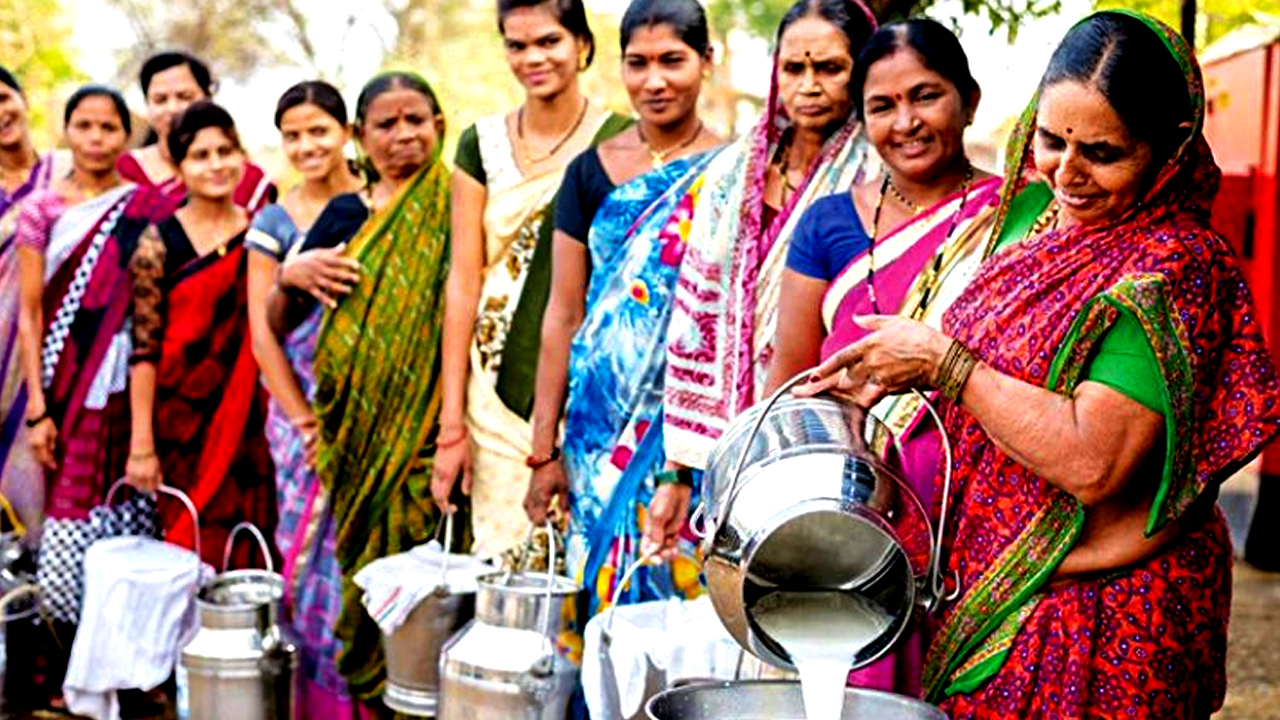
Large-scale, corporate-run, and heavily subsidized dairy production system of the US could devastate India’s marginal farmer-led dairy industry.
Debasis Mithiya
India and the United States are locked in a tense standoff over tariffs on agricultural and dairy products. To protect its domestic market, India has imposed high tariffs on import of specific goods, with dairy products being a major point of contention. While the US has long demanded a rollback of these tariffs, India has not complied, leading to growing friction in their trade relationship.
For several years, India and the US have been negotiating a Bilateral Trade Agreement (BTA). The current trade volume between the two countries is around $190 billion, with a target of reaching $500 billion by 2030. However, the agricultural and dairy sectors remain significant obstacles. Recently, these trade talks came to an unprecedented halt when the sixth round of BTA negotiations, scheduled for August 2025 in New Delhi, was abruptly cancelled. This happened after the US imposed a 25% tariff on certain Indian imports, followed by an additional 25% tariff (in total 50%) as a penalty for India’s import of Russian oil. This high tariff will negatively impact Indian micro, small, and medium enterprises (MSMEs) and directly harm the export of textiles, electronics, and gems and jewelry.
Two Models, a Vast Difference
At the ‘BL Agri & Commodity’ Summit in January 2024, Amul’s Managing Director, Jayen Mehta, opposed a Free Trade Agreement (FTA) for dairy products, stating that India should not reduce import duties on milk. This raises a question: despite Indian dairy products being cheaper than those from North America, why is Amul so afraid of bringing our dairy sector under an FTA? The answer lies in the vast difference between the two countries’ dairy production models.
The tremendous success of India’s dairy sector is credited to the “Anand Model,” born from Dr. Verghese Kurien’s “Operation Flood.” This cooperative-based model empowers over 80 million small, marginal farmers (who typically own no more than 2-3 cows) and forms the backbone of the rural economy, contributing around 5% to the country’s GDP. At its core, the model is a domestic production system run by small-scale, marginal farmers.
In sharp contrast, the US dairy industry is mechanized, corporate-controlled, and large-scale. The milk yield per cow there is more than three times that of India (approximately 7,400 liters per year). Due to advanced processing systems, the US and European Union use about 94% of their total milk to produce powdered milk, cheese, butter, and other high-value dairy products, allowing them to dominate the global market.
The Danger of Free Trade Agreements
Despite this difference, some still question why India can open its dairy market to ASEAN countries but not to the US. The answer is simple: dairy producers in ASEAN countries lack the capacity to challenge Indian dairy businesses. However, the large-scale, corporate-run, and heavily subsidized dairy production system of the US could devastate India’s marginal farmer-led dairy industry.
While an FTA can be beneficial for many sectors, the playing field is not level in the case of the dairy industry. Western countries provide massive subsidies with taxpayer money to protect their dairy industries and capture the global market, which artificially lowers their production costs. The US government provides substantial subsidies to its agricultural sector. In 2025, direct US government agricultural support is slated to increase from $9.3 billion to $42.4 billion. This aid includes specific dairy subsidies like the Dairy Margin Coverage Program and the Dairy Indemnity Payment Program. These massive subsidies allow US producers to sell their products at low prices in the world market.
Currently, a 30-60% import tariff on dairy products keeps foreign products at a higher price, protecting domestic farmers and industry. But if this tariff is reduced or eliminated under an FTA, the price of foreign dairy products will drop dramatically. This would boost the demand for cheaper imported dairy goods in the foodservice sector (bakeries, hotels, and restaurants), as they seek to cut costs. Consequently, demand and prices for local fresh milk would fall, threatening the livelihood of millions of India’s marginal dairy farmers. The daily income of these small farmers depends entirely on selling milk. The scene of a woman pouring milk at dawn is not just a romantic notion; it is the harsh economic reality that helps her send her children to school.
The Path to a Sustainable Solution
Dr. Kurien’s “Operation Flood” brought tremendous success to India’s dairy sector. If the market is opened, this rural economy will be in danger, and his dream of a self-sufficient dairy industry will be lost. Therefore, keeping India’s dairy products out of an FTA is not merely a commercial decision; it is a social commitment to protect the livelihoods of millions and ensure the stability of India’s rural economy.
However, in an era of free trade, no country can keep a sector completely isolated. India must find a balanced solution to open its dairy market.
Exert pressure in international forums: India should question the massive US dairy subsidies at international forums like the WTO. If the US government reduces its subsidies, the price of its products in the global market would normalize, creating a more level playing field for the Indian industry.
Gradual tariff reduction: Instead of an immediate reduction, India can propose a phased reduction of tariffs on US dairy products over 5-10 years. This would give the Indian dairy industry time to modernize and increase its productivity to become more internationally competitive.
Imposing import quotas: India can also impose specific import quotas, allowing a certain amount of dairy products to be imported at a lower tariff, while maintaining a high tariff beyond that limit. This would protect the domestic industry from ‘dumping’ by foreign players.
Modernising the Cooperatives: The Indian government should invest in providing technological support, better breeds of livestock, and modern processing systems to further strengthen the cooperative model in the dairy sector. This will make the Indian dairy sector stronger internally and more competitive internationally in the long run.
These solutions are not too difficult to implement. But, they require political will, economic analysis, and diplomatic and trade negotiations. However, following this path would allow India to protect its vast rural economic backbone—the small dairy farmers—while also somewhat alleviating US trade concerns.